Every bot management decision is the same tradeoff, expressed differently by each vendor: how much legitimate traffic are you willing to inconvenience to stop the automated traffic you do not want.
There is no configuration that blocks all bots and no humans. The signals that distinguish them are probabilistic, the adversary iterates faster than you do, and the population you are protecting includes people on old devices, corporate proxies, privacy browsers, screen readers, and mobile networks that share one address among thousands of subscribers. Turn the sensitivity up far enough to stop a competent scraper and you will block some of those people. Turn it down far enough to never block them and the scraper runs unimpeded.
What makes this harder than it sounds is that the failure is asymmetric and invisible in opposite directions. Blocked bots show up in your dashboard as a satisfying number. Blocked humans show up as a slightly lower conversion rate that nobody attributes to the security control installed three months ago. The vendor reports the first number. Nobody reports the second.
So the useful way to evaluate this category is to insist on measuring both sides on your own traffic, and to be precise about which problem you are actually solving, because scraping, credential stuffing and payment fraud need different responses even though one product claims to handle all three.
Key takeaways
- Scraping, credential stuffing and transaction fraud are three different problems with different signals and different acceptable false positive rates. A single global bot policy is the wrong shape for all three.
- Detection accuracy claims are unverifiable without your own traffic. The only honest evaluation runs candidates in monitoring mode on the same traffic and compares what each would have blocked, including what it would have blocked wrongly.
- CAPTCHA-free approaches shift the cost from the user to the infrastructure by making automation expensive rather than making humans prove themselves. That is better for conversion and is not free of false positives.
- The login endpoint deserves its own policy. Credential stuffing is defeated by a combination of bot detection, breached credential checks and step-up authentication, and no one of the three is sufficient.
Three problems wearing one label
Sort these before shortlisting, because the right answer differs for each.
Scraping and content theft. Someone is pulling your catalogue, your pricing, your listings or your documentation at scale. The traffic is usually high volume, often distributed, and increasingly runs real browser engines rather than simple HTTP clients. The business harm varies enormously: a competitor repricing against you in real time is a genuine problem, while an AI crawler reading your documentation may be free distribution. Decide what you actually object to before you buy something to stop it, because the default policies stop plenty of traffic you might want.
Credential stuffing and account takeover. Someone has a list of username and password pairs from a breach elsewhere and is testing them against your login endpoint. Volume per source is deliberately low, spread across many residential addresses, at human-like rates. This is the highest-stakes case because a success is a compromised customer account, and it is the case where pure volume-based defence works worst, since the attacker has specifically engineered around it.
Transaction and payment fraud. Card testing, promo abuse, fake account creation for referral bonuses, inventory hoarding, scalping. Here the request is often made by a real human, or by automation good enough that the bot question is the wrong question. The signals that matter are behavioural and transactional rather than protocol-level, which is why this shades into fraud tooling rather than bot management.
And a fourth category that is not a problem: good bots. Search engine crawlers, uptime monitors, link preview fetchers, payment provider webhooks, partner integrations, accessibility tools. Every one of these is automated, and blocking them causes outages that take a long time to diagnose because the affected party is not a person who will complain. Verified bot allowlisting is a feature, not a nicety, and the mechanism matters: user agent strings are trivially forged, so verification should rest on reverse DNS or on published address ranges or on signed request mechanisms.
The practical consequence: apply different policies to different routes. The product catalogue, the login endpoint, the signup form, the checkout and the public API have different traffic populations and different costs of error. A vendor that only offers one global sensitivity dial is a poor fit for any application with more than one kind of page.
How detection actually works
Understanding the signals makes the vendor claims much easier to evaluate, because they are all working from the same raw material.
Network and reputation signals. The address, the autonomous system it belongs to, whether it is a known datacentre range, a residential proxy network, a VPN exit, or a mobile carrier gateway. Cheap to evaluate and the first thing attackers defeat: residential proxy networks resell access through real consumer connections, which makes the address indistinguishable from a customer’s. Reputation alone is a filter for lazy automation and nothing more.
Protocol fingerprinting. The precise way a client negotiates TLS, the ordering of extensions and cipher suites, the HTTP/2 settings frame and header ordering, the header casing and sequence. Real browsers have characteristic fingerprints, and automation libraries have their own. A mismatch between a claimed Chrome user agent and a TLS fingerprint that no Chrome build produces is a strong signal. This is one of the more durable techniques, and tooling that mimics browser fingerprints exactly is now widely available, so it is a cost imposed rather than a wall.
Client-side interrogation. JavaScript that inspects the environment: the presence of automation flags, canvas and WebGL rendering characteristics, timing behaviour, available APIs, whether properties look patched. Powerful, and it requires the client to execute your script, which means it does not apply to API clients and it is where the privacy conversation begins.
Behavioural signals. Mouse movement, scroll patterns, typing cadence, the sequence and timing of page transitions, whether a session visits pages in an order a human would. Harder to forge convincingly and slower to collect, since a decision needs several interactions, which is why behavioural detection is strong on multi-step flows and weak on the first request.
Proof of work and interrogation cost. Rather than deciding whether a client is a bot, make each request cost the client something: a computational challenge that is trivial once and expensive ten thousand times. This changes the economics of scraping without asking the user to do anything. It is the mechanism behind most CAPTCHA-free approaches, and its limitation is that it taxes your legitimate mobile users too, in battery and latency.
Machine learning on the aggregate. Every vendor combines the above into a score using models trained across their customer base. The genuine advantage of a large vendor is the cross-customer view: an address or fingerprint that just attacked someone else is known before it reaches you. This is real and it is also the part you cannot verify, so treat it as a reason to prefer scale rather than as a specific claim.
The arms race note that belongs in every evaluation: the defeat of each technique above is commercially available. Browser automation frameworks with patched fingerprints, residential proxy networks, and CAPTCHA-solving services with human fallbacks are all products someone can buy. The goal is not to make scraping impossible. It is to make it more expensive than the value of the data, which is a business calculation rather than a technical one.
Needs first-hand data: Run every candidate in monitoring mode on the same traffic for at least two weeks, then sample the requests each one would have blocked and classify them manually. Report two numbers per vendor: the proportion of blocked traffic that was genuinely unwanted, and the proportion of your known-good traffic that would have been challenged or blocked. Vendor-published accuracy figures are measured on their traffic mix, not yours, and the second number is the one no vendor will give you.
The login endpoint needs its own policy
Credential stuffing is the case where generic bot management is least sufficient, and it is worth treating as a separate design problem.
The attacker’s constraints shape everything. They have a list of credential pairs, a meaningful fraction of which are valid somewhere, and they need to find which ones work on your site. They know that high request rates from one address get blocked, so they spread across residential proxies at low rates per source. They know that failed logins are monitored, so they pace them. What they cannot easily avoid is that the population of attempts, taken as a whole, has a different shape from real logins: a higher failure rate, unusual distribution across accounts, credentials that appear in known breach corpora, and sessions with no prior history on your site.
Layer the defence.
Detect at the edge, but do not rely on it alone. Bot scoring on the login route with higher sensitivity than the rest of the site is correct, because the cost of challenging a login is lower than the cost of an account takeover. Accept more friction here than anywhere else.
Check credentials against breach corpora. If a submitted password appears in a known breach list, that is decisive information regardless of how the request looks at the network level. Doing this at registration and at password change prevents the vulnerability existing; doing it at login catches accounts that were already weak. The privacy-preserving lookup methods that avoid sending the full password are well established and should be the only ones you consider.
Rate limit by account, not only by address. Attackers spread across addresses, so per-address limits miss the pattern. Counting failed attempts per account catches the same attacker regardless of source distribution, and counting across the whole login endpoint catches the broad sweep. Both are needed, and the mechanics are covered in rate limiting solutions.
Step up rather than block. A suspicious login is a candidate for an additional factor, not a 403. This is where bot management meets your identity layer, and the integration is the point: the bot score should be an input to the authentication decision rather than a gate in front of it. Strong second factors, and phishing-resistant ones in particular, change the value of a stuffed credential to roughly zero, which is the structural fix. Provider capabilities here are covered in authentication providers and MFA providers.
Never leak which half was wrong. Different responses, different timings, or different error messages for a valid username with a bad password versus an unknown username turn a stuffing attack into an account enumeration exercise first, which makes the stuffing more efficient.
Monitor the success rate, not the attempt rate. The attempt rate tells you that you are being attacked, which is always true. The ratio of successful to failed logins on the endpoint, tracked over time, tells you whether an attack is working. A rising success rate during an attack is the alert that matters.
Needs first-hand data: Baseline your login endpoint before deploying anything: attempts per hour, success ratio, distinct accounts per source address, distinct source addresses per account, and the geographic and network distribution of successful logins. You cannot evaluate a bot management deployment on a login endpoint without knowing what normal looked like, and almost nobody records this before the incident that makes them care.
The cost of a false positive
This is the side of the ledger that goes unmeasured, so it needs deliberate attention.
Conversion loss is invisible. A challenged user who abandons does not contact support. If the challenge sits on your signup or checkout flow, the loss lands directly on revenue, and it will be attributed to anything other than the security control.
Accessibility failures are real and legally exposed. Visual puzzles fail screen reader users. Audio alternatives are often worse. Behavioural detection can misread the input patterns of assistive technology and of users with motor impairments as non-human. If your challenge mechanism has no accessible path, you have an accessibility problem and an inclusion problem, not just a friction problem.
Shared and carrier-grade addresses concentrate risk. Mobile carriers, universities, large offices and entire countries behind national gateways present many users on few addresses. Address-reputation-heavy detection systematically penalises those populations, which correlates with geography and income in ways worth thinking about before turning sensitivity up.
Privacy browsers and blockers look like automation. Users who block fingerprinting scripts, disable JavaScript, or use hardened browsers deprive the detector of exactly the signals it needs, so they score as suspicious for doing something reasonable.
Legitimate automation belongs to your customers. API clients, integrations, monitoring, CI jobs and accessibility tools are automated by design. A policy that treats automation as inherently suspect breaks your own product’s integration story.
The operational answers: monitor before enforcing, apply per-route policy rather than one global dial, prefer step-up over block wherever a step-up exists, keep an accessible alternative on every challenge, allowlist verified good bots by a mechanism that is not the user agent string, and instrument abandonment on any flow carrying a challenge so the cost side of the ledger has a number on it.
Cloudflare Bot Management

Cloudflare’s bot product scores every request using machine learning across its network, protocol and TLS fingerprinting, behavioural analysis and a verified bot directory, exposing the score as a field you can act on in firewall rules. Its practical strength is integration: the score is available in the same rule engine as your WAF, rate limiting and routing logic, so policy is expressed once rather than assembled from three vendors.
Pros
- The bot score is a field in the same rule engine as everything else, so you can write per-route policy combining bot score, rate, path and request attributes in one expression
- Very large network means cross-customer signal is substantial, and an attacker seen elsewhere is often known before they reach you
- Verified bot directory handles the good-bot allowlisting problem properly, rather than leaving you matching user agent strings
- Turnstile is available as the challenge action, so escalation does not require a second vendor or a visual puzzle
Cons
- Available only on higher plans or as an add-on, so the capability you evaluate depends on commercial tier rather than on need
- Score-based policy gives you a dial and leaves the judgement to you, which is flexibility if you have someone to own it and a hazard if you do not
- Requires proxying traffic through Cloudflare including TLS termination, which is a constraint some organisations cannot accept
- Concentration risk, since DNS, CDN, WAF, DDoS and bot defence then sit with one provider and one control plane
Best for: Teams already proxying through Cloudflare who want bot scoring as one more signal in a unified rule engine.
Pricing: Add-on to higher-tier plans, priced with the enterprise-level packages rather than metered per request.
DataDome
DataDome is a dedicated bot and fraud protection vendor that runs detection on every request with a stated design goal of deciding in a very short time budget, deployable through a CDN integration, a server-side module or a reverse proxy. It covers web, mobile apps and APIs with the same engine, and its account protection module targets credential stuffing specifically.
Pros
- Deploys several ways including server-side modules, so it works for architectures that are not fully behind a supported CDN
- Covers mobile app traffic and APIs with the same detection engine, which closes the gap attackers move to once the web is protected
- Dedicated account protection module aimed at credential stuffing rather than generic bot scoring on a login path
- Detailed per-request decision visibility, which makes false positive investigation tractable rather than a support ticket
Cons
- Another vendor in the request path with its own availability characteristics, and you need to know what happens on failure
- Client-side signal collection means a privacy review and a decision about what is collected from your users
- Pricing scales with request volume, which is uncomfortable for high-traffic sites where most traffic is uninteresting
- Effectiveness against a determined targeted attacker still requires tuning and iteration rather than working out of the box
Best for: Teams who need bot protection across web, mobile and API traffic without adopting a specific CDN.
Pricing: Subscription metered on request volume across protected properties, with add-on modules for account and payment protection.
HUMAN
HUMAN, formed from the merger of White Ops and PerimeterX, spans bot defence and advertising fraud detection, and that heritage shows in its strengths: verification of whether traffic is human at very large scale, with particular depth in the fraud and account abuse cases rather than only in scraping prevention. It targets account takeover, payment fraud and scalping alongside classic bot mitigation.
Pros
- Deep focus on fraud outcomes rather than only bot classification, which matches how the business actually experiences the problem
- Very large observation surface across web and advertising ecosystems, giving broad signal on emerging automation infrastructure
- Coverage of account takeover, payment abuse and scalping as distinct products rather than one sensitivity setting
- Mature enterprise deployment options including several integration points in the request path
Cons
- Enterprise commercial model and sales cycle, which puts it out of practical reach for smaller teams
- Portfolio breadth means the product you need may be one module among several, with the others adding cost or confusion
- Client-side detection requires script deployment and the associated privacy review
- The advertising fraud heritage means some material and some sales motion is aimed at a different buyer than an application engineering team
Best for: Businesses where the harm is fraud and account abuse rather than content scraping, at enterprise scale.
Pricing: Enterprise subscription by traffic volume and modules, negotiated per deployment.
Kasada
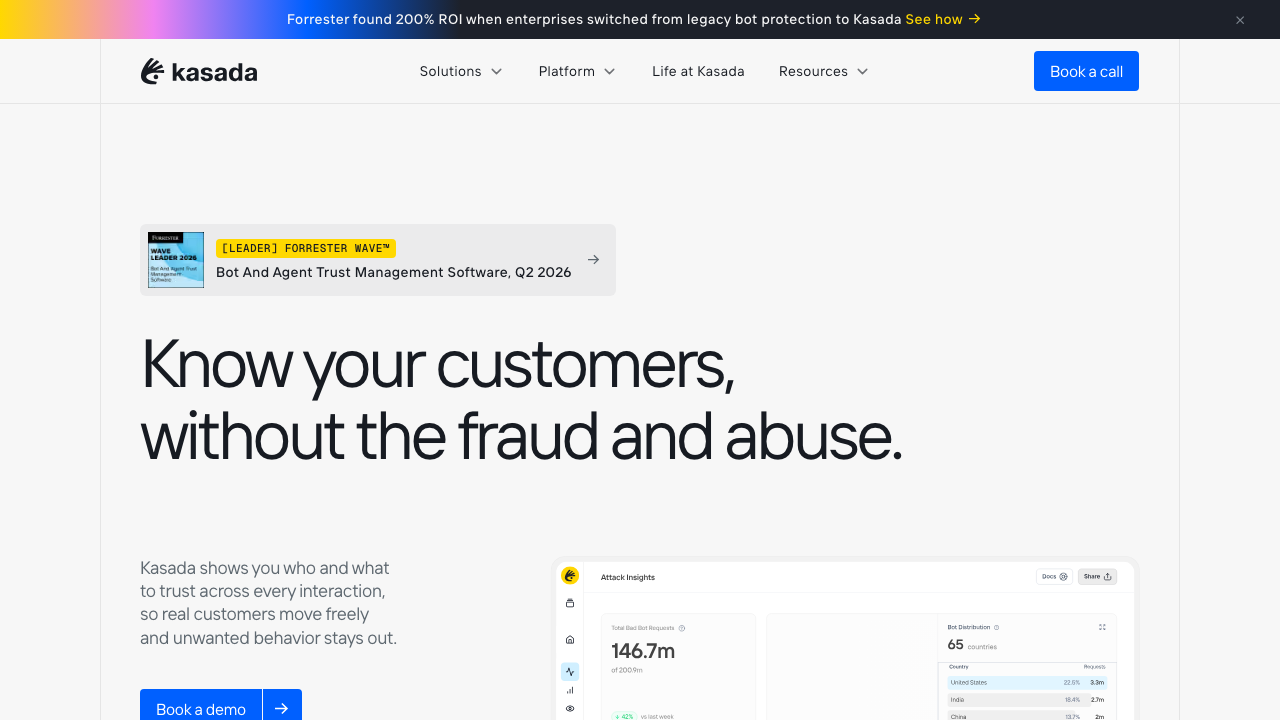
Kasada’s approach is the clearest expression of the CAPTCHA-free idea: rather than classifying clients, it makes automation expensive by requiring a client-side proof of work and by heavily obfuscating and rotating the client-side code so that reverse engineering it is continuous work rather than a one-time cost. The result is no user-facing challenge at all in the normal case, and an attacker economics problem instead.
Pros
- No visual challenge in the normal path, so the legitimate user experience is untouched and conversion is not taxed
- Attacks the economics of scraping directly, which scales better against determined adversaries than pattern matching does
- Client-side code that changes continuously means an attacker’s bypass has a short shelf life rather than being a solved problem
- Strong fit for high-value scraping targets such as ticketing, travel and retail where the adversary is commercially motivated
Cons
- Requires JavaScript execution, so pure API clients and non-browser consumers need separate handling and separate policy
- Proof of work costs your legitimate users battery and time too, which matters most on low-end mobile devices
- Obfuscated client-side code is a thing your security team may want to review and cannot meaningfully review
- Enterprise commercial model, and the approach is a poor fit for sites whose main problem is not scraping
Best for: High-value scraping and scalping targets who want automation made expensive without challenging real users.
Pricing: Enterprise subscription based on traffic volume and protected properties.
Arkose Labs
Arkose Labs takes the opposite strategy to Kasada and is explicit about it: rather than trying to be invisible, it presents interactive challenges to suspicious traffic and deliberately makes those challenges expensive to solve at scale, including for human solving farms. The challenges are designed so that automated solvers and cheap human labour both find the economics unattractive, and the targeting is aimed at attack traffic rather than everyone.
Pros
- Explicitly designed against human-powered solving services, which defeat conventional puzzle challenges entirely
- Challenge difficulty adapts to risk, so ordinary users usually pass without interaction while suspected attackers face escalating cost
- Strong fit for fake account creation and bonus abuse, where the attacker’s per-attempt economics are the whole game
- Clear, attributable decisions, which makes it possible to explain to a business stakeholder why traffic was stopped
Cons
- Interactive challenges are still interactive, so some legitimate users see friction and some of them abandon
- Accessibility of any visual or interactive challenge requires careful review and an alternative path that actually works
- Enterprise commercial model with implementation work to integrate the challenge flow into your product
- Less suited to pure content scraping by clients that never intended to complete a challenge anyway
Best for: Businesses fighting fake account creation, bonus abuse and human-assisted attacks where per-attempt cost is the lever.
Pricing: Enterprise subscription based on challenge and traffic volume.
hCaptcha
hCaptcha is a widely deployed challenge service that also offers a risk-scoring enterprise tier. For most teams its relevance is as the drop-in challenge on a signup or login form, with a privacy positioning that differentiates it from the incumbent and an accessibility path for users who cannot solve visual puzzles. It solves one narrow part of the problem, and it solves it cheaply.
Pros
- Drop-in deployment on a form, which is realistically the whole integration effort for a small team
- Privacy positioning and data handling that are easier to defend in a review than some alternatives
- Free tier makes it viable for small sites and side projects where an enterprise product is not a consideration
- Offers an accessibility path for users who cannot complete visual challenges, which not every challenge provider does
Cons
- A challenge on a form is a point control, not a traffic policy: it does nothing for scraping, APIs or anything not behind that form
- Visual challenges are defeated by commercial solving services, so a motivated attacker pays a small amount and continues
- Friction lands on every user you challenge, and the conversion cost is real and usually unmeasured
- The risk-scoring capability that makes it more than a puzzle sits in the paid enterprise tier
Best for: Small teams who need a challenge on signup or login today and are not fighting a commercially motivated adversary.
Pricing: Free tier for standard challenge use, with paid enterprise tiers adding risk scoring and higher volumes.
Cloudflare Turnstile
Turnstile is a challenge widget that usually resolves without any user interaction, using browser signals and lightweight checks rather than a puzzle. It is designed as a replacement for visual CAPTCHA on forms, works without requiring the rest of your traffic to be proxied through Cloudflare, and is free at the volumes most applications need.
Pros
- Typically invisible to users, so it removes the conversion and accessibility cost of visual puzzles almost entirely
- Works as a standalone widget without requiring your site to be proxied through the provider, which is unusual in this list
- Free at the volumes most applications operate at, which makes replacing a visual CAPTCHA an easy decision
- Server-side verification of the token is straightforward, so integration is an afternoon rather than a project
Cons
- A form widget only: it protects the form it is on and nothing else, so scraping and API abuse are untouched
- Determined attackers target the token issuance and verification flow, so it raises cost without being a boundary
- Relies on client-side signals, so users with hardened privacy settings may see more interaction than others
- Ties you to another provider’s availability on a path as critical as signup or login, which needs a considered failure mode
Best for: Any team still using a visual CAPTCHA on a form, as a direct replacement with less user cost.
Pricing: Free for standard use with a managed enterprise tier for higher volumes and additional controls.
How to choose
Start with the harm, not the technology.
What is the actual loss? Write it down in business terms. Competitor price scraping, account takeovers per month, fraudulent signups claiming promotional credit, inventory bought by scalpers, infrastructure cost from crawler traffic. The right product differs for each, and a written answer prevents buying a scraping product for a fraud problem.
Is the attacker commercially motivated? If someone makes money from beating your defences, they will iterate, and you need a vendor whose product also iterates. If your problem is undifferentiated automated noise, a challenge widget and sensible rate limiting handle most of it for a fraction of the cost.
Where does the traffic arrive? A challenge widget covers forms. Edge scoring covers everything proxied. Server-side modules cover architectures that are not behind a CDN. Mobile apps and APIs need explicit support rather than an assumption, and they are where attackers move once the web path is defended.
Can you tolerate JavaScript as a requirement? Proof-of-work and client-interrogation approaches need it. If a meaningful share of your traffic is legitimate non-browser clients, those approaches need a parallel policy, and that policy is where the bypass will be.
Who owns the tuning? Same question as every other control in this space, same answer: a bot policy nobody owns drifts into either blocking customers or blocking nothing.
| Product | Primary problem | User-facing friction | Covers APIs and mobile | Picks itself when |
|---|---|---|---|---|
| Cloudflare Bot Management | Scraping and abuse | Optional, score-driven | Yes, if proxied | Already on Cloudflare, want one rule engine |
| DataDome | Scraping and account abuse | Low, challenge on escalation | Yes, several integrations | Not on a single CDN, need mobile and API coverage |
| HUMAN | Fraud and account takeover | Low | Yes | The harm is fraud, at enterprise scale |
| Kasada | Commercial scraping and scalping | None in normal path | Browser clients only | High-value data, motivated adversary |
| Arkose Labs | Fake accounts and bonus abuse | Deliberate, escalating | Browser and app flows | Per-attempt attacker cost is the lever |
| hCaptcha | Form abuse | Visual challenge | No | Small team, needs something on a form today |
| Cloudflare Turnstile | Form abuse | Usually none | No | Replacing a visual CAPTCHA with less user cost |
Two things worth doing regardless of vendor. Put a different, stricter policy on the login and signup routes than on the rest of the site, because the cost of friction there is lower than the cost of an account takeover. And instrument abandonment on every flow that carries a challenge, so that when someone asks whether the bot product is worth the money, there is a number on both sides of the answer.
Frequently asked questions
How accurate are bot detection products really?
Nobody can tell you in a way that transfers to your site, and you should be suspicious of any figure presented as if it does. Accuracy depends on your traffic mix, your user population, your geography, how attractive your data is and how motivated your adversary is. A product that performs well on a consumer retail site may perform poorly on a developer tool whose users run privacy browsers and command-line clients. The only evaluation that means anything is running candidates in monitoring mode on your traffic simultaneously and manually classifying samples of what each would have blocked, including a sample of your known-good traffic to measure the error you would otherwise never see.
Do CAPTCHAs still work?
As a deterrent against unsophisticated automation, partially. Against anyone willing to spend money, no: commercial solving services with automated and human fallbacks exist and are cheap per solve. Meanwhile the cost falls entirely on your legitimate users, including users with disabilities for whom the challenge may be impossible. The current sensible position is to replace visual puzzles with an invisible challenge widget as the baseline, and to reserve deliberately expensive interactive challenges for traffic that is already scored as high risk, where the friction is targeted rather than universal.
How do I stop credential stuffing without blocking real users?
Layer it, and accept more friction on the login route than anywhere else. Bot scoring with higher sensitivity on that route, rate limiting counted per account as well as per address so that distribution across proxies does not evade it, breached credential checking so weak passwords are rejected at registration and flagged at login, and step-up authentication as the response to a suspicious attempt rather than a block. The structural fix underneath all of it is strong second factors, because a phishing-resistant factor makes a stuffed credential worthless on its own. Monitor the ratio of successful to failed logins rather than raw attempt volume, since attempts are always high and the success ratio is what tells you an attack is working.
Should I block AI crawlers?
Decide it as a business question rather than a security one. Some crawlers send referral traffic or influence how your product is described to people asking about your category, which is distribution you might want. Others take your content and return nothing. The mechanisms differ too: some respect robots directives, some honour published preference signals, and some ignore both, which is the point at which it becomes a bot management decision. Start by measuring what crawler traffic actually costs you in infrastructure, and be honest about whether the objection is cost, competitive harm, or principle, because those lead to different policies.
Will this slow down my site?
Edge-based scoring adds a small amount of processing on a path the request was taking anyway. Client-side interrogation adds a script to your page and some work in the browser. Proof-of-work approaches deliberately add client-side computation, and that cost is largest on the low-end mobile devices your most price-sensitive users carry. The failure mode to plan for is not steady-state latency but vendor unavailability: know whether your integration fails open or fails closed when the scoring service is unreachable, decide which you want per route, and test it. Failing closed on a login endpoint during a vendor outage is an outage of your product.
Related reading
- Best application security tools — where bot defence sits alongside the rest of the programme.
- Best authentication providers — step-up authentication and the identity layer that credential stuffing targets.
- Best MFA providers — the factor that makes a stuffed credential worthless.
- Best web application firewalls — the request-inspection layer that sits alongside bot scoring.
- Best DDoS protection providers — volumetric abuse, which is a different problem from automated abuse.
- Best rate limiting solutions — per-account and per-endpoint limits that catch distributed low-rate attacks.
- Best identity verification and KYC tools — when fake account creation needs identity, not just bot scoring.