Here is the moment that decides whether your GitOps setup is real. It is 03:10, the payment service is down, and an engineer fixes it by running kubectl edit deployment and bumping a memory limit. Traffic recovers. Everyone goes back to bed.
What happens next is the entire question.
In one configuration, a controller notices within a minute that the live resource no longer matches git, reverts the memory limit, and the service falls over again. Now you have an outage and a confused engineer fighting a robot.
In another, the controller notices, marks the application as out of sync, and does nothing. Someone sees a yellow badge on a dashboard on Tuesday. Or does not.
In a third, nothing notices anything, the change persists, and three weeks later a deployment from git silently reverts it and nobody connects the two events.
All three are common. All three are configuration choices, not product differences, and most teams do not make the choice deliberately. That is the gap this article is about, because the head-to-head feature comparisons in this category almost never touch it.
The second thing worth saying plainly: the hardest problem in GitOps is not sync, it is secrets. Your desired state lives in git, and a database password cannot. Everything about how a GitOps setup is structured downstream of that constraint, and the three common answers to it have genuinely different security properties.
Key takeaways
- Drift detection and drift correction are separate decisions. Detecting and alerting is almost always right; automatically reverting a live change during an incident can turn a fix into a second outage.
- Argo CD centralises: one control plane with a UI managing many clusters. Flux decentralises: a controller set per cluster, driven entirely by resources in git. That difference determines how each scales and how each fails.
- Nothing puts a plaintext secret in git. The three real answers are encrypt in git, reference an external store, or template at apply time, and they differ in blast radius and in who can decrypt.
- A rollback in GitOps is a git revert, which means your recovery speed is bounded by your reconciliation interval and your CI, not by a deploy button.
What GitOps actually is, stripped of the branding
Three mechanical properties, and a tool either has them or does not.
Declarative desired state in a versioned store. The manifests describing what should run live in git. Not the commands to create it, the end state.
A controller that reconciles continuously. Something inside the cluster repeatedly compares live state to desired state and acts on the difference. Continuously is the operative word. A CI job that runs kubectl apply on merge is push-based deployment, not GitOps, because between merges nothing is checking.
The cluster pulls. The controller reads from git, rather than a pipeline having credentials to write to the cluster. This is the security argument and it is a good one: your CI system never holds cluster admin credentials, which removes the most valuable target in most infrastructure estates. The CI/CD secrets management guide covers what that removes from your threat model.
The practical consequence people underestimate is the fourth property that falls out of the first three: git becomes the deployment interface for everything. There is no manual path anymore, or rather there is one, and using it is the drift problem. Emergency changes, one-off debugging, a quick scale-up before a launch, all of it now goes through a pull request. Teams that adopt GitOps without agreeing on the break-glass procedure discover this during their first incident, which is the worst time to design it.
Drift detection, and what to do when you find it
Drift is any difference between live state and desired state. It arrives from four directions and they need different handling, which is why a single global policy is usually wrong.
Human changes. Someone ran a command. This is the case everyone thinks about and it is the one where automatic reversion is most dangerous, because the human may have been fixing something.
Controller changes. A HorizontalPodAutoscaler sets replicas. A mutating webhook injects a sidecar. A cert manager writes into a secret. These are not drift, they are other systems doing their jobs, and a reconciler that fights them produces a loop where two controllers overwrite each other continuously. Every tool here needs to be told to ignore specific fields, and getting that list right is real configuration work rather than a one-line setting.
Defaulting. The API server fills in values you did not specify. Your manifest omits imagePullPolicy, the cluster sets it, and a naive comparison reports a difference forever. Tools handle this by comparing against the last applied configuration rather than against the full live object, which mostly works and occasionally does not.
Deletion. Someone deleted a resource, or a namespace, or an entire application. Whether the reconciler recreates it depends on configuration, and whether it should depends on whether the deletion was intentional.
The choice: detect, or detect and correct
Detect and alert only is the right default, and it is the setting most teams should start with. The controller notices divergence, marks the application out of sync, and raises a signal. A human decides. This preserves the emergency path, gives you an honest record of every manual change, and never surprises anyone.
The failure mode is social rather than technical: an out-of-sync application that nobody reconciles becomes normal, and after a while the dashboard is yellow everywhere and the signal is gone. Treat a persistent out-of-sync state the way you would treat a failing test, with an owner and a deadline.
Detect and correct automatically means the controller reverts live changes to match git. The security argument is strong, because it makes unauthorised changes ephemeral by construction. The operational risk is exactly the scenario at the top of this article: the 03:10 fix gets reverted and the incident resumes.
If you do turn on automatic correction, three things make it survivable. Configure explicit ignore rules for fields other controllers own, or you will have fighting controllers. Have a documented break-glass procedure that suspends reconciliation for a specific application in one command, and make sure the person on call knows it. And make the suspension visible, ideally alerting after a timeout, so a suspended application does not stay suspended for a month.
Pruning is the separate, sharper decision. Should the controller delete live resources that are no longer in git? Without pruning, deleted manifests leave orphaned resources that accumulate silently, which is its own mess. With pruning, a bad refactor that accidentally removes a directory from the repository deletes production. The mitigations are per-resource retention annotations on anything stateful, and reviewing deletions in pull requests with the attention you would give to a DROP TABLE.
Needs first-hand data: Turn on drift detection in alert-only mode and log every divergence for a month, tagged with its cause: human, controller, defaulting, or deletion. That log tells you which fields need ignore rules and whether your manual-change rate is low enough to justify automatic correction. Doing it in the other order, correction first, is how teams get the incident that turns them off GitOps entirely.
Secrets: the problem GitOps does not solve on its own
Desired state goes in git. A database password cannot go in git. Everything downstream of that is architecture.
There are three real patterns and they differ in who can decrypt what and what an attacker gets from a repository clone.
Encrypt in the repository. The encrypted value is committed; the controller or a companion component decrypts it at apply time.
Sealed Secrets encrypts with a public key whose private half lives only in the cluster’s controller. Anyone can encrypt, only the cluster can decrypt, which is an excellent property. The consequences are equally sharp: the value is cluster-specific, so the same secret must be sealed separately per cluster, and losing the controller’s private key means every sealed secret in the repository becomes permanently unreadable. Back up that key deliberately, and treat it as the single most important secret you own. Rotation of an individual secret means re-sealing and committing, so it is a pull request rather than a console action.
SOPS encrypts individual values inside a YAML file using a key from a cloud key management service or an age key, leaving the structure readable so diffs are meaningful. Decryption authority is whatever the key management service says, which means it composes with your existing access control rather than inventing a new one. The tradeoff is that anyone who can decrypt for the cluster can decrypt locally too, so a compromised developer machine with the right cloud credentials reads everything, and key access management becomes the actual control.
Both share one unavoidable property: the ciphertext is in git forever. A key compromise plus repository access is retroactive across your whole history, so rotation after a compromise means rotating the underlying secrets, not just the keys.
Reference an external store. External Secrets Operator puts no secret material in git at all. The repository contains an ExternalSecret resource that names a secret in a cloud secret manager or a vault, and the operator fetches it and creates a Kubernetes Secret. Rotation happens in the store and propagates without a commit, which is the strongest operational property available and the main reason to choose this pattern. The costs are a new runtime dependency, since an unavailable secret store means new pods cannot start with fresh secrets, and the fact that the operator’s own credential to the store is now the crown jewel. Use workload identity for that rather than a static credential, or you have moved the problem rather than solved it.
Template at apply time. The controller pulls values from a store during rendering. Clean in theory, and it means the secret never becomes a Kubernetes Secret object, but it couples your rendering step to a secret store’s availability and makes local reproduction of a manifest awkward.
Whichever you pick, remember that a Kubernetes Secret is base64, not encryption. Anyone with read access to secrets in a namespace reads them, so encryption at rest in etcd and sensible RBAC are prerequisites regardless of how the value got there.
For most teams starting now: External Secrets Operator if you already run a cloud secret manager, because rotation without a commit is worth a lot. SOPS if you want everything self-contained in the repository and you already have key management discipline. Sealed Secrets if you want the simplest possible model and can commit to backing up that private key.
Argo CD
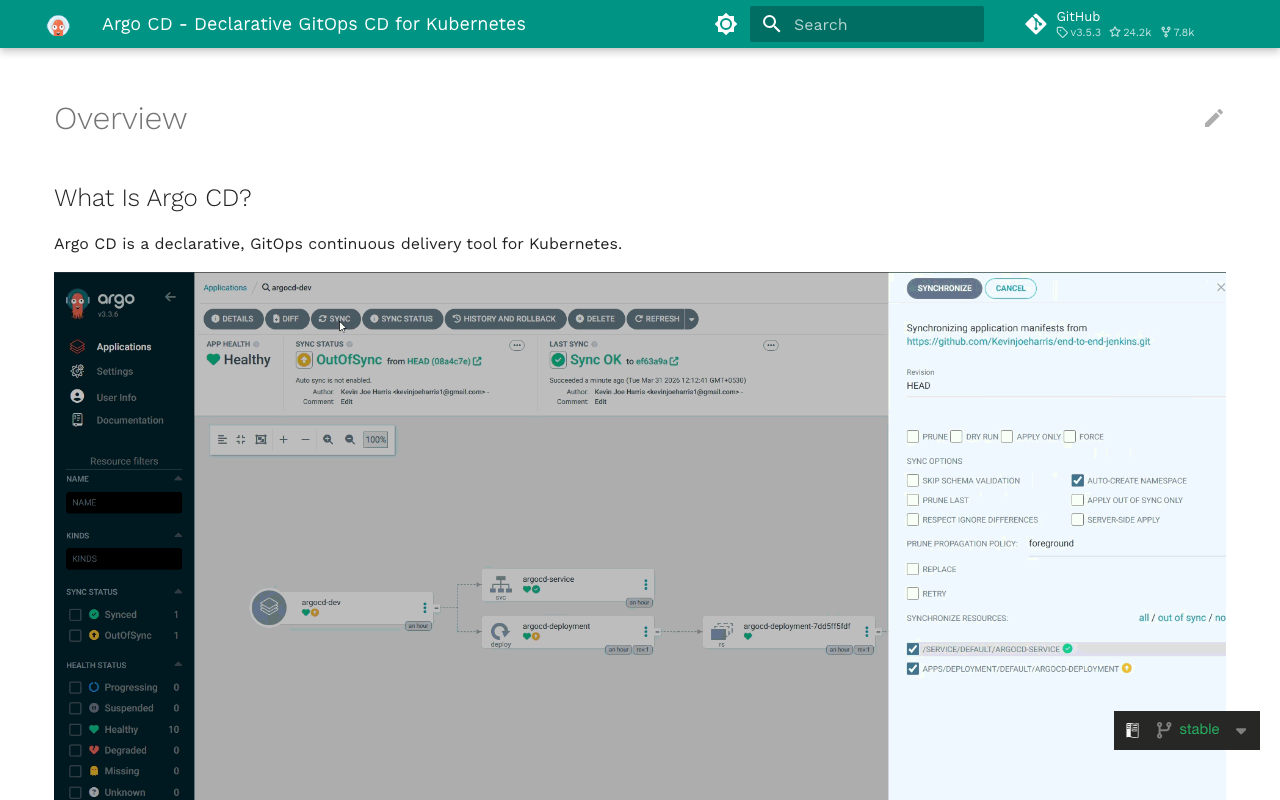
Argo CD is a centralised control plane. You run it in one place, register clusters with it, and it manages applications across all of them from a single UI and API. The interface is the reason most teams choose it: a visual resource tree showing every object an application owns, its health, its sync status, and a diff between live and desired state that you can read without reconstructing it mentally.
Pros
- The UI turns drift from an abstraction into a readable diff, which is the single biggest reason teams actually respond to out-of-sync applications rather than ignoring them
- Application health assessment understands common resource types, so a sync reports whether the workload is actually healthy rather than only whether the apply succeeded
- Sync waves and hooks give explicit ordering, which matters for anything with a dependency between resources such as a migration job that must complete before the deployment rolls
- Role-based access control and single sign-on integration make it usable as a shared interface for developers who should see state without holding cluster credentials
Cons
- The centralised control plane is a production dependency with cluster credentials for everything it manages, which makes it a high-value target and a single point of failure for deployments
- Managing many clusters from one instance eventually strains it, and the standard answer is ApplicationSets plus sharding, which is real operational complexity rather than a setting
- The UI makes manual sync and manual override easy, which quietly reintroduces the out-of-band change pattern GitOps was supposed to eliminate
Best for: Organisations that want a shared visual deployment interface across teams and clusters, where the control plane can be operated as a first-class internal service.
Pricing: Open source with no vendor and no bill. Commercial distributions with support exist from several vendors, and the operational cost is running the control plane itself.
Flux
Flux is a set of controllers that run in each cluster and reconcile from sources defined as Kubernetes resources. There is no central server and no built-in UI. Everything, including which repositories to watch and which cluster to bootstrap, is expressed as custom resources, which makes the whole configuration something you manage the same way you manage workloads.
Pros
- No central control plane means no single point of failure and no component holding credentials for every cluster, which is a materially better security posture at multi-cluster scale
- Composable controllers for git sources, Helm releases, OCI artifacts, image automation and notifications, so you run only the parts you use
- Native OCI artifact support lets you deliver manifests through a registry instead of git, which brings signing and supply chain verification into the delivery path
- Image update automation can write a new image tag back to git when a registry gets a new build, closing the loop between CI and deployment without CI holding cluster access
Cons
- No first-party UI, so answering “what is running and is it healthy” means the command line or a third-party dashboard, which is a real adoption barrier for developers who are not cluster operators
- Per-cluster installation means per-cluster upgrades and per-cluster configuration, and without a bootstrap process that is itself automated this becomes tedious at scale
- Debugging a stalled reconciliation means understanding which of several controllers is responsible, which is a steeper learning curve than one server with one log
Best for: Platform teams comfortable on the command line who want no central control plane, per-cluster autonomy, and a supply-chain-aware delivery path.
Pricing: Open source with no vendor and no bill. Commercial distributions with support are available, and the cost is the controller footprint in each cluster.
Argo CD versus Flux, head to head
They both reconcile git to clusters. The differences that matter in practice are these.
Drift detection. Both detect. Argo CD surfaces it as a readable diff in a UI, which means people see it and act. Flux surfaces it through resource status and events, which means people see it if they built something to show them. Argo CD wins on whether drift gets noticed; the underlying detection is comparable. Both require the same ignore-rule work for fields owned by other controllers, and neither does that for you.
Automatic correction. Both support it per application. Both support suspending it. Argo CD’s suspension is a click, which is better at 03:10 and worse for auditability. Flux’s is a command or an annotation, which is more likely to be recorded.
Multi-cluster scale. This is the real fork. Argo CD manages many clusters from one place, which is excellent up to a point and then becomes a scaling exercise involving ApplicationSets, sharded controllers and a control plane you must keep highly available. Flux scales by having nothing central, so each cluster is independent and adding one is a bootstrap rather than a registration. The cost is that you lose the single pane of glass, and building one back is on you. Roughly: Argo CD is better for tens of clusters with shared visibility, Flux is better for many clusters with autonomy.
Secret handling. Flux has native SOPS decryption in its Kustomize controller, which makes the encrypt-in-git pattern a first-class path with no extra component. Argo CD needs a plugin or a companion operator for the same thing. Both work perfectly well with External Secrets Operator, which is a separate system either way, so this difference only matters if you chose SOPS.
The 03:10 kubectl edit. Identical in both by default: detected, reported, not reverted. Identical in both when auto-sync with self-heal is enabled: reverted, usually within the reconciliation interval. The meaningful difference is that Argo CD makes it more visible and easier to suspend, and Flux makes it more likely that the suspension leaves a trace in git.
Who should use which. If developers who do not administer clusters need to see deployment state, Argo CD, and the UI alone justifies it. If you run a large fleet, care about blast radius, and your users are platform engineers, Flux. If you want image automation writing tags back to git as part of delivery, Flux has the stronger story. If you need sync ordering and health assessment out of the box for complex applications, Argo CD.
Running both is not unusual and not wrong: Flux for platform components bootstrapped per cluster, Argo CD for application teams who need the interface.
Needs first-hand data: Bootstrap the same set of applications into two identical clusters, one with each tool, and time three operations: adding a new cluster from scratch, rolling back a bad change by git revert, and recovering from a deliberately deleted namespace. Those three numbers predict your operational experience far better than a feature comparison does.
Rancher Fleet
Fleet is built for the case the other two treat as an advanced topic: managing a large number of clusters, including edge and downstream clusters, from one place. It groups clusters into targets and applies bundles to them with per-group customisation, which is a fundamentally different model from managing applications one cluster at a time.
Pros
- Cluster grouping and per-group value overrides are native, so deploying the same application with different configuration to hundreds of clusters is the normal path rather than a workaround
- Designed for scale in the thousands of clusters, including intermittently connected edge clusters, which neither Argo CD nor Flux targets directly
- Integrated into the broader Rancher management experience, so cluster provisioning and application delivery share one interface for teams already using it
- Bundle model handles Helm charts, Kustomize and raw manifests through the same targeting mechanism
Cons
- Strongest inside the Rancher ecosystem, and adopting it standalone means most of the surrounding value is unused
- Smaller community and ecosystem than Argo CD or Flux, so fewer integrations and a thinner body of shared knowledge when something unusual breaks
- Application-level health assessment and diff visibility are weaker than Argo CD’s, so understanding why a bundle is unhealthy takes more work
Best for: Organisations running a large fleet of clusters, particularly edge deployments, that already use Rancher for cluster management.
Pricing: Open source with no vendor and no bill for the component itself. Commercial support comes through the broader management platform subscription.
Sveltos
Sveltos approaches multi-cluster delivery from the policy direction. Rather than declaring which applications go to which clusters by name, you write selectors over cluster labels and let add-ons flow to whatever matches. It is aimed at the platform team problem of keeping a consistent baseline of controllers, policies and add-ons across a changing set of clusters.
Pros
- Label-based cluster selection means a newly provisioned cluster receives its whole baseline automatically without being registered anywhere by hand
- Event-driven add-on deployment can react to cluster state, which covers ordering problems that pure declarative targeting handles awkwardly
- Focuses on the platform baseline rather than application delivery, so it composes with Argo CD or Flux rather than competing with them
- Handles the dependency ordering between add-ons, which is a genuinely fiddly problem when bootstrapping a cluster from nothing
Cons
- A young project with a small community, so production adoption means accepting that you may be the first to hit a given problem
- Narrower in scope than the alternatives, and if you want one tool for both platform add-ons and application delivery this is not it
- Label-driven targeting is powerful and consequently easy to misconfigure, since a mislabelled cluster can receive or lose an entire baseline silently
Best for: Platform teams managing a dynamic set of clusters who want add-ons and policies to follow cluster labels automatically.
Pricing: Open source with no vendor and no bill. Cost is the controller footprint and the time to operate a young project.
How to choose
Decide your drift policy before you pick a tool. Detect-only or detect-and-correct, what the break-glass procedure is, and who is allowed to use it. Both major tools implement both policies, so this is a decision about how your team operates during an incident and it should not be made by accepting a default.
Pick your secret pattern second. External Secrets Operator if you already run a cloud secret manager and value rotation without commits. SOPS if you want everything in the repository and have key management discipline, which also nudges you toward Flux for the native integration. Sealed Secrets if you want the simplest model and will genuinely back up that private key.
Count your clusters and ask who looks at the dashboard. A handful of clusters with application developers who need visibility points at Argo CD. Many clusters with platform engineers as the users points at Flux. Hundreds of clusters, particularly at the edge, points at Fleet.
Decide where the image tag comes from. If CI writes a new tag into a manifest repository, you need either Flux image automation or a CI job with write access to that repository. That choice determines whether your CI system needs repository write credentials, which is a security conversation worth having explicitly. The CI/CD platform comparison covers the credential side, and container registry tagging discipline determines whether automation can even tell which image is newer.
Test the revert. Make a bad change, merge it, watch it deploy, then revert the commit and time the recovery. Your rollback speed is your reconciliation interval plus your CI time, and teams are consistently surprised by how long that total is. If it is too slow for your worst case, you need a faster reconciliation interval, or a rollout controller that can abort without waiting for git, as covered in the deployment orchestration guide.
| Tool | Architecture | Best drift visibility | Native secret story | Scale sweet spot |
|---|---|---|---|---|
| Argo CD | Central control plane with UI | Visual diff per resource | Plugin or companion operator | Tens of clusters, shared visibility |
| Flux | Controllers in each cluster | Resource status and events | Native SOPS decryption | Many clusters, autonomous |
| Rancher Fleet | Central management, grouped targets | Bundle status | External operator | Hundreds to thousands, edge |
| Sveltos | Label-driven add-on controller | Add-on status | External operator | Dynamic platform baselines |
For most teams the answer is Argo CD if the interface matters and Flux if it does not, with External Secrets Operator alongside either. Fleet and Sveltos solve real problems that only appear at fleet scale, and adopting them before you have that scale means carrying complexity for a problem you do not have yet.
Frequently asked questions
What happens when someone edits a resource directly in production?
That depends on one setting you should choose deliberately. With drift detection alone, the controller marks the application out of sync and raises a signal, and the change persists until a human decides. With automatic correction enabled, the controller reverts the change to match git, typically within the reconciliation interval, which can undo an emergency fix mid-incident. Most teams should start with detect-and-alert, and only enable correction once ignore rules for other controllers are configured and a break-glass suspension procedure is documented and known to whoever is on call.
Argo CD or Flux?
Argo CD if people outside the platform team need to see deployment state, because the UI is what makes drift and health legible to developers. Flux if you run many clusters, want no central component holding credentials for all of them, and your users are comfortable on the command line. Flux also has the stronger story for SOPS decryption and for writing image tags back to git. Running both, Flux for platform components and Argo CD for application teams, is a reasonable and common arrangement.
How do I store secrets in a GitOps repository?
You do not store the secret, you store something that becomes the secret. Encrypt it in the repository with SOPS or Sealed Secrets, or commit a reference that External Secrets Operator resolves from a real secret store. The reference approach is operationally best because rotating a secret does not require a commit. The encryption approaches are self-contained but the ciphertext lives in git history permanently, so a key compromise is retroactive and recovery means rotating the underlying secrets.
Is a CI job running kubectl apply good enough?
It deploys, but it is not GitOps and it gives up the two properties that matter. Nothing reconciles between merges, so drift is undetected until the next deployment silently overwrites it. And your CI system holds cluster credentials, which makes it the most valuable target in your infrastructure. If you are choosing between push-based CI deployment and a pull-based reconciler, the credential argument alone is usually decisive.
How fast can I roll back with GitOps?
A revert commit, plus CI time if anything is rendered, plus the reconciliation interval, plus the rollout time of whatever changed. That is frequently longer than teams assume and it is worth measuring rather than estimating. If your worst case cannot tolerate it, pair GitOps with a rollout controller that can abort a canary independently, or shorten the reconciliation interval and accept the extra load on your git provider.
Related reading
- Best CI/CD platforms — what builds and pushes the artifact before the reconciler ever sees it.
- Best deployment and release orchestration tools — progressive rollout and automated abort alongside reconciliation.
- Best infrastructure as code tools — the layer that creates the clusters these controllers run in.
- Best secrets management for CI/CD pipelines — the credential problem on the other side of the pull-based boundary.
- Best container registries — tagging and signing discipline that image automation depends on.
- Best APM for Kubernetes — seeing whether the reconciled state is actually healthy.
- Best software supply chain security tools — verifying what the cluster pulls before it runs.