The OpenAPI document is the highest-leverage file in an API organisation and almost nobody treats it like one. It generates your reference documentation, your client SDKs, your mocks, your contract tests and increasingly your gateway configuration. Every one of those outputs inherits whatever is wrong with the input, including the errors that are perfectly valid YAML.
That is the thing worth internalising before looking at any tool. A spec can be syntactically valid and still be a liability: every endpoint named differently, half the error responses undocumented, additionalProperties unspecified so generated clients silently drop fields, three date formats across four endpoints, and a required field added last Tuesday that broke every consumer. None of that fails a parser. All of it fails a consumer.
So the tooling in this category does three jobs, and teams usually only adopt the first. Linting enforces that the document is consistent and complete, which is a style and governance problem. Diffing detects when a change breaks consumers, which is a release safety problem. Code generation turns the document into clients and servers, which is a distribution problem. They are separate tools, they belong at separate points in your pipeline, and the second one is the one that prevents outages.
There is also a version problem underneath all of it that nobody maintains a public matrix for, and it will bite you in the middle of an adoption: the OpenAPI specification has moved on faster than the tools that read it, and “supports OpenAPI 3.1” means different things in different products.
Key takeaways
- Linting, breaking-change detection and code generation are three separate jobs with three separate tools. Adopting only the linter is the common half-measure.
- Breaking-change detection belongs in CI as a build-failing gate comparing the pull request spec against the released spec, not in a human review.
- OpenAPI 3.1 support is uneven and partial across the ecosystem, and there is no authoritative compatibility matrix. Verify with your own document before committing.
- Generated code quality is mostly a property of your spec, not the generator. A vague schema produces vague clients in every language.
OpenAPI: the spec underneath, not a product
OpenAPI is a specification, not a tool you buy. It defines a machine-readable description of an HTTP API: paths, operations, parameters, request and response schemas, security schemes, and the metadata around them. It has no runtime, no vendor, no dashboard and no bill. Everything in this article either produces an OpenAPI document, validates one, or consumes one.
The naming confusion is worth clearing up because it shapes search results and vendor claims. Swagger was the original specification and the name of the surrounding toolset. The specification was donated and renamed OpenAPI; the Swagger name stayed attached to a family of tools (the editor, the UI renderer, the codegen) now maintained under a commercial umbrella. So “Swagger” today means tools, “OpenAPI” means the specification, and anyone using them interchangeably is describing the era they learned it in rather than making a technical distinction.
The version lineage matters more than the naming. OpenAPI 2.0 is the old Swagger format, still present in a startling number of estates. 3.0 is the version most tooling was built for and the safe default. 3.1 realigned the schema language with JSON Schema proper, which removed a long-standing source of incompatibility between OpenAPI schemas and every other JSON Schema tool, and introduced first-class webhook description. That realignment is the right direction and the reason support is uneven: it was not a small change for tool authors.
What it gives you
- One machine-readable description that documentation, mocks, tests, SDKs and gateway configuration can all derive from, so those artifacts cannot disagree with each other
- A stable contract to diff, which is what makes automated breaking-change detection possible at all
- Schema definitions expressive enough to validate real request and response bodies, including nested objects, unions and enumerations
- A vendor-neutral interchange format, so moving between gateways, docs platforms and client generators is a conversion rather than a rewrite
What it does not do
- It does not describe behaviour. Idempotency, ordering guarantees, rate limit semantics, eventual consistency and which of your three ID formats goes where are all prose, and prose lives outside the spec
- It does not guarantee accuracy. A hand-maintained document diverges from the implementation silently, and every downstream artifact inherits the divergence with full confidence
- It expresses REST-shaped request and response APIs well and event-driven, streaming and long-running interfaces poorly. AsyncAPI exists for the first of those gaps
- Version support across tools is inconsistent, so a valid 3.1 document is not universally consumable
- It has no vendor and no licence cost, and it is not free: the expense is the discipline to keep it accurate, the CI time to validate it, and the work of teaching every team to write it the same way
The 3.0 versus 3.1 support gap
This is the practical trap in this category, and it is worth a section because no authoritative compatibility matrix exists anywhere.
The core change in 3.1 is that schemas became full JSON Schema rather than a modified subset. Several familiar constructs changed shape as a result. Nullability stopped being a separate boolean flag and became an ordinary type union. Exclusive bounds became numeric values instead of booleans. Sibling keys alongside a reference became legal. Webhooks got a top-level home rather than being described as a callback attached to an operation, or more commonly not described at all.
Every one of those is an improvement, and every one is a parser change for tool authors. The consequence is a landscape where “3.1 supported” can mean any of four different things:
Parses it. The tool reads the document without erroring. This is the weakest claim and the most common one.
Parses and validates it. The tool understands the new schema semantics well enough to validate an instance correctly, including the union-type nullability form.
Renders or generates from it faithfully. Documentation shows the right optionality and the right types; generated code has correct nullable types in the target language. This is where things most often silently degrade, because the output looks fine.
Round-trips it. The tool can read and write 3.1 without downgrading or dropping constructs it does not understand. Rare, and the one that matters if a tool sits in the middle of your pipeline.
The failure mode is not a crash. It is a nullable field arriving in the generated client as non-nullable, so the consumer dereferences a null in production. Or an enumeration widening in a way the renderer drops silently. Quiet wrongness, discovered downstream.
The defensive position is straightforward. Pick a spec version deliberately rather than by accident, keep the whole toolchain on it, and before adopting any tool, run your real document through it and inspect the output rather than the exit code. If some of your chain is 3.0-only, staying on 3.0 is a perfectly respectable decision, and converting down at the boundary for one laggard tool is better than splitting your estate across versions.
Needs first-hand data: Build one small OpenAPI 3.1 document that deliberately exercises the constructs that changed: union-type nullability, numeric exclusive bounds, sibling keys next to a reference, and a top-level webhook. Run it through every tool in your chain and record which of the four support levels above each one actually reaches. Publishing that matrix would be the single most useful artifact in this category, because nobody maintains one.
Linting: consistency is the point, not correctness
A linter checks the document against rules. The default rule sets catch genuine omissions, missing descriptions, undocumented error responses, operations without an identifier, schemas without types. Useful, and not the reason to adopt one.
The reason is consistency across teams. In any organisation with more than a handful of services, the specs diverge in ways that are individually harmless and collectively expensive: one team paginates with page and per_page, another with limit and offset, a third with an opaque cursor. Error bodies have four shapes. Timestamps are ISO strings in two services and epoch integers in a third. Nothing is wrong, and consumers of your platform have to learn your API four times.
Custom rules are where the value is. The ones worth writing first, in rough order of payoff:
- Every operation declares the error status codes your platform actually returns, with the shared error schema
- Path segments and property names follow one casing convention, enforced by pattern
- Every operation has a stable identifier, because that identifier becomes the method name in generated SDKs and changing it is a breaking change to every client
- Objects declare whether additional properties are permitted, because leaving it unstated produces generated clients that silently drop unknown fields
- Every schema property that can be absent is marked as such, correctly for your spec version
Run the linter in CI on every pull request that touches a spec, failing the build. Run it as an editor plugin too, but the build gate is what makes it real. And introduce it to an existing estate with warnings first, because turning a full rule set on across forty existing specs produces thousands of failures and an immediate decision to disable it.
Breaking-change detection is the one that prevents outages
Linting tells you the document is tidy. Diffing tells you whether shipping it will break somebody, and it is the more valuable of the two by a wide margin.
The mechanism is simple: compare the spec in the pull request against the spec of the currently released version, classify each difference, and fail the build on anything breaking. What counts as breaking is asymmetric in a way that is worth stating explicitly, because people get it backwards.
Breaking for consumers: removing an endpoint, removing a response field, making an optional request parameter required, narrowing an enumeration of accepted values, narrowing a type, adding a new required request field, tightening validation, removing a security scheme option, changing a status code.
Not breaking: adding an endpoint, adding an optional request parameter, adding a response field, widening an enumeration of accepted request values, loosening validation.
The asymmetry is that request and response directions flip. Widening what you accept in a request is safe; widening what you return in a response can break a strict consumer that validates. Narrowing what you return is definitely breaking. A good diffing tool encodes this and a review by a human does not, reliably, at half past five on a Friday.
Where it goes in the pipeline matters as much as having it. The comparison base should be the spec of what is currently deployed, stored as an artifact from the release pipeline rather than read from the main branch, because the main branch may contain merged changes that are not live yet. Failing the build is the right default, with an explicit override that requires naming the version bump and a deprecation plan. The deliberate breaking change is legitimate; the accidental one is what you are catching. How to run that deliberately is API versioning and deprecation.
Needs first-hand data: Take twelve months of your own release history, reconstruct the spec at each release, and run a diffing tool across consecutive pairs. Count how many breaking changes shipped without a version bump. That number, for your own API, is the business case for this entire section, and most teams find it is not zero.
Codegen quality is mostly your spec
Generated clients get blamed on generators. Most of the time the generator faithfully rendered a vague document.
Four spec properties determine whether generated code is pleasant or awful:
Operation identifiers. They become method names. Absent, the generator invents something from the path and method, producing names like getUsersUserIdOrdersGet. Present and well chosen, you get listUserOrders. This is the single largest quality lever and it costs one line per operation.
Schema names and reuse. Inline anonymous schemas become generated types named after their position in the document. Named, referenced schemas become sensible type names that are stable across regenerations. If your spec inlines everything, every regeneration churns type names and every consumer’s diff is noise.
Nullability and requiredness, stated correctly. In typed languages this is the difference between a client that models your API accurately and one that makes every field optional, which pushes null handling onto every caller and destroys the benefit of having types.
Error schemas. If error responses are undocumented, the generated client has no typed error and every consumer parses your error body by hand, differently. Documenting one shared error schema and referencing it everywhere is a small change with a large effect on every SDK you ship.
The other axis is what kind of generator you want. Template-driven generators covering dozens of languages optimise for breadth: they will emit something for any target, and the output is recognisably machine-generated. Purpose-built generators covering a handful of languages optimise for output quality, producing clients that look handwritten and idiomatic. That tradeoff, and the vendors on each side of it, is the subject of SDK and API client generators.
Redocly CLI
Redocly CLI is the workhorse command-line tool of this category: it lints, bundles multi-file specifications into one document, validates, converts between versions and previews documentation, all from one binary that drops into CI. The bundling matters more than it sounds. Real specs get split across files for sanity, and most downstream tools want a single document, so a reliable bundler sits in the middle of almost every serious pipeline.
Pros
- Combines linting, bundling, validation and preview in one tool, removing three separate pipeline dependencies
- Configurable rule sets with custom rules, so platform-wide conventions become enforceable rather than aspirational
- Handles large multi-file specifications properly, which is where lighter tools start producing confusing reference errors
- Fits naturally into CI as a single command with a meaningful exit code
Cons
- Configuration surface is substantial, and getting a house rule set right is a project rather than an afternoon
- The most useful governance and portal capabilities connect to the commercial platform, so the free tool is a subset of the story
- Rule authoring has its own learning curve, which in practice means one person owns the config and nobody else touches it
Best for: Teams with multi-file specs across several services who want one command handling lint, bundle and validate in CI.
Pricing: The CLI is open source with no licence cost; the surrounding platform for hosted portals and governance is commercial, priced by APIs and seats. The documentation side is covered in API documentation tools.
Spectral
Spectral is the linter most other tools embed. It is a generic JSON and YAML linter with OpenAPI and AsyncAPI rule sets built in, and the important property is that rules are declarative: you express them as path expressions plus assertions in a configuration file, rather than writing code. That makes organisational conventions something a platform team can define once and every repository can extend.
Pros
- Declarative rule definitions mean conventions are configuration, versionable and reviewable like anything else
- Rule sets are shareable and extendable, so a central platform rule set can be inherited and locally extended per team
- Covers AsyncAPI as well as OpenAPI, giving one linting story for both REST and event-driven definitions
- Embedded inside many other tools, so the rules you write are portable across the editors and platforms your teams use
Cons
- Linting only; it has no concept of comparing two versions, so it cannot tell you anything about breaking changes
- Complex rules push you past the declarative syntax into custom functions, at which point the simplicity advantage disappears
- Default rule sets generate a large volume of findings on an existing estate, which needs a staged rollout to avoid being switched off
Best for: Organisations that need one shared, inheritable set of API conventions enforced across many teams and repositories.
Pricing: Open source with no vendor and no bill. The real cost is the ongoing ownership of the rule set, which needs a named owner or it calcifies.
oasdiff
oasdiff does the job most teams are missing: it compares two OpenAPI documents and tells you what changed, classifying differences as breaking or not. It runs as a single binary, produces machine-readable output, and is designed to be a CI gate rather than a report. If you adopt exactly one tool from this article, and you already have a linter, this is the one that prevents an incident.
Pros
- Purpose-built breaking-change classification, which encodes the request and response asymmetry that human reviewers get wrong
- Single binary with machine-readable output, so wiring it into any CI system is a one-step job
- Produces a readable changelog as a byproduct, which is useful to publish to consumers as well as to gate on
- Configurable severity, so an organisation can decide which change classes fail the build and which only warn
Cons
- Correctness depends entirely on your spec being accurate; it compares documents, not implementations, so a spec that lags the code reports a clean diff on a breaking release
- Needs a reliable stored baseline of the deployed spec, and building that artifact pipeline is work the tool does not do for you
- Narrow by design, so it is an addition to your toolchain rather than a consolidation of it
Best for: Any team publishing an API to consumers they cannot deploy in lockstep with, which is most teams with external or cross-team consumers.
Pricing: Open source with no vendor and no bill. The real cost is the baseline artifact pipeline and the discipline to keep the build gate enabled when it is inconvenient.
openapi-generator
openapi-generator is the broad, template-driven code generator: dozens of client languages, several server frameworks, and a template system you can override. It is the default answer when the requirement is “we need a client for a language nobody has heard of by Friday”, and it is genuinely remarkable in coverage. The quality tradeoff is the well-known one: breadth means each target gets less attention, and the output is recognisably generated.
Pros
- Coverage across more languages and frameworks than any other generator, including targets no commercial vendor supports
- Template overrides let you fix the parts you dislike without forking the project
- No vendor relationship required, so generated clients can be produced entirely inside your own build
- Also generates server stubs, which is useful for scaffolding a service from an agreed design
Cons
- Output quality varies sharply by target language, and the weaker generators produce clients your consumers will resent using
- Java toolchain dependency is awkward for teams with no other JVM in their pipeline
- Generator behaviour changes between versions, so pinning is mandatory or regenerated clients churn for no reason
- Newer specification features lag, which is exactly where the 3.1 gap described above tends to appear
Best for: Teams needing clients across many languages, including unusual ones, who can accept generated-looking code and will pin versions carefully.
Pricing: Open source with no vendor and no bill. The real cost is the engineering time spent on templates and version pinning, and the consumer-facing cost of shipping clients that read as machine-generated.
Swagger Editor
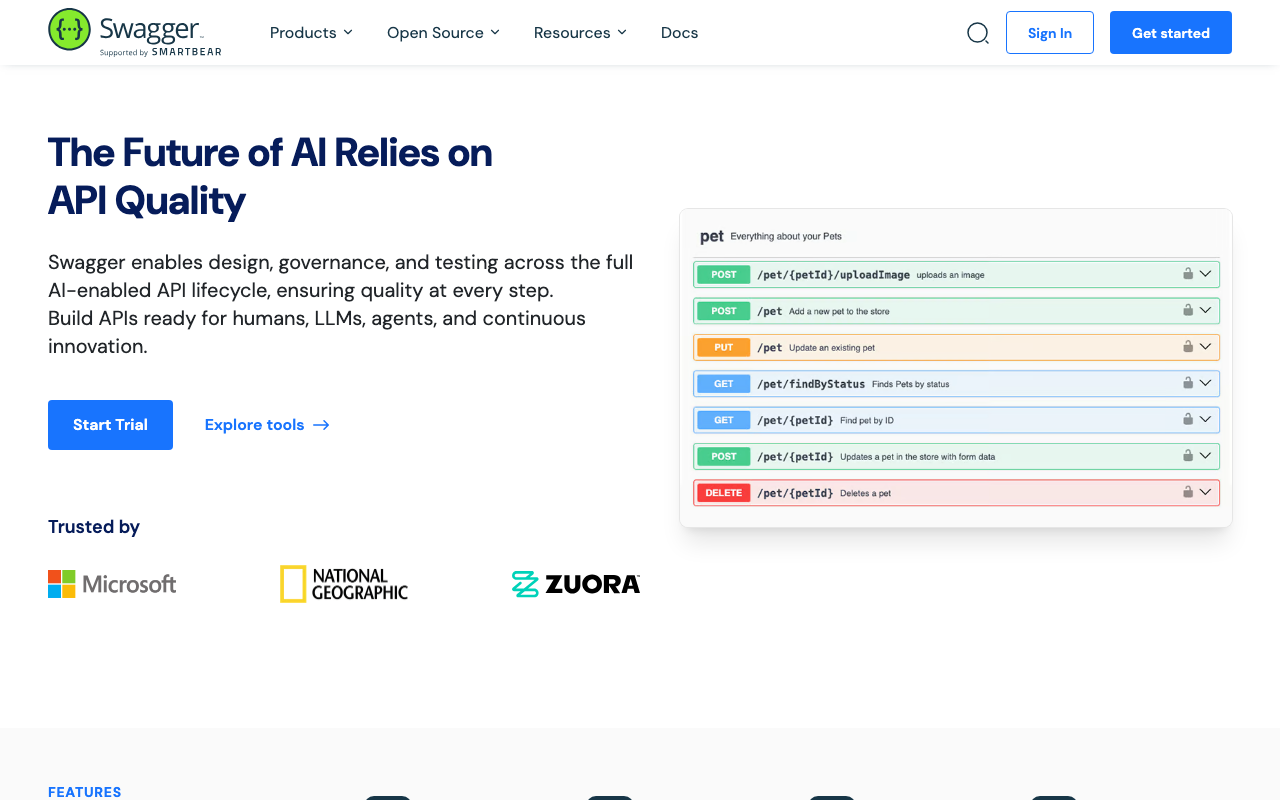
Swagger Editor is the browser-based spec editor with live validation and a rendered preview beside the document. Its role today is narrower than it used to be: it is the fastest way to open a spec, see whether it is valid, and look at how it renders, without installing anything. That makes it a useful scratchpad and a poor pipeline component.
Pros
- Zero setup, so anyone can validate and preview a document in a browser immediately
- Immediate feedback loop between editing and rendering, which is genuinely good for learning the format
- Self-hostable, so an organisation that will not paste specs into a public tool can still offer it internally
- Universally familiar, which lowers the barrier for non-specialists asked to review a definition
Cons
- Editing a real multi-file specification is impractical, since the workflow assumes a single document
- No governance, custom rules or diffing, so it contributes nothing to a CI pipeline
- Pasting a specification into a hosted editor is a data exposure decision people make without thinking about it
Best for: Quick validation, learning the format, and previewing a document without installing a toolchain.
Pricing: Open source with no vendor and no bill, with commercial hosted variants available in the wider Swagger product family. The real cost is that it solves none of the pipeline problems, so it is always an addition to a real toolchain.
Optic
Optic attacks the accuracy problem rather than the tidiness problem. It treats the spec as something to be verified against real traffic: capture actual requests and responses, compare them with the document, and report where the implementation and the specification disagree. It also does change review, presenting spec diffs as a governed approval step. That verification angle addresses the failure mode every other tool in this article is blind to, namely a spec that is internally perfect and factually wrong.
Pros
- Verifies the spec against observed traffic, catching the drift that document-only tooling structurally cannot see
- Diff review presents changes in terms of consumer impact rather than YAML lines, which makes the review meaningful
- Fits code-first teams well, where the spec is generated and the risk is undocumented behaviour rather than untidy definitions
- Can bootstrap a specification for an existing undocumented API from its traffic, which is often the hardest starting problem
Cons
- Requires capturing real traffic, which is an integration and a data-handling decision before it is a tooling one
- Coverage is limited to paths that traffic actually exercises, so rarely-used endpoints stay unverified
- Younger and narrower than the linting and diffing incumbents, so it complements rather than replaces them
Best for: Code-first teams whose specs are generated and whose real risk is undocumented behaviour rather than inconsistent style.
Pricing: Open-source core with a commercial hosted offering for team governance features, priced by seats and APIs. The real cost of the open path is the traffic capture integration you build around it.
Scalar
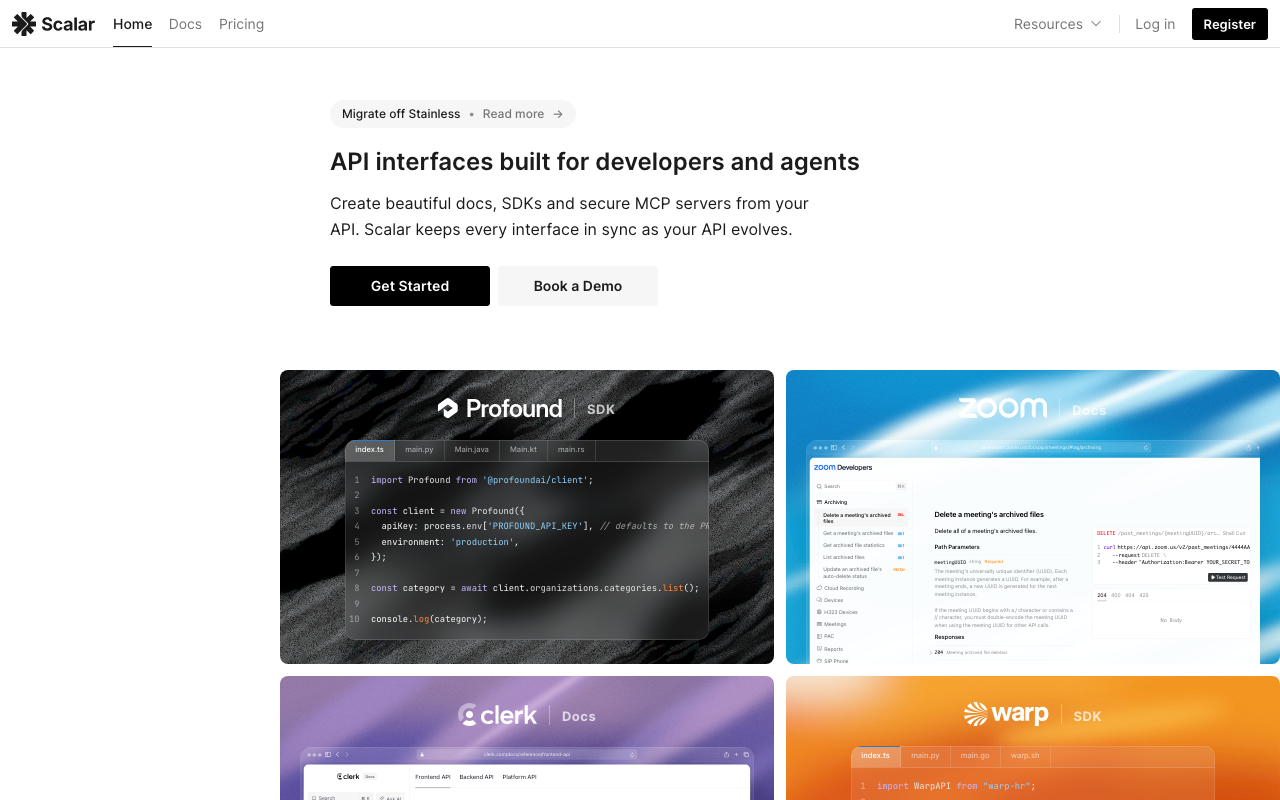
Scalar shows up in this article as well as the documentation one because it spans both: an OpenAPI renderer with an interactive console, plus a growing set of spec-adjacent utilities, distributed as embeddable open-source components with a hosted platform around them. In a tooling pipeline its role is the human-facing end, turning the validated, linted, diffed document into something a developer can read and try.
Pros
- Embeddable rendering means the output stage of your spec pipeline is a component rather than a platform commitment
- Console support gives an immediate way to sanity-check that a published spec actually describes a working API
- Open-source core, so the rendering stage carries no vendor dependency
- Modern handling of current specification versions, which is where older renderers show their age
Cons
- Rendering and interaction focused, so it contributes nothing to linting, diffing or generation
- Younger than the established renderers, with fewer unusual specification shapes already battle-tested
- Hosted platform is where the commercial model sits, so the fully free path means you own hosting and integration
Best for: Teams who want the readable, try-it-out end of the pipeline as an embeddable component rather than a docs platform.
Pricing: Open-source renderer with no licence cost; hosted platform tiers priced by seats and features.
How to choose
Think in pipeline stages rather than in products. Most teams need three or four tools, and the mistake is expecting one to cover everything.
Stage one, authoring. Editor plugin plus a validator. Cheap, immediate, and it stops obviously broken documents reaching review.
Stage two, lint on every pull request. A shared rule set, failing the build. Start with warnings on an existing estate and promote rules to errors as the backlog clears.
Stage three, diff against the deployed spec. Breaking changes fail the build with an explicit, documented override. This is the stage that prevents incidents and the one most commonly skipped.
Stage four, publish. Bundle to a single document, store it as a release artifact (this artifact is also your diff baseline), render documentation, and generate clients from exactly that artifact so the SDK and the docs cannot disagree.
Optional stage five, verify against traffic. Worth adding when your spec is generated from code and your real risk is undocumented behaviour rather than inconsistency.
| Tool | Stage it covers | Runs where | Picks itself when |
|---|---|---|---|
| OpenAPI (standard, not a product) | The artifact everything else consumes | Your repository | Always; the question is which version you standardise on |
| Redocly CLI | Lint, bundle, validate, preview | CI and locally | Multi-file specs across several services need one command |
| Spectral | Lint | CI, editors, embedded in other tools | Conventions must be shared and inherited across many teams |
| oasdiff | Breaking-change detection | CI gate | You have consumers you cannot deploy in lockstep with |
| openapi-generator | Client and server generation | Build pipeline | You need many languages including unusual ones |
| Swagger Editor | Authoring and validation | Browser | Somebody needs to check a document right now |
| Optic | Spec verification against traffic | Alongside a running service | The spec is generated and undocumented behaviour is the risk |
| Scalar | Rendering and try-it-out | Embedded in your site | The output stage should be a component, not a platform |
If you only add one thing this quarter, add the diff gate. Linting improves the document; diffing prevents the incident.
How all of this connects to gateway, documentation, testing and client distribution decisions is mapped in API management platforms.
Frequently asked questions
Should the spec be written by hand or generated from code?
Generated from code cannot drift, and it also cannot be reviewed before the code exists, which removes design-first review entirely. Written by hand enables design review and can be factually wrong. The arrangement that gets both is a hand-written design document for new work, with a CI check that compares the published spec against what the implementation actually serves, so divergence fails a build rather than surprising a consumer.
Do I need both a linter and a diffing tool?
They answer different questions and neither substitutes for the other. The linter asks whether the document is consistent and complete. The diff asks whether this change breaks somebody. You can ship a beautifully linted spec that removes a field every consumer depends on, and the linter will approve it.
How do I introduce linting to forty existing specs without a revolt?
Run the full rule set in warning mode, publish the counts per team, then promote rules to errors one at a time starting with the ones with the fewest violations. New specs get the full rule set from day one. The failure pattern is enabling everything at once, generating thousands of findings, and having the whole thing disabled within a fortnight.
Is OpenAPI 3.1 worth moving to?
Yes eventually, because the JSON Schema alignment removes a permanent source of incompatibility with every other schema tool in your stack, and because webhook description is a real gap in 3.0. Not yet if any tool in your chain has only partial support, and check that yourself rather than trusting a support claim. The cost of a split estate exceeds the benefit of the newer version.
What about APIs that are not request-response?
OpenAPI describes them badly or not at all. AsyncAPI covers event-driven and message-based interfaces with a similar shape and a much smaller tooling ecosystem, and a few tools render both. For gRPC, the protobuf definitions are already the machine-readable contract and OpenAPI adds nothing; see gRPC tooling for that side of the estate.
Related reading
- Best API documentation tools — what the validated spec should turn into for human readers.
- Best SDK and API client generators — the codegen half, and why output quality tracks spec quality.
- Best API mocking tools — spec-derived mocks, another artifact that inherits your document quality.
- Best tools for API versioning and deprecation — what to do when the diff tool correctly reports a breaking change you intend to ship.
- Best API testing tools — generated tests that check the implementation against the same document.
- Best API management platforms — how spec, gateway, docs and client decisions constrain one another.