Most teams do not have an API testing problem. They have four hundred saved requests in a collection that one person maintains, a nightly job that fails twice a week for reasons nobody investigates, and no mechanical connection between any of it and the OpenAPI document the client team codes against.
The failure mode is always the same. Somebody renames a response field from created_at to createdAt. The service tests pass, because they were written against the new code. The collection passes, because the assertions only check status codes. The mobile client breaks in production on Tuesday. Nothing in the pipeline was designed to catch a change to the shape of the contract, so nothing caught it.
That is the question worth organising this whole category around: when the spec changes, which of your tests notice? Answer it and the tool choice mostly falls out, because the tools split cleanly by whether they derive anything from the spec or ignore it entirely. Answer it late and you buy a nicer request editor and keep shipping the same breakages.
The second thing that decides this is where the tests run. A suite that only runs when a human clicks a button is documentation, not testing. Everything below gets judged on whether it runs unattended in a pipeline, what it needs to be given (a base URL, credentials, a seeded database) and what it does when the environment is slower than usual.
Key takeaways
- Contract, functional and load testing answer different questions, run at different cadences and fail for different reasons. A single tool that claims all three is usually strong at one.
- The only test worth trusting is one that fails when the OpenAPI document and the implementation disagree. Handwritten request collections structurally cannot do this.
- Test data management, not assertion syntax, is what kills API suites. Decide how state gets created and destroyed before you pick a runner.
- Anything that stores your test suite as an opaque record in a vendor cloud will drift from the code it tests. Git-native storage is the cheapest reliability fix in this category.
API testing is three jobs that share a name
The category is sold as one thing. It is three, and confusing them is why teams end up with expensive suites that miss obvious breakages.
Functional testing asks: given this request, does the service return the right answer? It exercises business logic through the HTTP surface. Chained requests, auth flows, pagination, error handling. This is what most people mean when they say API testing, and it is the job that request-builder tools like Postman and Bruno do well.
The failure mode of functional tests is that they only assert what you thought to assert. Nobody writes an assertion for every field on every response, so the tests check status code plus two or three values, and the other thirty fields are unverified. A rename in one of those thirty ships silently.
Contract testing asks a different question: do the producer and the consumer still agree about the shape of the exchange? It does not care whether the business logic is right. It cares that the consumer expects createdAt as an ISO 8601 string and the producer still emits exactly that. Two families exist here.
Consumer-driven contract testing, which is what Pact implements, records what each consumer actually asks for during its own unit tests, publishes that as a contract, and replays it against the producer. The producer’s pipeline fails when it would break a real consumer, and critically it only fails for fields somebody actually uses. That precision is the entire point: a producer can add or reshape fields nobody consumes without breaking the build.
Schema-driven contract testing goes the other way. The OpenAPI document is the source of truth, and tests are generated from it so that every endpoint and every declared response shape is checked against the running service. Schemathesis is the clearest example. This catches drift the consumer-driven approach cannot see, because it tests the whole declared surface rather than the used subset.
Load testing asks what happens at volume. Not “does it work” but “at what concurrency does p99 go bad, and what breaks first”. This is a fundamentally different tool shape: you need a runner that can generate real concurrency from multiple machines, and a results model built around percentiles over time rather than pass or fail. k6 owns this in the developer-tooling end of the market.
The three jobs have different owners and different cadences. Functional tests run on every pull request. Contract tests run on both sides of every integration, which means in two repositories. Load tests run before a release or on a schedule, because they are slow and need an environment that resembles production. A team that tries to run all three from one collection ends up with a pipeline stage that takes twenty minutes and gets disabled.
The real test: what survives a spec change
Here is the exercise I would run before buying anything in this category. Take your OpenAPI document. Rename one response field. Make one optional field required. Change one integer to a string. Then run your entire test suite and count what fails.
For a handwritten request collection the answer is usually nothing, unless that specific field happened to be one of the three somebody asserted on. The collection has no knowledge of the spec. It knows a URL, a method, a body and a handful of assertions a human typed.
For spec-derived tests the answer is that the tests either fail or regenerate. That is the whole difference, and it is structural rather than a matter of effort. A tool that reads the spec can check every declared field on every response automatically, including the ones nobody thought about.
There are three ways the spec and the implementation get connected, and they differ in what they can catch:
Spec-first, tests generated from the spec. The document is written or designed first, the tests derive from it, and a mismatch fails the build. This catches implementation drift. It does not catch a spec that is wrong, because the spec is assumed correct.
Code-first, spec generated from the implementation. Annotations or framework introspection emit the document. The spec is always accurate by construction, which sounds ideal and mostly removes the ability to catch anything, because the spec changes automatically the moment the code does. The check you want here is not spec-versus-code, it is spec-versus-previous-spec, which is breaking change detection rather than testing. That is covered in OpenAPI and Swagger tooling.
Neither, with the spec written by hand after the fact. This is the most common state in real companies and the one where every category of test is unreliable, because the document is fiction and the clients generated from it are fiction too.
Whichever you run, the assertion that earns its keep is the schema assertion: this response validates against the declared schema for this status code. It is one line per test and it covers every field, including the ones added after the test was written. If your current suite has no schema assertions, adding them is a larger improvement than changing tools.
Needs first-hand data: Take a real service with an existing suite and introduce five specific spec breakages one at a time: rename a response field, make an optional request field required, narrow an enum, change a numeric type to a string, and remove a nullable marker. Record which of your functional tests, contract tests and generated tests catch each one. Publishing that five by three grid for one real API would settle most arguments in this category.
Where API suites actually die: test data and CI
Assertion syntax is the part everyone argues about and the part that never causes a problem. Two other things do.
Test data. An API test that creates an order needs a customer, a product and a payment method to exist. There are four ways to get them and each has a distinct failure mode.
Seeding a shared environment before the run is fast and breaks the moment two pipelines run concurrently, because the second run finds state the first one left. Creating everything through the API at the start of each test is slow and correct, and it becomes the dominant cost of your suite. Database fixtures loaded directly bypass the API, which is fast and lets you create states the API cannot produce, at the cost of coupling your tests to the schema. Ephemeral environments per pull request solve it properly and cost infrastructure, which is a CI problem rather than a testing one and is covered by preview environment tooling.
Whichever you pick, the rule that saves you is that every test must create what it needs and clean up after itself, and must not assume ordering. Suites that violate this work locally and fail in parallel, and the fix is always a rewrite rather than a flag.
Auth. Nearly every API test needs a token, and the way tokens are obtained is the single most common source of hardcoded secrets in collections. The right shape is a pre-request step that exchanges a client credential held in the CI secret store for a short-lived token, cached for the run. Collections that carry a pasted bearer token work for about a week. If you are standardising on how services authenticate to each other, API authentication tooling is the adjacent decision.
CI behaviour. Judge a tool on four things: does it have a headless runner that exits non-zero on failure, does it emit a machine-readable report your CI can render, can it run tests in parallel without shared state, and does it retry sensibly rather than either never or always. Tools built around a GUI usually bolted the runner on afterwards, and it shows in the report formats and the exit codes.
Flakiness. The specific hazard in API testing is that timeouts look like failures. A service returns slowly because of a cold start rather than a defect, your test times out, the build goes red, and within a month everyone reruns red builds reflexively. Set timeouts from observed latency rather than intuition, and treat a flaky test as a broken test rather than a nuisance. What your API actually does under load belongs in API monitoring, and that data should inform your timeouts.
Needs first-hand data: Instrument one pipeline to record, per test run, total wall clock, time spent creating test data versus time spent asserting, and the failure reason for every red build over a month split into real failures, timeouts and environment problems. The ratio of real failures to the other two is the honest measure of whether a suite is worth keeping.
Postman
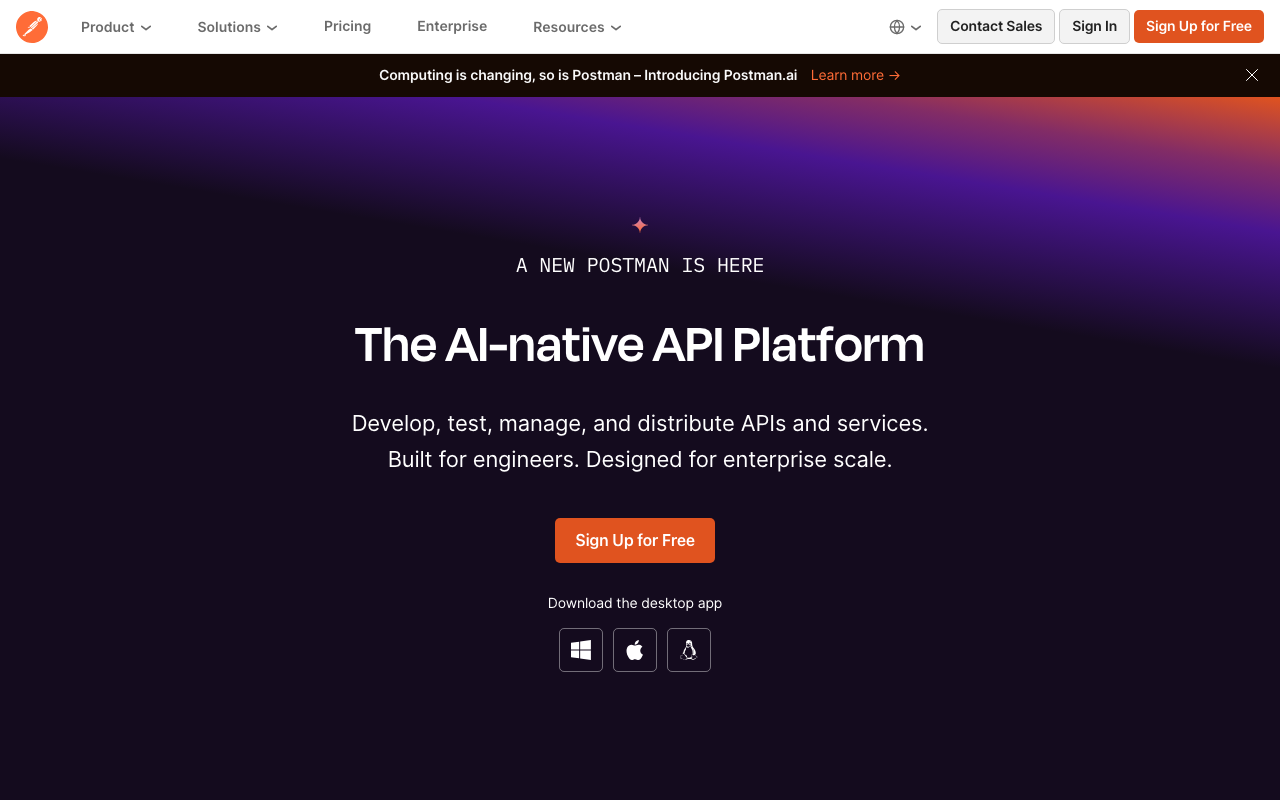
Postman is the default in this category by a wide margin and the reason most teams have an API testing story at all. It is a request builder, a collection runner, a mock server, a documentation generator and a collaboration workspace, with a scripting model that lets you chain requests and write assertions in JavaScript. The architectural fact that matters is that it is cloud-first: collections live in a workspace, sync is the default, and the local-only mode has narrowed over successive versions. That is excellent for a team that wants shared state and awkward for one that wants the test suite to live beside the code that it tests.
Pros
- The broadest feature surface in the category, covering requests, tests, mocks, monitors and docs from one place
- Newman gives you a headless runner that works in any CI system with machine-readable reports
- Enormous installed base, so onboarding a new engineer costs nothing and public collections exist for most third-party APIs
- Collection-level scripting handles genuinely complex chained flows, including auth dances that simpler tools cannot express
Cons
- Collections stored in a vendor workspace drift from the repository, so a pull request that changes an endpoint does not change the tests in the same review
- Scripted assertions are handwritten, so the suite only checks what somebody remembered to check and is blind to spec changes
- Seat-based commercial model makes it expensive to give everyone write access, which pushes teams toward a single collection owner and a bus factor of one
Best for: Teams who value a shared visual workspace across engineering, QA and support more than they value having the suite versioned alongside the service.
Pricing: Per-user subscription tiers, with collection runs, mock server calls and monitor executions metered against plan allowances. If seat count or the cloud-sync default is the problem, Postman alternatives is the migration-shaped version of this section.
Bruno
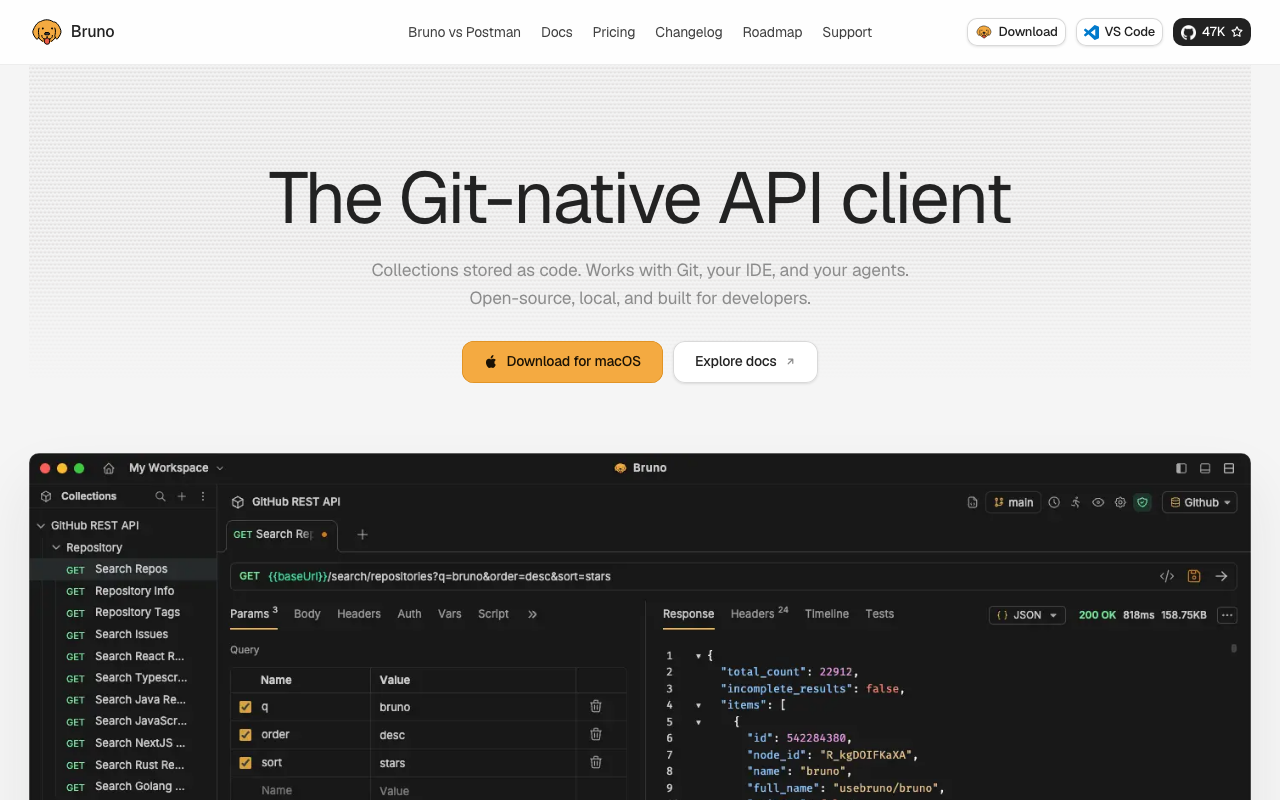
Bruno is the git-native answer to Postman. Requests are plain text files in a directory in your repository, written in a small declarative format, and there is no account, no workspace and no sync. That one decision changes the workflow completely: a pull request that changes an endpoint contains the changed request file, code review covers the tests, and branching gives you per-branch test suites for free. It is an open-source project with a commercial tier for team features, and the core client is the part most teams use.
Pros
- Tests live in the repository as reviewable text, so they branch, merge and diff like any other code
- No mandatory account or cloud sync, which removes an entire category of data residency questions
- Command-line runner is a first-class citizen rather than an afterthought, so CI behaves the same as the desktop app
- Import from existing collections makes a migration from a request-builder incumbent a days-long job rather than a rewrite
Cons
- Younger ecosystem, so advanced scripting patterns and third-party integrations have fewer worked examples to copy
- Collaboration features that come free with a cloud workspace (shared environments, comments, activity history) need a different workflow or the paid tier
- Still fundamentally handwritten assertions, so it inherits the blindness to spec changes that all request builders have
Best for: Teams who want their API tests reviewed in the same pull request as the code change, and who consider mandatory cloud sync a disqualifier.
Pricing: The core client is open source with no licence cost; a paid tier covers team collaboration features. The real cost is that you own the workflow conventions that a hosted workspace would otherwise impose.
Hoppscotch
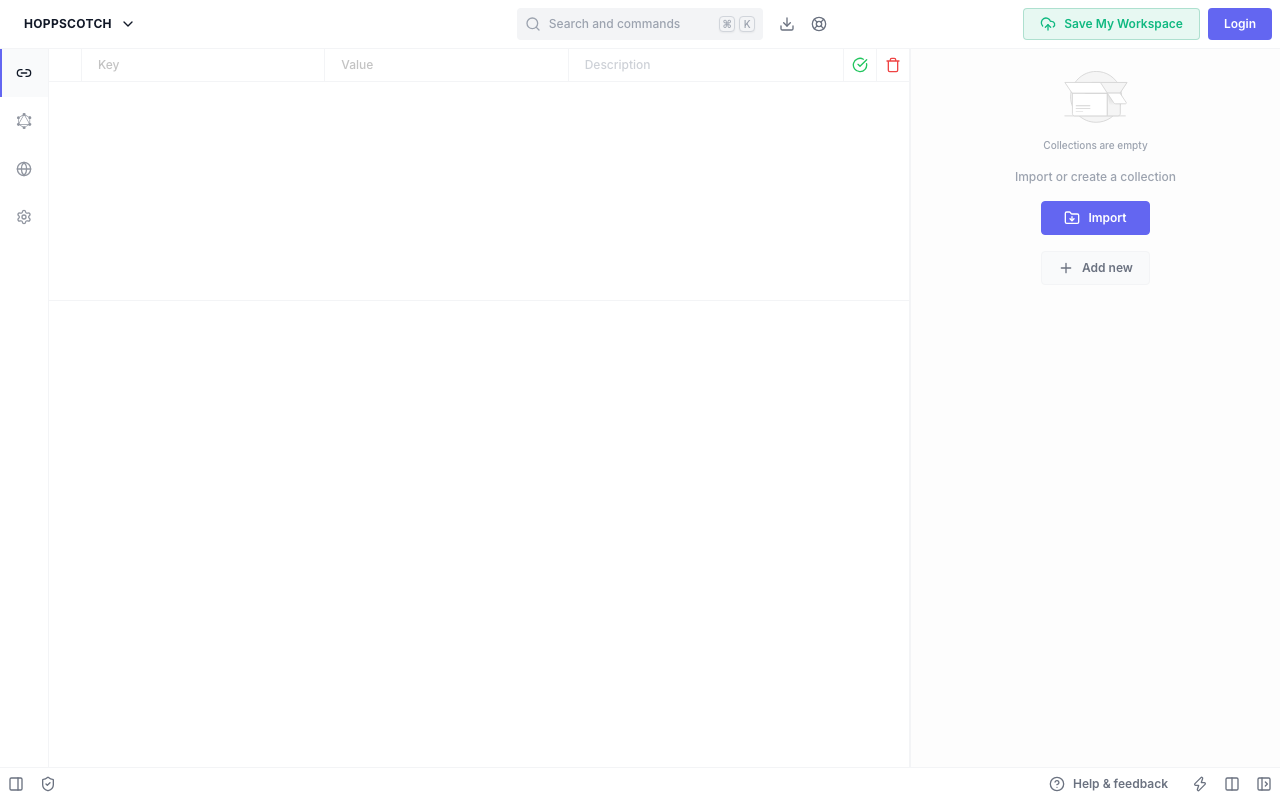
Hoppscotch is a browser-based API client that is open source and can be self-hosted. It started as a lightweight alternative to installing a desktop app and grew into a full workspace with collections, environments, team sharing and a command-line runner. The self-hosting option is the differentiator: an organisation that cannot send request bodies containing customer data to a third-party workspace can run the whole thing inside its own network and still give engineers a shared UI.
Pros
- Runs in a browser with nothing to install, which makes it trivial to hand to a support engineer or a partner team
- Self-hostable in full, so request data and credentials never leave your infrastructure
- Lightweight and fast compared with the heavier desktop clients, especially on constrained machines
- Supports REST, GraphQL and realtime protocols in one interface rather than three separate tools
Cons
- Self-hosting means you now operate a web application, with the upgrades and authentication wiring that implies
- Test scripting and assertion capabilities are thinner than the established request builders for complex chained flows
- Browser-based storage models make it easy to lose local work if you treat it as the source of truth rather than exporting to a repository
Best for: Organisations with a hard requirement that API request data stays inside their own network, who still want a shared graphical client.
Pricing: Open source and self-hostable with no licence cost, plus a hosted tier with per-user pricing for teams that do not want to run it. Self-hosting moves the cost into the container, the database behind it and whoever keeps them patched.
Insomnia
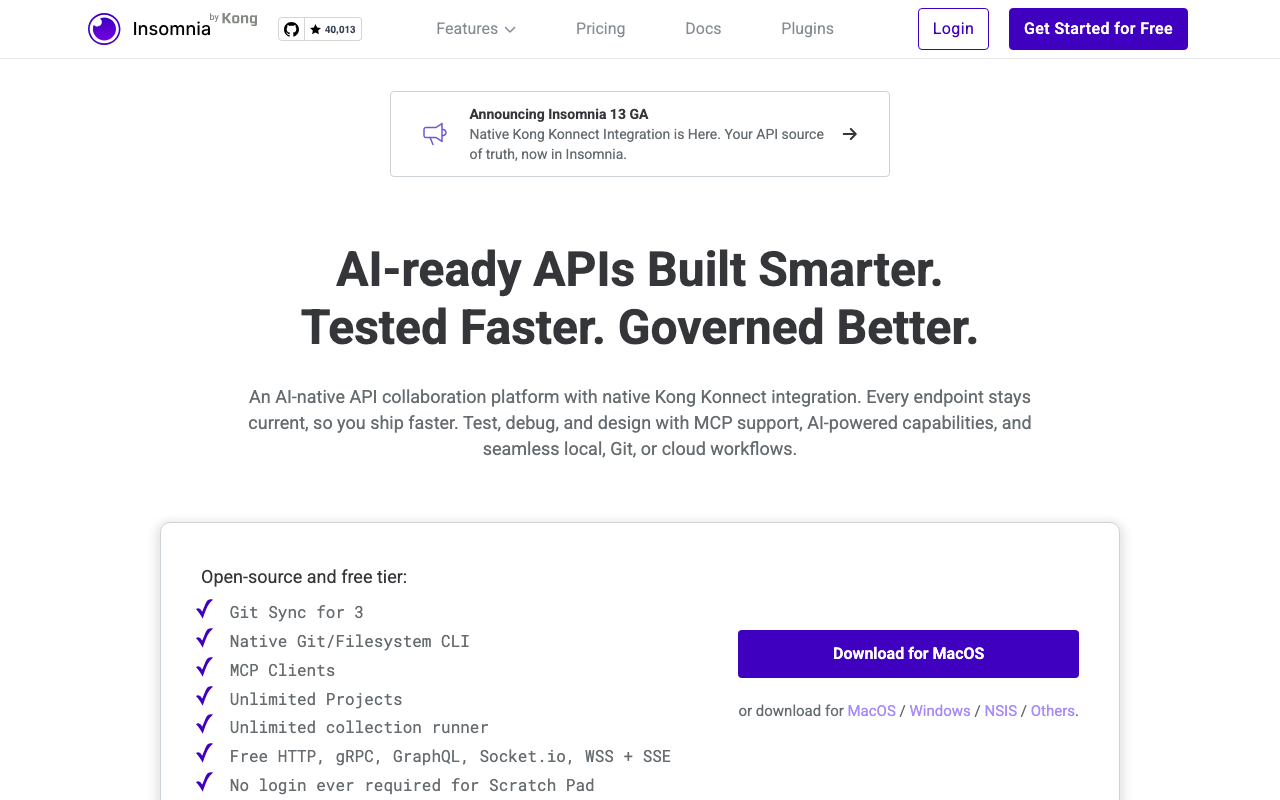
Insomnia is the other long-standing desktop API client, now part of the Kong portfolio. It covers REST, GraphQL, gRPC and WebSocket from one interface, and it has a design-document workflow where an OpenAPI document sits alongside the requests and can be linted in the same app. Being owned by a gateway vendor cuts both ways: the integration story with that gateway is strong, and the product roadmap follows a company whose main business is elsewhere. Storage has moved between local-only and cloud-sync defaults across versions, which is worth checking against the version you would standardise on.
Pros
- Handles gRPC, GraphQL and WebSocket alongside REST, which matters once your estate stops being purely REST
- Design workflow keeps an OpenAPI document in the same tool as the requests, with linting attached
- Plugin system covers auth schemes and response transformations that would otherwise need scripting
- Integrates cleanly with the Kong ecosystem if that is already your gateway
Cons
- Storage and account defaults have changed direction more than once, which is disruptive for teams that standardised on a previous model
- Roadmap is subordinate to a gateway business, so client-side investment is not guaranteed
- Test and assertion features are less developed than the request and design features, so complex suites still push you toward scripting
Best for: Teams with a mixed REST, GraphQL and gRPC estate who want one client for all of it, particularly if they already run Kong.
Pricing: Free tier with per-user paid plans for team collaboration and cloud features. For the gateway it sits next to, see API gateways.
Pact
Pact is the reference implementation of consumer-driven contract testing and the only tool here that solves a genuinely different problem. The consumer’s own test suite runs against a Pact mock, and the interactions it exercises are recorded as a contract. That contract is published to a broker, and the producer’s pipeline verifies it by replaying those interactions against the real service. The result is a build that fails precisely when a change would break a consumer that exists, and passes when it changes something nobody uses.
Pros
- Catches producer changes that break real consumers before deployment, which no amount of functional testing on either side can do
- Contracts describe only what consumers actually use, so producers stay free to evolve unused parts of the response
- Language bindings exist for the major stacks, so a polyglot estate can participate without standardising runtimes
- The broker gives you a deployment gate: a service can check whether the versions it depends on are compatible before it ships
Cons
- Requires coordinated adoption in two repositories with two teams, which is an organisational cost rather than a technical one and is where most rollouts stall
- It verifies shape and agreement, not correctness, so you still need functional tests underneath it
- Poor fit for public APIs with unknown consumers, since the whole model assumes you can enumerate who calls you
Best for: Organisations with several internal services and separate teams either side of an integration boundary, where the breakages you fear are between your own services.
Pricing: The Pact libraries and the self-hostable broker are open source with no vendor and no bill; the cost is running the broker and the coordination effort across teams. A commercially hosted broker with additional governance features is sold separately on a per-service or per-user basis.
Schemathesis
Schemathesis takes the OpenAPI document and generates test cases from it, using property-based testing to produce inputs that satisfy the declared schema and inputs that deliberately violate it. It then checks the responses against what the document says should happen. The value is that it tests the surface you declared rather than the surface you remembered to write tests for, and it is very good at finding the endpoints that return a 500 for an input the schema says is legal.
Pros
- Tests every declared endpoint and schema without anyone writing a test case, so coverage tracks the spec automatically
- Property-based generation finds edge-case inputs that handwritten tests never produce, particularly around boundaries and nullability
- Fails loudly when the implementation and the document disagree, which is exactly the spec-drift check most suites lack
- Runs as a command-line tool or inside a Python test suite, so it drops into an existing pipeline without a new platform
Cons
- Only as good as the document; a vague or permissive spec produces vague tests and false confidence
- Generated inputs against a stateful API cause real writes, so it needs an environment it is allowed to damage
- Findings need triage, because a technically-legal input that your product will never receive still reports as a failure
Best for: Teams with a maintained OpenAPI document who want automatic coverage of the whole declared surface rather than the handful of endpoints somebody tested.
Pricing: Open source with no vendor and no bill for the core tool. The real cost is the disposable environment it needs and the triage time on generated findings.
k6
k6 is the load testing tool in this list and should not be compared with the request builders. Tests are written as JavaScript, executed by a Go runtime, and the execution model is built around virtual users, stages and thresholds rather than pass or fail. Thresholds are the part that makes it useful in CI: you declare that p95 must stay under a limit and the run fails when it does not, which turns a load test into a regression gate instead of a report somebody reads.
Pros
- Thresholds turn performance into a build-failing condition rather than a chart, which is what makes load testing stick in CI
- Scripts are JavaScript but the runtime is Go, so a single machine generates far more load than a Node-based generator
- Supports protocols beyond HTTP, including gRPC and WebSocket, so the load story survives a protocol change
- Distributed and cloud execution available for load levels beyond one machine, with the same scripts
Cons
- Not a functional testing tool; using it as one gives you an awkward assertion model and no request-building workflow
- Meaningful load tests need a production-like environment and production-like data, which is usually the blocker rather than the tool
- Interpreting results correctly is a skill; a test that saturates the load generator rather than the service produces confident nonsense
Best for: Teams who already have functional coverage and need performance regressions to fail a pipeline rather than be discovered in production.
Pricing: The core tool is open source with no licence cost; the hosted execution service is metered on virtual user hours and test runs. Self-hosted, the cost is the load generator infrastructure and the environment you test against.
Step CI
Step CI takes the declarative route: tests are YAML files describing a sequence of requests and checks, with no scripting language in the middle. That makes suites readable by people who do not write JavaScript and easy to generate, and it can validate responses against a JSON Schema rather than only field-by-field assertions. The declarative model is the point, and also the ceiling: anything the YAML does not express is not expressible.
Pros
- Plain YAML suites are diffable, reviewable and easy for non-specialists to read and edit
- Schema-based response validation is built in rather than something you script yourself
- Runs from a single binary in CI with no runtime to install alongside it
- Suites can be generated from an existing specification rather than written by hand
Cons
- Declarative format hits a wall on complex chained logic, conditional flows or custom signing, where a scripting model would just work
- Smaller project and community than the incumbents, so fewer worked examples and a thinner integration surface
- Maintenance activity has been uneven, which is a real risk to weigh before standardising a whole organisation on it
Best for: Teams who want API tests as reviewable configuration rather than code, with straightforward request flows.
Pricing: Open source with no vendor and no bill. The cost to weigh is maintenance risk: adopting it means being prepared to fix it yourself if upstream activity stalls.
Karate
Karate combines an API test DSL, assertions, mocking and load testing in one JVM-based tool. Tests are written in a Gherkin-style syntax with built-in JSON and XML matching that is genuinely better than handwritten assertions: you can assert against a whole response document in one expression, including optional fields, type matching and nested structures. That matching syntax is the reason JVM teams pick it over anything else.
Pros
- Whole-document matching lets one expression assert the entire response shape, which is far closer to a schema check than field-by-field assertions
- Functional tests, mocks and load tests come from the same syntax, so one skill covers several jobs
- Runs as part of a standard JVM build, so it inherits the existing CI, reporting and parallelism setup
- Handles JSON and XML with equal seriousness, which matters in estates with SOAP or XML-era systems still in production
Cons
- JVM toolchain is a hard dependency, which is a poor fit for a team with no other Java or Kotlin in the pipeline
- The Gherkin-style DSL looks like BDD but is not, which reliably confuses people who arrive expecting Cucumber semantics
- Advanced features concentrate in the commercial tier, so the open-source experience and the sales demo diverge
Best for: JVM shops who want API tests inside their existing Maven or Gradle build with strong response matching, without adding a separate toolchain.
Pricing: Open-source core with no licence cost, plus a commercial product adding IDE tooling and reporting, sold per user. On a non-JVM team the real cost is introducing and maintaining a JVM build purely for tests.
How to choose
Do this in the order given. Most teams start at step four and wonder why it does not help.
One: write down what actually broke in the last six months. Not what could break. What did. If the answer is “a client broke when we changed a response”, you need contract or schema testing and a nicer request builder will not help. If the answer is “we shipped a bug in the logic”, you need functional coverage. If it is “it fell over at month end”, you need load testing.
Two: check whether you have a trustworthy OpenAPI document. If yes, spec-derived testing is available to you and is the highest-leverage option in this article. If no, fixing that comes first, because every downstream tool including SDK generation and mocking depends on it.
Three: decide where the suite lives. In the repository next to the service, or in a vendor workspace. This decision has more effect on whether the suite stays accurate than any feature, because tests that are not in the pull request do not get updated by the pull request.
Four: then pick the runner. By this point the shortlist is two tools, not nine.
| Tool | Job it does | Storage model | Picks itself when |
|---|---|---|---|
| Postman | Functional, plus mocks and docs | Vendor workspace, cloud-synced | You want one shared workspace across engineering, QA and support |
| Bruno | Functional | Plain files in your repository | Tests must be reviewed in the same pull request as the code |
| Hoppscotch | Functional | Self-hosted or hosted workspace | Request data is not allowed to leave your network |
| Insomnia | Functional across REST, GraphQL, gRPC | Local or cloud, version-dependent | The estate is multi-protocol and probably already on Kong |
| Pact | Consumer-driven contract | Contracts in a broker | The breakages you fear are between your own services |
| Schemathesis | Schema-driven contract | Generated from the spec | You have a real OpenAPI document and want the whole surface covered |
| k6 | Load and performance | Scripts in your repository | Performance regressions need to fail a build |
| Step CI | Functional, declarative | YAML in your repository | You want tests as configuration, not code |
| Karate | Functional, mocks and load on the JVM | Feature files in your repository | The build is already Maven or Gradle |
The combination I would actually run for a mid-sized service estate is three tools, not one: a git-native request builder for functional flows, schema-derived tests to cover the declared surface, and consumer-driven contracts on the two or three integration boundaries that have burned you. Load testing is a fourth tool on a schedule, not in the pull request path.
Where this sits in the wider picture is covered in API management platforms, which maps how testing, gateway, documentation and monitoring decisions constrain each other.
Frequently asked questions
Do I need contract testing if I already have integration tests?
Usually yes, because they catch different things. Integration tests run your consumer against a real or mocked producer at a point in time. Contract testing creates a standing agreement that fails the producer’s build when it would break you, even though the producer’s team never ran your tests. The value is in the gate on the other side of the boundary, not in the assertions themselves.
Should API tests run against a deployed environment or a locally started service?
Both, at different stages. Start the service locally in the pull request pipeline so tests are fast and isolated, then run a smaller smoke suite against the deployed environment after release to catch configuration problems that local runs structurally cannot see: wrong environment variables, missing secrets, gateway rules, TLS. The deployed run is a different job with a different suite, not the same suite pointed elsewhere.
Can I use my mock server as a test double in CI?
Yes, and it is the right pattern for testing a consumer in isolation, provided the mock derives from the spec rather than from handwritten examples. A handwritten mock encodes what somebody believed the API returned and will drift from reality silently, which converts your test suite into a machine for confirming an old assumption. API mocking tools covers which ones derive from the spec.
How many API tests are enough?
Wrong question, and the one that produces four hundred unloved requests. Better framing: every endpoint should be covered by a schema check, every error path your clients handle should have a test, and every integration boundary between teams should have a contract. Coverage of happy paths beyond that adds maintenance cost faster than confidence.
Is Postman still the right default in 2026?
It is still the fastest way to get a team from nothing to something, and it is no longer the obvious default for teams that want tests versioned with code. The pressure came from its storage and pricing model rather than its features, which is why the git-native tools grew. If your suite is already there and working, the migration is not urgent; if you are starting now, storage model is the first question to answer.
Related reading
- Postman alternatives — what teams are escaping and what a git-native migration actually costs.
- Best OpenAPI and Swagger tooling — spec linting, breaking-change detection and the 3.0 versus 3.1 support gap.
- Best API mocking tools — spec-derived versus handwritten mocks, and why the difference decides whether your tests lie to you.
- Best API security testing tools — the failures functional tests are not designed to find.
- Best API monitoring tools — what your API does in production, which is where your timeouts should come from.
- Best API management platforms — how gateway, docs, testing and monitoring choices constrain one another.