The pitch for prompt management is that your product manager should be able to fix a prompt without waiting for a deploy. It is a good pitch, and the first time it works you will feel clever.
The second time, somebody edits a prompt to be friendlier, the model stops emitting the exact JSON shape your parser expects, and a function three layers downstream starts throwing on every request. No deploy happened. No commit exists. Your git history says nothing changed, your alerts fire, and the person who made the change does not know they caused it because from their side they improved some wording in a text box.
That is the whole trade, and it is not a tooling problem you can solve by picking a better vendor. Moving a prompt out of your repository converts a compile-time constant into a runtime dependency — and a runtime dependency that changes the behaviour of your program without going through any of the controls you built for changing the behaviour of your program.
I am not arguing against prompt platforms. I use them and I would recommend them to most teams shipping LLM features at any scale. I am arguing that you should adopt one having decided, deliberately, which of the two failure modes you prefer, and having designed the fetch path and the evaluation gate before the first non-engineer gets an editor login.
Key takeaways
- Prompts in the repo get review, diffs and atomic rollback with the code that depends on them, at the cost of a deploy for every wording change.
- Prompts in a platform get versioning, non-engineer editing and instant rollout, at the cost of becoming a runtime dependency that can change under a shipped binary.
- If your app fetches prompts at call time, you have added a dependency to the hot path. Cache locally, pin a version per release, and define behaviour when the service is unreachable.
- A prompt platform without an evaluation gate is a faster way to ship an unmeasured change. Wire scoring to the version before you let anyone edit in production.
Prompts as code versus prompts as content
Both models are defensible. They fail differently, and the failure mode is what you are choosing.
Prompts in the repository
The prompt is a file, or a template, or a string in a module. It ships with the binary that uses it.
What you get is everything your engineering process already provides, for free. Code review — a change to the system message gets the same scrutiny as a change to the parsing logic that depends on it, from the person who understands both. Diffs — you can see exactly what changed, line by line, months later. Atomic rollback — reverting the deploy reverts the prompt and the code together, which matters enormously, because a prompt and the code that parses its output are one coupled unit whether you acknowledge it or not. Bisect — a quality regression is findable by the same method as any other regression. Environment parity — the prompt running in staging is provably the prompt running in production, because it is the same artifact.
The failure mode is the deploy bottleneck, and it is real rather than theoretical. Fixing an awkward phrase in a customer-facing response requires a pull request, a review, a CI run and a deploy window. If that is thirty minutes, nobody minds. If your deploy pipeline takes two hours and needs a release captain, then every prompt improvement is an engineering ticket, the people with the domain knowledge cannot act on it, and iteration on the part of your product most in need of iteration slows to the speed of your slowest process. Teams in that position stop improving prompts, which is a worse outcome than any tooling risk.
Prompts in a platform
The prompt is a versioned record in a service. Your application references it by name and, if you are careful, by version.
What you get: versioning with history independent of your release cycle. Non-engineer editing, so the support lead who knows exactly how that reply should be worded can change it. Instant rollout and instant rollback — a bad prompt is reverted in seconds rather than in a deploy cycle, which during an incident is a genuine advantage. A playground where a change can be tried against real examples before it goes anywhere. Labels and environments, so the same prompt name resolves differently in staging and production. And critically, a version identifier you can attach to every trace, which is what makes a quality change attributable at all.
The failure mode is the one in this article’s opening. The prompt has become a runtime dependency that can change under a shipped binary, and three specific things follow.
The prompt and its parser drift apart. Your code expects a JSON object with four named fields, or a response beginning with a specific token, or a bounded set of classification labels. That contract is enforced nowhere. An editor rewording the instructions can invalidate it without touching code, and the failure surfaces as an exception in a function far from the edit.
Change control is bypassed. Whatever review, audit and approval process you built for production changes does not cover this path unless the platform provides its own and you configured it. For a regulated product, a non-engineer silently changing the instructions given to a model that talks to customers is a compliance issue, not just an engineering one.
Attribution gets harder before it gets easier. An incident timeline built from deploys and commits now has an invisible category of change. Every prompt platform can tell you what changed and when, but only if someone thinks to look there — which is why the version identifier belongs on every span in your LLM traces, so the correlation is automatic rather than remembered.
The shape most mature teams land on
Not one or the other. Prompts live in the platform, and the platform’s client is configured to resolve a pinned version per release rather than “latest”. Non-engineers can create and test new versions freely; promoting a version to the label your production release resolves requires an approval and a passing evaluation run. Emergency rollback is instant because it is just re-pointing a label.
That gets you the iteration speed of the platform and most of the safety of the repository, and the cost is that “instant rollout without a deploy” now has a gate in front of it. That gate is the point. If your reaction is that the gate defeats the purpose, then what you actually want is prompts in the repository, and you should keep them there.
The runtime fetch is a distributed-systems decision
This is the part that gets skipped, because the SDK makes it look like a function call.
get_prompt("support-reply") is a network request to a third-party service, and you have put it in front of the model call, which is in front of your user. Treat it exactly as you would treat any other synchronous dependency added to a request path, because that is what it is.
Cache locally, and decide the TTL on purpose. Every serious client caches. What varies is whether the cache is populated at startup or lazily on first use, and how long entries live. A short TTL means faster propagation of changes and more requests to the service; a long one means the opposite. The default in most SDKs is a modest TTL that quietly makes your application’s behaviour eventually consistent with a system you do not run.
Serve stale rather than fail. Stale-while-revalidate is the correct pattern here: return the cached prompt immediately, refresh in the background, and never let a refresh failure become a request failure. A prompt that is sixty seconds out of date is almost always fine. A request that fails because a prompt service was slow is never fine. If your client does not do this by default, wrap it so it does.
Pin a version per release, and prefer a build-time fetch. Resolving “latest” at runtime is the configuration that produces the failure mode in the opening paragraph. Resolving a specific version means an edit cannot change a running deployment, and promotion becomes an explicit act. Better still, fetch the pinned prompts at build time and bake them into the artifact or a config map — then you get platform authoring and repository-grade determinism, and the runtime dependency disappears entirely. This is the option I would default to for anything with real traffic, and the reason more teams do not do it is simply that the SDK’s happy path is the runtime fetch.
Define what happens when the service is unreachable. Three options, in descending order of how much I like them. Serve from the local cache, which is why the cache should be populated at startup rather than lazily. Fall back to a prompt bundled in the repository as a last-resort default — slightly stale, always available, and it makes the whole dependency non-critical. Or fail the request, which is only acceptable if you genuinely cannot ship a default. Whichever you choose, test it by blocking the service in staging and watching what your application does. Almost nobody runs that test, and it is a ten-minute exercise that reveals whether you have added a single point of failure to every AI feature you have.
Do not forget the cold start. In a serverless or scale-to-zero deployment, a lazily populated cache means the first request on every new instance pays the fetch latency, and a service degradation coinciding with a scale-up event means many instances failing at once. Fetch at initialisation, or bake it in.
One more consideration that matters for prompts specifically: prompt payloads are not small. A system message with tool definitions and few-shot examples is kilobytes, and a bad cache configuration turns that into meaningful traffic on every request. The bandwidth is unimportant; the added latency on the critical path is not.
Needs first-hand data: Block the prompt platform’s endpoint at the network level in staging while a load test runs, and record what your application does — error rate, added latency, and whether the local cache and repository fallback actually engaged. Then repeat with a cold instance so nothing is cached. Publish both results. Most teams do not know the answer, and it is the single most important property of this dependency.
A prompt platform without evaluation is a faster way to ship an unmeasured change
Here is the uncomfortable part. Prompt management on its own increases the rate at which prompts change and does nothing to increase your confidence that the changes are improvements. That is a net negative if the changes are being made on vibes, and they usually are, because a person who edits a prompt and reads three sample outputs has genuinely no idea whether they helped or hurt the other 99.99% of traffic.
A version you cannot score is a version you cannot safely roll out. So the minimum viable wiring is:
A fixed dataset attached to the prompt. Twenty to a hundred cases minimum, drawn from real traffic — including the failures that motivated previous prompt changes, which is the most valuable category and the one that vanishes if you do not deliberately keep it. Every prompt platform worth adopting lets you store datasets next to prompts, and that adjacency is most of its value.
Scorers that run on every version. Deterministic checks first, because they are cheap and unambiguous: does the output parse as the required JSON shape, does it contain the required fields, does the classification fall within the permitted label set, is it within a length bound, does it avoid a forbidden phrase. Then model-graded scores for the things that need judgment, with the caveat that a judge is another model call with its own biases and its own drift — the reliability problem covered in the evaluation tools guide.
A promotion gate. Creating a version is free. Pointing the production label at it requires the evaluation run to pass a threshold. This is the mechanism that makes non-engineer editing safe, and it converts prompt management from a risk into a control.
Per-case diffs, not just aggregate scores. An average that improves while three important cases break is the most common way a prompt change causes an incident. The comparison view that shows you which specific cases changed direction is the feature that earns the subscription.
And measure cost when you measure quality. Prompt changes move token counts, and a longer system message multiplies across every request, which lands in the same place as everything else in LLM cost tracking. A prompt that scores two points higher and costs considerably more per call is a business decision, not an obvious win.
Needs first-hand data: For the last ten prompt versions you promoted, record the evaluation score delta and the mean input-token delta side by side. Then count how many of those promotions would have failed a gate that required score to improve without input tokens growing. That ratio tells you whether your prompt iteration has been buying quality or buying length.
The platforms below vary enormously on this axis, and it is the axis I would weight most heavily. Several of them are evaluation products that also store prompts, and for most teams that is the right shape.
PromptLayer
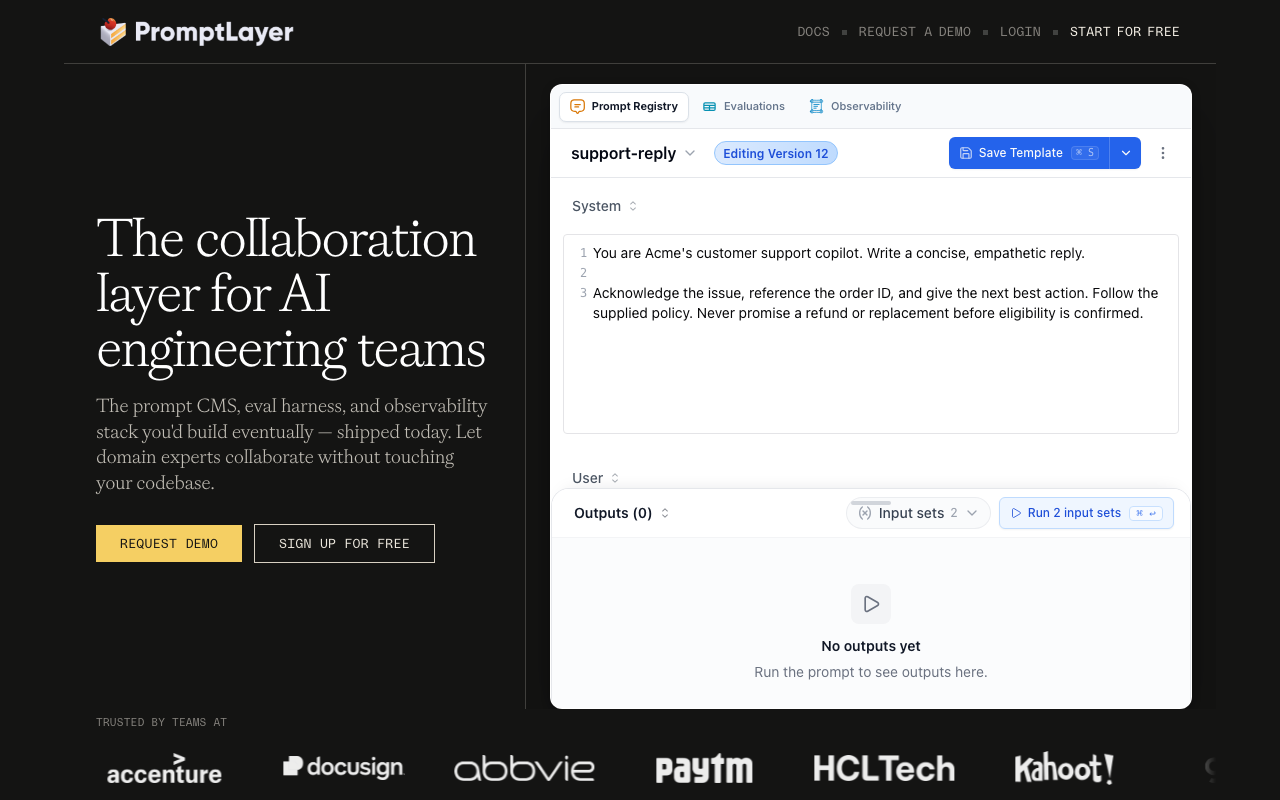
PromptLayer is the most focused product here: prompt registry, versioning, a visual editor, request logging and evaluation, built around the idea that a non-engineer should own the prompt. Its distinguishing feature is a genuinely usable editing and testing surface for people who do not write code, which is the actual requirement behind most prompt-platform purchases even when it is not how the requirement gets phrased.
Pros
- The editing and comparison experience is designed for domain experts rather than engineers, which is what makes non-engineer ownership work in practice rather than in theory
- Prompt registry, version history and release labels are the core product, so pinning and promotion are first-class rather than bolted on
- Logging is tied to the prompt version that produced each request, giving you the attribution link that makes regressions findable
- Evaluation and dataset runs sit next to the registry, so a version can be scored before promotion without a second tool
Cons
- Narrower than the platforms that also do full tracing and agent observability, so it usually sits alongside another tool rather than replacing one
- Commercial and managed; there is no self-hosted build, so prompts and logged payloads live with the vendor
- Because the prompt is fetched from a hosted service, the runtime dependency and fetch design in the previous section is entirely on you to get right
Best for: Product teams where a non-engineer genuinely owns prompt wording day to day and needs an editing and testing surface built for them.
Pricing: Per-seat subscription with usage-based metering on logged requests, and higher tiers for larger teams and retention.
Langfuse
Langfuse bundles prompt management into an open-source observability and evaluation platform, and the combination is what makes it my usual starting recommendation. Prompts are versioned with labels, the client caches locally and can serve stale on failure, traces automatically carry the prompt version that produced them, and datasets and scores live in the same product. Self-hosting means the whole thing can run inside your perimeter.
Pros
- Prompt version is attached to traces automatically, so a quality or cost change is attributable without anyone remembering to correlate two systems
- Labels give you environment-specific resolution and instant rollback by re-pointing a label rather than editing a prompt
- The SDK caches locally and is designed to keep serving on fetch failure, which is exactly the behaviour the hot-path dependency needs
- Open source and self-hostable, so prompts and the payloads they produce stay in your infrastructure
Cons
- The editing surface is engineer-shaped; a non-technical owner will find it less approachable than a purpose-built prompt editor
- Self-hosting the full platform means operating a columnar store and supporting services, which is more than a prompt registry warrants on its own
- Evaluation is present and broad rather than deep, so a team gating releases on nuanced scoring will find eval-first tools more refined
Best for: Engineering-led teams that want prompt versioning, tracing and evaluation in one self-hostable platform with prompt version linked to every trace.
Pricing: Open source with no licence cost when self-hosted, plus managed cloud metered on ingested events with retention tiers and higher tiers for enterprise controls.
LangSmith
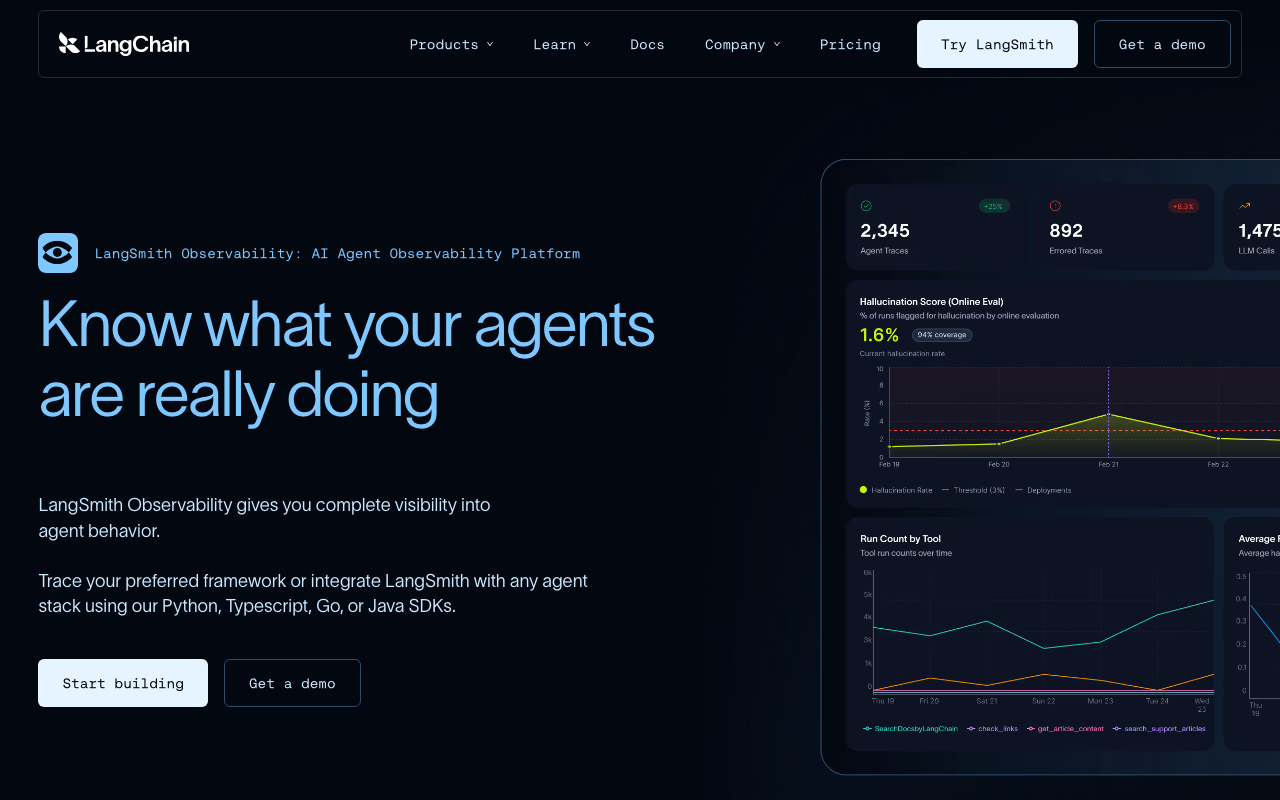
LangSmith is LangChain’s commercial platform, and its prompt features — a hub with versioning, commit-style history, a playground and dataset-backed evaluation — are tightly integrated with the LangChain and LangGraph runtimes. Worth stating plainly: LangChain and LangGraph are open source, LangSmith is not. If your agent is already a LangGraph graph, pulling prompts from LangSmith is close to free effort.
Pros
- Prompt versions, playground, datasets and evaluation are one integrated workflow rather than four integrations
- Commit-style prompt history with tagging maps cleanly onto pinning a version per release
- Deep runtime integration means prompt version, node-level trace and evaluation result line up without wiring
- Annotation queues let a human reviewer feed labelled examples straight into the dataset that gates the next version
Cons
- Not open source, and self-managed deployment is an enterprise arrangement, so prompt content and logged payloads sit with the vendor by default
- Most valuable when you are on LangChain or LangGraph; the benefit thins considerably for a bespoke stack
- Deepens single-vendor dependency across framework, runtime, prompts and evaluation simultaneously, which is worth naming before you build on it
Best for: Teams already building on LangChain or LangGraph who want prompts, traces and evaluation in the same platform as their runtime.
Pricing: Per-seat subscription plus usage-based metering on traces ingested, with an enterprise tier for self-managed deployment.
Braintrust
Braintrust approaches prompts from the evaluation side: a prompt is an object you version, run against a dataset, and compare per-case against the previous version. That ordering is the right one, because it makes the promotion gate the default path rather than an optional add-on. The playground is where the work happens, and the scoring functions you write there are the same ones that run in CI.
Pros
- Prompt versions are evaluated against datasets by default, so “we changed the prompt and did not measure it” is not the easy path
- Per-case comparison between versions surfaces the change that improved the average while breaking three cases you care about
- Scorers are versioned code rather than a fixed menu, so quality metrics can be as domain-specific as your product needs
- The same prompt and scoring definitions run in the playground and in CI, so manual and automated results agree
Cons
- Commercial and managed only, with no self-hosted build, so prompt content lives with the vendor
- The eval-first model requires the team to have opinions about scoring before the tool pays off, and that thinking is the real blocker
- The editing surface is aimed at engineers, so it is a weaker fit where a non-technical owner is meant to hold the pen
Best for: Teams that want every prompt change gated on a scored comparison against a fixed dataset before it reaches production.
Pricing: Usage-based metering on logged spans and evaluation runs with a seat component, and enterprise agreements above that.
Portkey
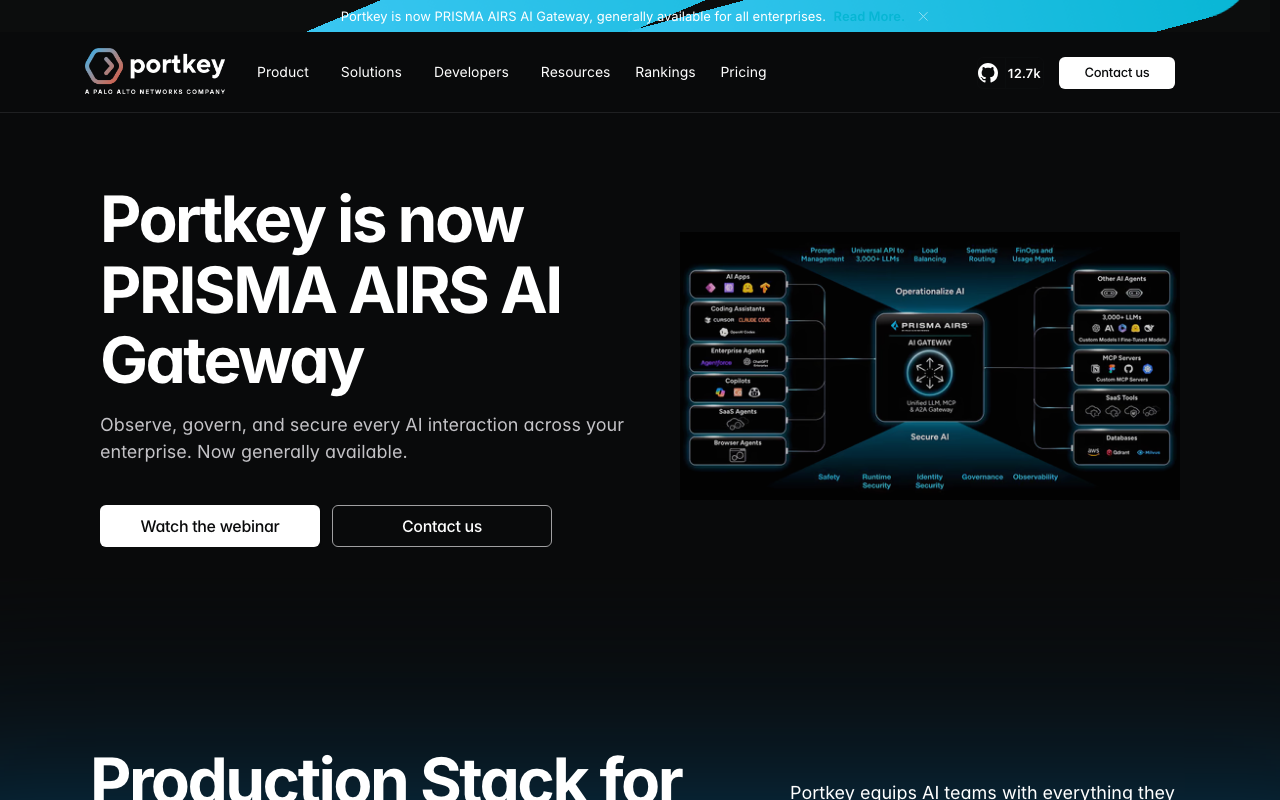
Portkey is now Prisma AIRS AI Gateway, part of Palo Alto Networks, and it holds prompts in a different place from everything else here: in the gateway. A prompt template is a gateway-side artifact, so your application sends variables and a prompt identifier and the gateway assembles the request. That removes the separate prompt fetch entirely, because the prompt lives in a hop you were already making.
Pros
- Prompt resolution happens inside a hop you already have, so there is no additional synchronous dependency on the request path
- Versions, labels and gateway-side rendering mean prompt changes deploy without touching application code at all
- Sits with routing, fallback, caching and budget enforcement, so a prompt version can be bound to a model and a policy as one unit
- Enterprise governance and audit arrive with the product, which matters when a non-engineer can change model instructions
Cons
- The independent-startup framing is gone; this is enterprise software from Palo Alto Networks, with the sales cycle and packaging that implies
- Coupling prompts to the gateway means changing gateway means migrating prompts, which is a heavier lock-in than a prompt registry alone
- Evaluation depth trails the eval-first platforms, so the promotion gate is weaker unless you build it elsewhere
- The gateway becomes a single point of failure for every AI feature, and now for prompt resolution too
Best for: Enterprises already routing all model traffic through a gateway who want prompts, policy and routing governed as one artifact.
Pricing: Enterprise commercial gateway with usage-based metering on requests routed and tiered enterprise agreements rather than a public per-request list price.
HoneyHive

HoneyHive covers prompt management alongside OTel-based tracing, datasets, evaluation and human review, aimed at teams shipping agents. The value proposition is coverage rather than depth in any one area: the prompt version, the trace it produced, the score it received and the human’s judgment on it are one chain, which is the chain the promotion gate needs.
Pros
- Prompt version, trace, evaluation score and human review form a single connected chain rather than four systems you join by hand
- Built on OpenTelemetry, so the tracing half of the story does not lock your instrumentation to this vendor
- Agent-shaped by design, so prompts belonging to different nodes of an agent are managed and evaluated separately rather than as one blob
- Human review is a first-class workflow, which is what turns subjective quality judgments into a dataset
Cons
- Smaller vendor and ecosystem than the leaders, which shows in integration breadth and available community material
- Commercial and managed-first, so a self-hosting requirement narrows your options quickly
- Functional overlap with Langfuse and Braintrust is heavy, so the choice comes down to ergonomics that only a real trial reveals
Best for: Agent-focused teams that want per-node prompt versioning wired to tracing, evaluation and human review from one vendor.
Pricing: Usage-based on traced events and evaluation runs with tiered plans, and enterprise agreements for larger deployments.
W&B Weave
Weave treats prompts as versioned objects in the Weights & Biases artifact model, which is a meaningfully different philosophy: a prompt is a tracked artifact with lineage, like a dataset or a model checkpoint, and an evaluation run references specific versions of all three. For a team that already reasons about reproducibility this way, prompts joining that system is natural rather than a new concept.
Pros
- Prompts are versioned artifacts with lineage, so reproducing a result from three months ago means resolving versions rather than reconstructing them
- Evaluation comparison across versions inherits a decade of experiment-tracking ergonomics, and it shows
- Decorator-based capture means the prompt, the call and the result are linked without framework-specific instrumentation
- One account and one mental model for teams that also fine-tune or serve their own models
Cons
- The artifact model is unfamiliar to product engineers and actively unfriendly to non-technical prompt owners
- Pulls application-level concerns into an ML-research account structure, which is awkward when the platform team owns the tool
- Self-managed deployment is an enterprise arrangement, so prompt content sits with the vendor by default
- Weaker as an operational surface — this is not where you page someone about a bad prompt rollout
Best for: ML-heavy teams already using Weights & Biases who want prompts versioned as artifacts alongside datasets and model checkpoints.
Pricing: Usage-based on traced data volume with retention tiers, layered on existing W&B seat-based plans, with enterprise contracts for self-managed deployment.
DSPy
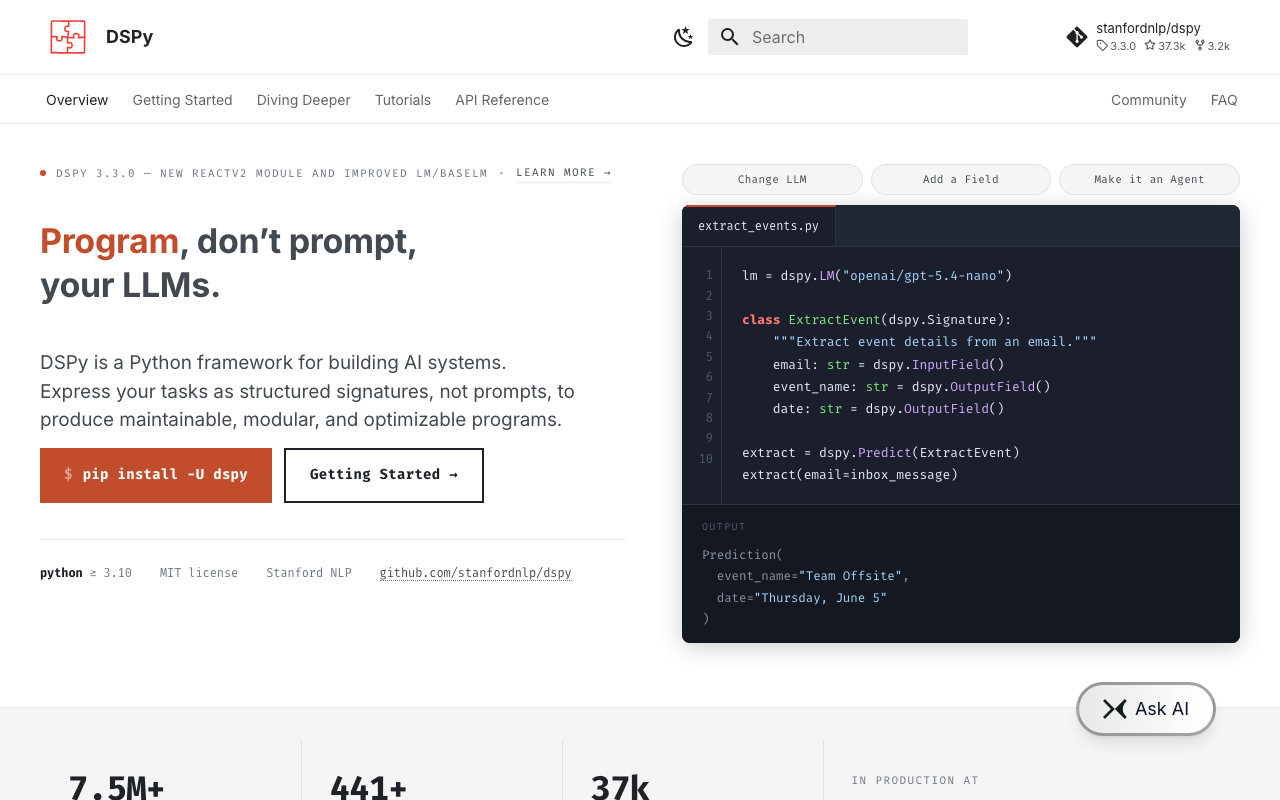
DSPy is the deliberate outlier, and it belongs here because it disagrees with the premise of every other tool on this page. Its position is that hand-managing prompt strings is the wrong abstraction entirely: you declare the signature of a step — inputs, outputs, and a description of the task — and an optimiser compiles the actual prompt, including few-shot demonstrations, from your training examples and a metric. The prompt becomes build output rather than source, so versioning it is a different problem: you version the program, the examples and the metric, and the prompt is regenerated.
Pros
- Removes the class of failure this article is about, because a human editing a prompt string is no longer part of the loop
- Optimisation against a metric on real examples usually beats hand-tuned few-shot selection, and it does so reproducibly rather than by taste
- Swapping the underlying model becomes a recompile against the same examples and metric, instead of re-tuning prompts per model by hand
- Forces you to state a metric and collect examples before you can ship, which is the discipline most teams are missing anyway
Cons
- A programming-model commitment, not a tool you add: adopting it means restructuring how your LLM code is written, and it is not incremental
- The compiled prompts are machine-generated and often long, which makes them hard for a human to review and unfriendly to inspect during an incident
- No non-engineer path at all — the whole point is that humans do not edit prompts, which kills the main reason many teams want a prompt platform
- Optimisation runs cost real compute and real time, and the metric you optimise against becomes a load-bearing artifact that can be quietly wrong
Best for: Engineering teams with a measurable task metric and a labelled example set who would rather compile prompts than curate them, and who have nobody demanding a text box.
Pricing: Open source with no licence cost; you pay in compute for the optimisation runs and in the learning curve.
How to choose
Answer three questions in order. The first one eliminates most of the list.
Who actually edits prompts? If the honest answer is “engineers”, keep prompts in the repository and buy an evaluation platform instead. You will get the safety you already have plus the measurement you are missing, and you will avoid adding a runtime dependency for a benefit you were not going to use. If the answer is a non-engineer who genuinely owns the wording, you need a platform, and the editing surface matters more than any other feature — which points at PromptLayer, or at LangSmith and Braintrust if the editor is technical enough.
Is the promotion gate going to exist? If you will not build one, do not adopt a platform. Unreviewed prompt changes reaching production instantly is worse than a slow deploy pipeline, and the tool will make it fast. If you will, choose from the platforms where evaluation and prompts are the same product — Braintrust and Langfuse are the clearest, HoneyHive and LangSmith close behind.
Where does the prompt get resolved? Runtime fetch with a local cache and a repository fallback is the common answer. Build-time fetch baked into the artifact is the safer one, and I would default to it for anything with real traffic. Gateway-side rendering is the third option and the reason Portkey is on this list — it removes the extra dependency by folding prompt resolution into a hop you already make.
| Tool | Prompt lives | Non-engineer editing | Evaluation gate | Self-hostable |
|---|---|---|---|---|
| PromptLayer | Hosted registry | Designed for it | Present | No |
| Langfuse | Hosted or self-hosted registry | Engineer-shaped | Broad | Yes |
| LangSmith | Hosted hub | Workable if technical | Integrated | Enterprise only |
| Braintrust | Hosted, eval-first | Engineer-shaped | Default path | No |
| Portkey | In the gateway | Workable | Thin | Enterprise gateway |
| HoneyHive | Hosted platform | Workable | Integrated | Enterprise only |
| W&B Weave | Versioned artifact | Not really | Strong comparison | Enterprise only |
| DSPy | Compiled from examples | Not by design | Required by design | Yes, it is a library |
| Repository (no platform) | Your codebase | No | Whatever CI you build | Yes |
The last row is there on purpose. For a small engineering-only team, prompts in the repository plus an evaluation harness in CI is a completely defensible answer, and it is the one I would pick over a platform nobody outside engineering will log into.
Frequently asked questions
Should prompts live in git or in a platform?
In git if engineers are the only editors, because you get review, diffs and atomic rollback with the code that parses the output, and you give up only deploy latency. In a platform if a non-engineer owns the wording, because the deploy bottleneck otherwise stops prompt iteration entirely. The hybrid most mature teams reach is authoring in the platform with a pinned version per release and an evaluation gate on promotion.
What happens if the prompt service is down?
Whatever you designed, which for most teams means “nobody knows”. Serve from a local cache populated at startup, fall back to a prompt bundled in the repository, and never let a background refresh failure fail a user request. Then verify it by blocking the endpoint in staging under load, including on a cold instance where nothing is cached yet.
How do I stop a prompt edit from breaking my output parsing?
Make the contract testable and gate on it. A fixed dataset with deterministic scorers — does it parse, are the required fields present, is the label in the permitted set — run automatically on every new version, with promotion blocked on failure. This catches the common case cheaply, before any model-graded scoring enters the picture.
Is DSPy a replacement for a prompt platform?
For the prompt-editing problem, yes, by removing it: prompts become compiled output from examples and a metric rather than text a human maintains. It is not a replacement for tracing, logging or cost attribution, and it explicitly does not give a non-engineer a text box. Adopting it is a change to how your LLM code is structured, not a tool you add next to what you have.
Related reading
- Best LLM evaluation tools — the scoring layer that makes prompt promotion safe.
- Best LLM observability tools — where the prompt version needs to appear on every trace.
- Best AI gateways — gateway-side prompt rendering and why it removes the extra fetch.
- Best LLM cost tracking and FinOps tools — why a longer system message is a pricing change.
- Best AI agent frameworks — where per-node prompts multiply the management problem.