The requirement almost never arrives as a plan. It arrives as a line in a procurement email from a prospect who is ready to sign, asking for your SOC 2 report before legal will look at the contract. Somebody forwards it to engineering. Engineering has never seen one. Within a day the team is on a demo call with a compliance automation vendor who is happy to explain that you can be audit ready quickly.
What that call usually does not make clear is that you are buying two different things from two different suppliers. The platform is software: it connects to your cloud accounts and your identity provider, watches configuration, stores policies, and collects evidence. The report is an attestation produced by a licensed accounting firm, which is a separate engagement with a separate contract and a separate bill. No amount of green checkmarks in the platform produces a report. An auditor produces the report.
That split is the single most useful thing to understand before you spend money, because it tells you what you are actually optimising. The platform’s job is to make the auditor’s evidence requests cheap to satisfy, repeatedly, for years. Everything else in the category is marketing around that one function.
The second most useful thing to understand is that the controls are yours. SOC 2 does not hand you a checklist of technical requirements. It hands you criteria, you describe the controls you operate against those criteria, and the auditor tests whether you actually operate them. A platform that ships a default control set is giving you a starting draft, not a specification.
Key takeaways
- The platform and the audit are two purchases. The platform collects evidence continuously; a licensed firm performs the examination and issues the report. Neither replaces the other.
- Type I is a point in time, Type II covers a window. Enterprise buyers increasingly want Type II, and a Type II window cannot be compressed by buying software faster.
- Integration coverage for your specific stack decides how much work remains. Every system the platform cannot reach becomes a manual evidence task repeated at every audit.
- Controls are yours to define and operate. The platform monitors what you tell it to monitor and cannot make an untrue statement true.
SOC 2: the framework underneath, not a product
SOC 2 is an attestation standard maintained by the AICPA. A service organisation describes the controls it operates, an independent licensed CPA firm examines those controls, and the firm issues a report containing its opinion. The report is the deliverable. It is not a certificate, there is no logo you earn by passing, and there is no central registry of who holds one.
The criteria come from the Trust Services Criteria, organised into five categories. Security is always in scope and is the one everybody means when they say SOC 2. Availability, Confidentiality, Processing Integrity and Privacy are optional and you choose which of them to include. Most first reports cover Security alone, sometimes Security plus Availability and Confidentiality because a customer asked.
Scope is also yours. You define the system being examined: which product, which environments, which supporting infrastructure, which subservice organisations. A narrow, honestly drawn scope produces a report faster than a broad one, and a scope that excludes something your customer cares about produces an argument later.
Type I examines whether your controls are suitably designed as of a specific date. The auditor looks at the design of the control and whether it was in place on that day. It does not test whether the control worked over time, because there is no time period involved.
Type II examines whether those controls operated effectively across an observation window. The auditor samples evidence from throughout that window. If your access review control says reviews happen quarterly, the auditor wants to see the reviews that happened during the window, with dates, with the person who performed them, with what changed as a result.
That distinction is the one that breaks schedules. Type I can be reached relatively quickly because it is a snapshot. Type II requires the window to elapse with the controls actually running, and no software shortens elapsed time. A team that starts the week the procurement email arrives and needs Type II is going to have a conversation with the prospect about a bridge letter and a Type I in the interim.
What the auditor does, concretely: agrees scope and criteria with you, reviews your system description, requests evidence samples, interviews the people who operate the controls, tests a selection of items against each control, writes up exceptions where evidence does not support the control, and issues an opinion. An opinion can be unqualified, qualified, adverse or a disclaimer. Exceptions in a report are not fatal and are more common than founders expect, but they are visible to every customer who reads it.
What it gives you
- A structured, independently examined answer to the security questionnaire, which removes the per-deal custom evidence exercise that otherwise consumes engineering time
- A defined set of criteria to build a security programme against, which is more useful than an unprioritised backlog of good ideas
- An annual forcing function, because the report expires and the next window starts, so practices that would decay get exercised every year
- Portability across customers, since one report answers the same question for every prospect instead of a bespoke response each time
- A reason the organisation will fund work that engineering already wanted, such as access reviews, logging retention and offboarding automation
What it does not do
- Prove you are secure. It attests that the controls you described were designed appropriately and, for Type II, operated during the window. A weak control operated faithfully passes
- Specify technical requirements. There is no SOC 2 requirement for a particular encryption algorithm, password length or scanner. You choose the controls and the auditor tests those
- Replace penetration testing, though most auditors expect to see evidence of one. That is a separate engagement covered in penetration testing services
- Cover your subprocessors. Their controls are their own reports, and your control is vendor management, meaning you collected and reviewed those reports
- Transfer to a different framework automatically. ISO 27001 overlaps substantially but is a certification with a different structure, a different body and its own audit cycle
- Get shorter because you bought software. The Type II window is elapsed time and nothing sells a way around it
In a comparison table, SOC 2 belongs on a row of its own labelled as a framework, because it is the thing the products are pointed at rather than one of the products.
What the platform actually automates
Strip away the positioning and there are five jobs a compliance platform does. Evaluating vendors is easier when you rate them on these rather than on the size of the integration list.
Continuous configuration monitoring. The platform connects to AWS, GCP, Azure, your identity provider, your repository host and your endpoint management, and checks a set of assertions on a schedule. Public storage buckets, root account MFA, disk encryption, branch protection, screen lock on laptops. When an assertion fails, a test goes red. This is the closest thing in the category to real security value, and it overlaps heavily with cloud security posture management, which does the same thing with more depth and no compliance framing.
Evidence collection and retention. Every passing check is stored with a timestamp so that when the auditor samples a date inside the window, there is an artefact. This is the function that actually matters for Type II, and it is the one that is hard to replicate with a folder of screenshots, because screenshots are taken when someone remembers rather than continuously.
Personnel workflows. Security awareness training assigned and completed, policy acceptance recorded per employee, background check status, onboarding and offboarding checklists. Unglamorous, and a large share of the evidence an auditor samples. This is also where the platform needs a clean feed from your HR system, because an employee list that is wrong makes every personnel control untestable.
Policy management. Templates for the dozen or so policies an auditor expects, versioned, with acknowledgement tracking. The templates are a genuine time saver for a first audit and a genuine liability if you adopt them unread, because the auditor will test you against what your own policy says. A policy claiming quarterly access reviews you do not perform is worse than no policy.
Vendor and risk management. A register of subprocessors with their reports attached, a risk assessment, and a review cadence. Mostly a structured place to keep things, which is fine, because structured places to keep things are exactly what fails without tooling.
What stays manual, in every platform, for every team: writing the system description, defining and owning the controls, performing the access reviews themselves, running the risk assessment conversation, remediating whatever the monitoring finds, and answering the auditor’s questions. The platform reduces the evidence gathering. It does not reduce the operating.
Needs first-hand data: Before you sign, ask each vendor to list which of their automated tests map to controls you will actually claim, then count how many of your intended controls have no automated test behind them. That residual count, not the vendor’s total test count, is the manual work you are keeping. Record it per vendor and compare.
Integration coverage for your actual stack
Integration lists are the most misleading artefact in this category. A list of two hundred integrations is irrelevant if the four systems that carry your evidence are not on it, and a list of forty is sufficient if they are.
Do this instead. Write down the systems that hold evidence for the controls you intend to claim. For most SaaS teams that is a cloud provider, an identity provider, a source host, a CI system, a ticket tracker, an HR system, an endpoint manager and a password manager. Then check each candidate platform against that specific list, including the depth of each connection rather than its presence.
Depth matters more than presence. An integration that reads your cloud account and evaluates thirty configuration assertions is a different thing from one that confirms the account exists. Ask what each connector actually collects.
Four gaps recur.
Self-hosted and on-premises infrastructure. Platforms are built around API-reachable SaaS and public cloud. If a meaningful part of your production runs on machines you own, or in a colocation facility, or on a cloud the vendor has not prioritised, the evidence for that part is manual. This is the most common cause of a team feeling misled after purchase.
Non-standard CI and deployment. Change management is a control every auditor tests, and the evidence is that changes were reviewed and approved before reaching production. If your pipeline is unusual, or you deploy from a mix of systems, or approvals live somewhere other than the pull request, expect to build that evidence path yourself. The shape of that evidence is easier if your CI/CD platform already records approvals as first-class events.
HR systems outside the common set. Personnel evidence depends on an accurate roster with start and end dates. A payroll system or employer of record the platform does not integrate with means maintaining that roster by hand, and a stale roster silently breaks onboarding, offboarding and training controls at once.
Anything your customers care about that is not in the platform’s model. Customer-facing audit logs, data retention enforcement, deletion workflows. These get claimed as controls, and the evidence is your own product telemetry, which no compliance platform reads. Building that evidence path is covered in audit logging for SaaS products.
For every gap, the platform offers a manual evidence upload: you attach a file, tag it to a control, and set a reminder. That mechanism works. It is just a recurring task that someone has to perform on schedule, forever, and its cost belongs in your evaluation rather than in the footnotes.
Auditor relationships and why they are part of the product
Every platform in this category has a relationship with audit firms, and the models differ in ways that affect both price and independence.
Marketplace. The platform maintains a list of firms familiar with its evidence export, you contract directly with one, and the platform’s role ends at handing over evidence. Most vendors work this way. You get choice and the price is negotiated with the firm.
Bundled. The platform sells the audit alongside the subscription as one commercial arrangement, with a partner firm delivering the examination. Fewer moving parts, one contract, and less visibility into what the audit portion costs on its own.
Integrated firm. Some vendors include an audit practice within the same group. This is the most convenient and the one that deserves the most scrutiny, because independence is the entire value of an attestation. Ask directly how the examination team is separated from the software business, and expect a clear answer.
What to ask any firm, regardless of how you find them: how many companies of your shape and size they audit, whether the people doing the testing are the people on the sales call, how they handle evidence delivered through your platform, what their exception threshold looks like, and how long after fieldwork ends the report is issued. That last one catches teams out, because the report arrives after the window closes and after fieldwork, and prospects are waiting.
One more consideration. The auditor is a multi-year relationship. Changing firms means re-explaining your architecture and re-agreeing scope, and a new firm may test controls the previous one accepted differently. Pick as if you are staying.
The cost shape, without the numbers
Nobody publishes real totals here and I am not going to invent any. What is useful is the shape: which meters exist, which of them grow, and which are one-off.
Platform subscription. Annual, almost always. The meter is usually a combination of headcount band and the number of frameworks in scope. Adding ISO 27001 or HIPAA alongside SOC 2 is a line item, not a free extra. Discounts for multi-year commitments are standard and so is a steep rise at renewal once you are dependent, which is worth negotiating before the first signature rather than after.
The audit engagement. Separate, per report, per year. Scope drives it: more Trust Services Criteria, more systems, more locations, higher fee. A Type II generally costs more than a Type I because the testing is broader.
Penetration test. Annual, separate vendor, scoped by application surface. Auditors expect evidence of testing even though no criterion names it.
Security awareness training. Often bundled into the platform, sometimes a separate per-seat subscription.
Background checks. Per hire, through a separate provider, usually integrated.
Staff time. The largest cost and the one nobody budgets. Someone owns the programme. In a small company that is a founder or a senior engineer, and the work is concentrated in bursts around readiness and fieldwork rather than spread evenly.
Remediation. Whatever the monitoring finds that you have to fix. Enabling encryption everywhere, buying a logging tier with longer retention, adding an endpoint management tool, replacing a subprocessor. This is genuinely unpredictable before you connect the platform and see what goes red.
The renewal shape matters as much as the first year. SOC 2 is annual and continuous, so this is a recurring cost with a recurring time commitment, not a project with an end date. Teams that budget it as a project are surprised eleven months later.
Needs first-hand data: After your first audit completes, record the total hours your team spent, broken down by readiness, evidence collection during the window, and auditor fieldwork. Repeat the measurement in year two. The delta is the only honest measure of whether the platform is earning its subscription, and it is the number the vendor cannot give you.
Vanta
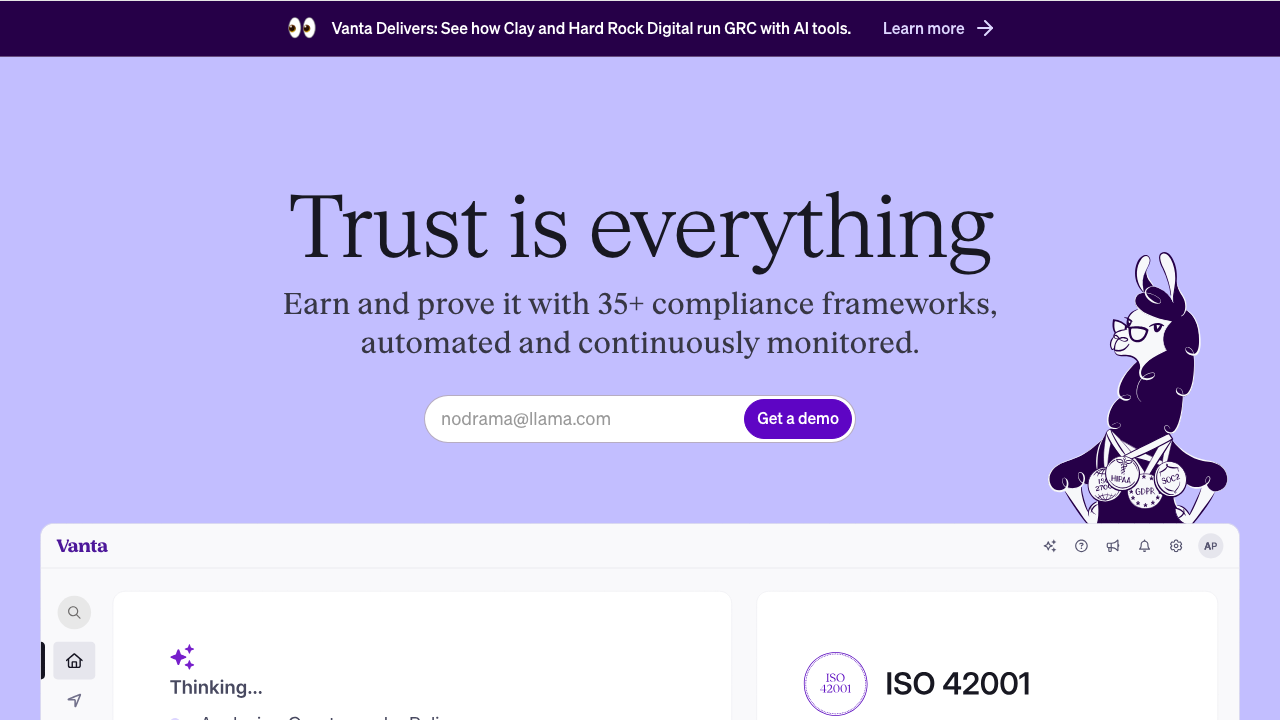
Vanta defined this category and is still the default answer when a founder asks a peer what to buy. It connects to your infrastructure and identity systems, runs continuous tests against a control set, packages policies and training, and hands evidence to an auditor from its partner network. The product is polished and the onboarding is genuinely well designed for a team that has never done this before.
Pros
- The most mature onboarding flow in the category, which matters when the person driving the project has no compliance background and a deadline
- Very broad integration coverage across common SaaS, cloud and identity systems, so most standard stacks connect without custom work
- Large auditor network and a Trust Center product that answers prospect security questions without a human, which removes real sales friction
- Strong ecosystem familiarity, so auditors, investors and prospects recognise the evidence format and ask fewer questions about it
Cons
- Priced at the top of the category, and the gap widens at renewal once your evidence history lives inside it
- The default control set is generous, and accepting it unedited commits you to operating controls you may not need, each of which is testable
- Depth of security checking is shallower than a dedicated posture management tool, so it tells you a bucket is public without the context to prioritise it
- Coverage thins for self-hosted infrastructure and less common platforms, which pushes evidence back to manual upload
Best for: Teams facing their first SOC 2 under deal pressure who want the least ambiguous path and are prepared to pay a premium for it.
Pricing: Annual subscription banded by headcount with each additional framework priced as a separate module. The audit is contracted separately with a firm you choose.
Drata
Drata is Vanta’s closest competitor and competes on automation depth and on the control-mapping layer. Its strongest claim is cross-framework mapping: one piece of evidence satisfying the corresponding controls in SOC 2, ISO 27001 and others simultaneously, which is the argument that matters once you are heading for a second framework rather than a first.
Pros
- Cross-framework control mapping is well executed, so adding ISO 27001 later reuses evidence instead of restarting collection
- Granular control over test configuration, including custom tests and adjusted thresholds, which suits teams who want their controls to describe reality rather than a template
- Detailed personnel automation covering training, policy acceptance and offboarding, which is where most of the sampled evidence comes from
- Audit hub workflow gives the auditor direct access, reducing the export-and-email cycle during fieldwork
Cons
- More configuration surface than Vanta, which is the point but also means a slower start for a team that just wants defaults
- Priced comparably at the top of the category, so it is not the answer to a budget problem
- Heavier product with more concepts to learn, and an under-resourced owner will use a fraction of it
- Same structural limit as the rest on infrastructure it cannot reach by API
Best for: Teams who know they need more than one framework, or who want their control definitions tuned rather than inherited.
Pricing: Annual subscription scaled by headcount with per-framework modules, sold with multi-year commitments. Audit fees are separate.
Secureframe
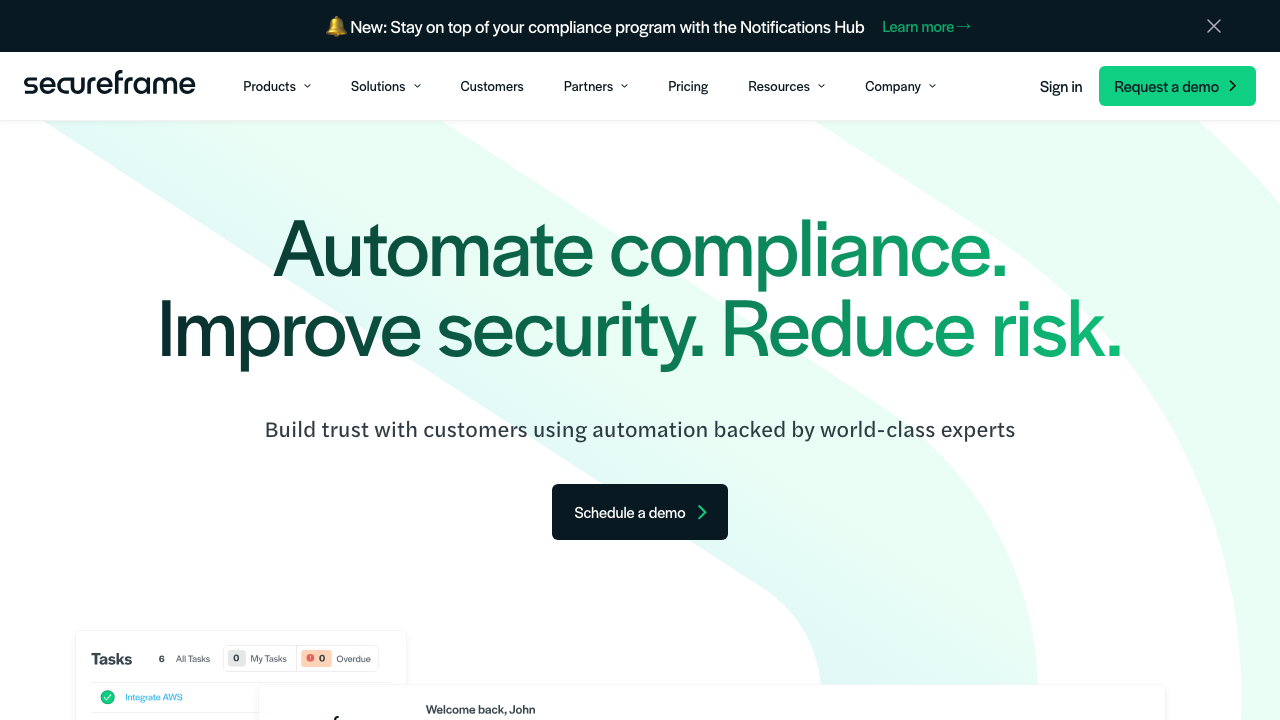
Secureframe sits in the same tier and differentiates on guided service: a named person helping you through readiness rather than a documentation portal. For a team with no internal compliance capacity, that guidance is often the deciding factor, because the hard part of a first audit is not knowing what good looks like.
Pros
- Guided onboarding with human support included rather than sold as a premium tier, which compresses the time a first-timer spends confused
- Broad framework coverage, so the platform does not need replacing when the requirement expands beyond SOC 2
- Clean policy and training workflows with acceptance tracking, covering the personnel evidence auditors sample most
- Positioned slightly below the two market leaders on price while covering the same core function
Cons
- Less brand recognition than Vanta or Drata, which occasionally prompts a question from a prospect rather than none
- Automation depth on unusual infrastructure is comparable to peers, meaning the same manual residue
- Product surface is broad rather than deep, and specialists beat it on any individual capability
- Guided service quality depends on the person assigned, which is difficult to evaluate before signing
Best for: First-time teams with no compliance experience in house who want a named human walking them through readiness.
Pricing: Annual subscription by headcount and framework count, with implementation support included rather than billed separately.
Sprinto
Sprinto targets cloud-native companies and builds its automation around that assumption rather than trying to cover every possible environment. The result is a tighter product with a narrower target, and for teams whose entire stack is managed SaaS and public cloud it removes more manual work than a more general tool.
Pros
- Built for fully cloud-native stacks, so the automated checks map closely to what such teams actually run
- Priced below the market leaders, which is the practical reason many small teams shortlist it
- Strong async evidence workflows that push tasks to the responsible person rather than to a central dashboard nobody opens
- Fast time to a working configuration when your stack matches its assumptions
Cons
- The cloud-native assumption is load-bearing, and hybrid or self-hosted infrastructure fits poorly
- Smaller auditor network in some regions, which narrows your choice of firm
- Less recognised by enterprise procurement teams, though this matters less than founders fear since the report comes from the auditor
- Fewer configuration escape hatches when your control needs to differ from the template
Best for: Small cloud-native SaaS teams who want the standard path at a lower price and have nothing unusual in their infrastructure.
Pricing: Annual subscription banded by headcount, generally positioned below the category leaders, with frameworks added as modules.
Oneleet
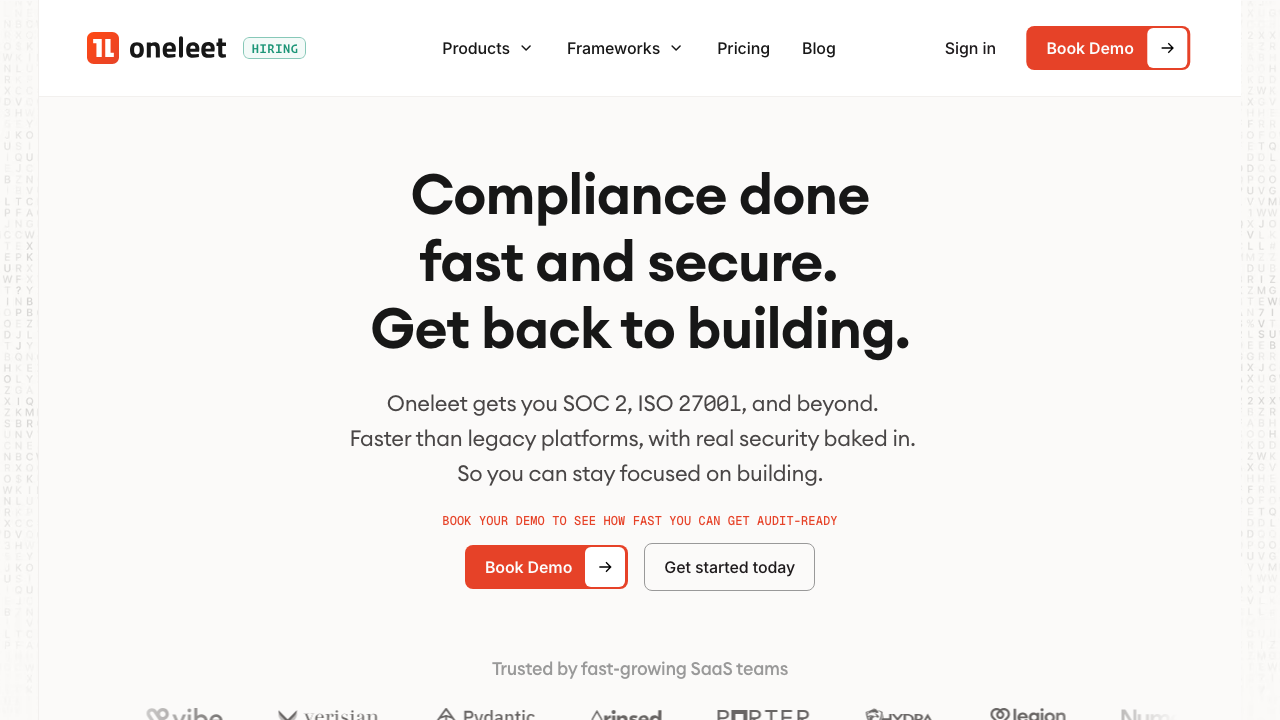
Oneleet takes a deliberately different position: it argues that the compliance platform market optimises for passing audits rather than being secure, and bundles genuine security work such as penetration testing and code review alongside the evidence automation. Whether that framing is marketing or substance depends on how much of the security work you were going to buy anyway.
Pros
- Bundles penetration testing with the platform, which consolidates two purchases you were making separately and removes a vendor from the cycle
- Security-first framing produces findings that are useful independently of the audit, rather than tests that exist only to satisfy a criterion
- Newer product with a cleaner, less bloated surface than incumbents who have accumulated a decade of features
- Attractive to technical founders who resent paying for checkbox compliance and want the money to buy something real
Cons
- Smaller vendor with less operating history, which is a live consideration for a system holding years of audit evidence
- Bundled penetration testing is a different proposition from a specialist firm and may not satisfy an enterprise customer who asks who performed it
- Narrower integration catalogue than the established platforms, so check your specific stack carefully
- Less procurement familiarity, meaning more explaining during enterprise diligence
Best for: Technical teams who want the audit and a real penetration test from one vendor and are comfortable with a younger supplier.
Pricing: Annual subscription with security services bundled into the package rather than sold as separate engagements.
Thoropass
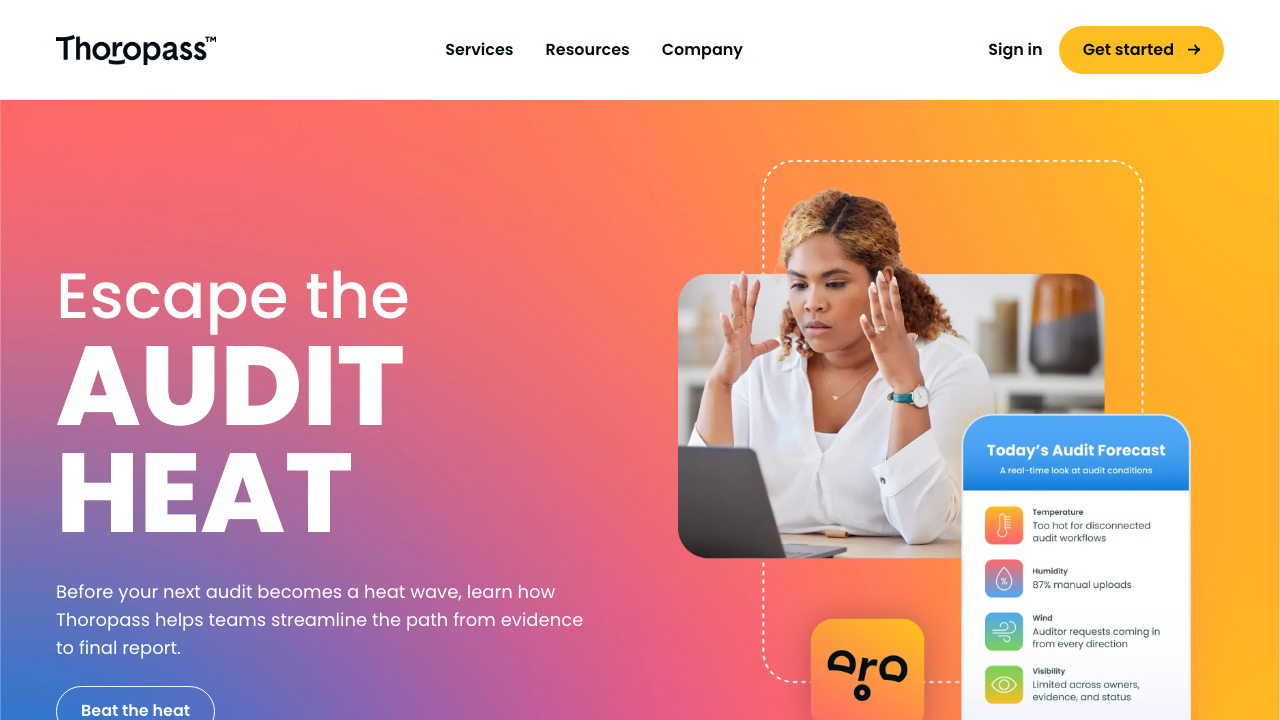
Thoropass combines the software with an in-house audit practice, selling the platform and the examination as a single path. The integration is real and the convenience is real. So is the question about independence, which you should ask directly rather than assume is handled.
Pros
- Platform and audit in one engagement removes the coordination overhead and the evidence-format negotiation between two vendors
- Auditors see evidence in the system continuously rather than at fieldwork, which surfaces problems earlier in the window
- Multi-framework coverage with the same combined model, so a second framework does not mean finding a second firm
- Predictable commercial shape, since the audit is not a separate negotiation each year
Cons
- Independence of the examination deserves direct scrutiny when the software and the audit come from the same group, and you should ask how the teams are separated
- Bundling makes it harder to see what the audit actually costs, which weakens your position at renewal
- Switching away means replacing both the platform and the audit relationship at once, which is a larger migration than either alone
- Product polish on the software side is behind the platform-only leaders
Best for: Teams who want one vendor accountable for both halves and value coordination over the ability to shop each half separately.
Pricing: Combined annual pricing covering the platform and the audit engagement, scaled by headcount and by the frameworks in scope.
Scytale
Scytale offers compliance automation with a strong emphasis on assigned compliance expertise, and has notable traction outside North America. For teams whose auditors, customers and regulators sit in several regions at once, that geographic spread is a practical advantage rather than a marketing point.
Pros
- Assigned compliance expert included, giving a first-time team someone to ask rather than a knowledge base
- Broad framework coverage including regional regimes beyond the North American default set
- Reasonable pricing for smaller teams relative to the category leaders
- Useful when your customer base spans regions and you need more than SOC 2 to answer procurement
Cons
- Smaller integration catalogue than the leaders, so verify your specific systems rather than trusting the category
- Less recognised in North American enterprise procurement than the incumbents
- Automation depth on cloud configuration is behind dedicated posture tooling, as with every platform here
- Company is smaller, so diligence on longevity is warranted for a multi-year evidence store
Best for: Smaller teams with a multi-region customer base who need several frameworks and want an assigned expert included.
Pricing: Annual subscription by headcount and framework, positioned for smaller companies, with audit contracted separately.
How to choose
Answer four questions in order and the shortlist collapses quickly.
Do you need Type I or Type II, and by when? If the customer will accept Type I now with Type II to follow, you have room to choose carefully. If they want Type II and the window has not started, the platform choice is less urgent than starting the window, and every week spent evaluating is a week not counted.
Is your infrastructure inside the assumptions? Fully managed SaaS and public cloud means most of these work and price becomes the differentiator. Self-hosted, hybrid or unusual platforms means integration depth becomes the differentiator and you should demand a specific answer per system rather than an integration count.
Is SOC 2 the whole requirement or the first of several? If ISO 27001, HIPAA or a regional framework is coming, weight the control-mapping quality heavily, because re-collecting evidence for a second framework is the cost you are trying to avoid.
Who owns this internally? A dedicated owner can operate a configurable platform and get more from it. A founder doing this in the gaps between everything else should buy the most opinionated defaults available and accept the constraints that come with them.
| Tool | Audit relationship | Distinguishing property | Meter | Picks itself when |
|---|---|---|---|---|
| Vanta | Partner marketplace | Category default, broadest recognition | Headcount band plus frameworks | First audit, deal pressure, budget available |
| Drata | Partner marketplace | Cross-framework control mapping | Headcount band plus frameworks | More than one framework is certain |
| Secureframe | Partner marketplace | Guided human onboarding included | Headcount band plus frameworks | No compliance experience in house |
| Sprinto | Partner network | Built around cloud-native stacks | Headcount band | Stack is entirely managed cloud and SaaS |
| Oneleet | Partner, with security services bundled | Penetration testing in the package | Bundled annual package | You want real security work, not just evidence |
| Thoropass | In-house audit practice | Platform and audit as one engagement | Combined annual pricing | You want one vendor accountable for both |
| Scytale | Partner network | Assigned expert, multi-region frameworks | Headcount band plus frameworks | Regional frameworks and a small team |
| SOC 2 (framework, not a product) | The examination itself | Criteria you map controls to | None | Never a choice, it is what the customer asked for |
Needs first-hand data: Run the same evaluation stack against your two finalists in a trial: connect your real cloud account and identity provider, and count how many of their automated tests actually returned a result versus how many required a manual upload. That ratio, measured on your infrastructure rather than described on a pricing page, is the only comparison that predicts your ongoing workload.
Frequently asked questions
Can I get SOC 2 without buying a compliance platform?
Yes, and small teams do. The controls, the policies and the evidence are all things you can maintain yourself with a document store, a calendar and discipline. What you lose is continuous evidence capture, which is precisely what Type II testing samples, so the manual version means someone taking and filing artefacts on a schedule for the length of the window. That works and it is tedious, and it fails when the person doing it gets busy. The honest calculation is whether a year of that discipline costs more than the subscription. Vanta alternatives covers the do-it-yourself path in more detail.
Does a compliance platform make my product more secure?
Marginally, and not in the way the marketing implies. The configuration monitoring genuinely catches real problems such as public storage, missing MFA and unencrypted disks, and fixing those is a real improvement. But the checks are shallow by design, because they are built to map to criteria rather than to find attack paths. If security is the goal rather than the report, the money is better spent on the tools in best application security tools, with the compliance platform doing the evidence job it is actually good at.
How much of the work does the platform actually remove?
The collection and retention of evidence, which is the largest repetitive piece, plus policy templates and training administration. What remains is defining the controls, operating them, remediating findings, writing the system description, and answering the auditor. In year one the platform removes less than you hope because everything is new. In year two it removes a lot, because the window runs itself while you work on the product. That second-year effect is the actual return, which is why evaluating after one audit is misleading.
What happens if the auditor finds an exception?
An exception means the evidence did not support the control for some sampled items. It appears in the report with management’s response. This is more common than founders expect and not automatically disqualifying, since most enterprise reviewers read exceptions for severity and pattern rather than treating any exception as failure. What damages you is a pattern of exceptions across related controls, because it reads as a programme that exists on paper. Fix the underlying process before the next window rather than arguing about the sample.
Do I need ISO 27001 as well?
It depends entirely on where your customers are. SOC 2 dominates North American enterprise procurement, ISO 27001 is more often asked for in Europe and Asia, and plenty of companies eventually hold both. The overlap in underlying controls is substantial, which is why control mapping is worth weighting in your platform choice. Do not buy both speculatively. Wait until a real deal asks, then use the mapping you already have.
Related reading
- Best application security tools — the security work that sits underneath the evidence, and what an auditor expects to see running.
- Vanta alternatives — the same category examined through price, framework breadth and remaining manual work.
- Best cloud security posture management tools — the deeper version of the configuration monitoring a compliance platform does shallowly.
- Best penetration testing services for SaaS — the separate engagement almost every auditor expects evidence of.
- Best audit logging tools for SaaS products — the customer-facing evidence trail that no compliance platform can produce for you.
- Best security tools for small engineering teams — what to run when compliance is one of several things nobody owns full time.