Two conversations produce this search, and they want different answers.
The first happens before anything is bought. A five-person company has a prospect asking for a SOC 2 report, gets a quote from Vanta, and discovers that the annual subscription is a noticeable fraction of what the deal is worth. The question is not whether Vanta is good. It is whether the category leader’s price is justified when the entire security programme is three people and a cloud account.
The second happens at renewal, usually in year two or three. The platform worked, the report arrived, and now the invoice has grown while the framework requirement has also grown, because a European customer wants ISO 27001 and a healthcare prospect has said HIPAA. The question now is whether the mapping between frameworks in the current tool is good enough to justify staying, or whether the evidence should be re-collected somewhere cheaper.
Both questions come down to the same three variables: what the meter is at your headcount, how many frameworks you will genuinely need, and how much manual work each option leaves behind after the automation runs. Everything else in this category is interface differences, and interface differences do not justify a migration.
Worth saying plainly before the list: Vanta is a good product. It defined the category, the onboarding is the most forgiving in the market, and auditors, investors and enterprise procurement all recognise it. Leaving it should be a decision about price or fit, not a belief that something on this page is better at the core job.
Key takeaways
- The meter in this category is a headcount band multiplied by framework count. At small headcount the bands are coarse, which is why the price feels disproportionate to a tiny team.
- Framework breadth matters less than framework mapping. Reusing one piece of evidence across SOC 2 and ISO 27001 is the capability that decides your second-year cost.
- Every platform leaves manual work. The amount depends on how much of your stack is reachable by API, not on the vendor.
- A spreadsheet, a document store and a good auditor is a real option for a small team with disciplined people, and it is the honest baseline the paid options should beat.
What you are actually replacing
Before comparing, be precise about what Vanta does, because different alternatives replace different parts and a cheaper tool that drops the part you needed is not cheaper.
Continuous configuration monitoring. Connectors into your cloud, identity provider, source host and endpoint management, evaluating assertions on a schedule and recording the result with a timestamp. Every alternative here does this. Coverage and depth vary by connector, which is where the real differences live.
Timestamped evidence retention. The artefacts an auditor samples during a Type II window. This is the function that is genuinely hard to replicate by hand, because the evidence has to exist for dates throughout the window rather than the day someone remembered.
Policy templates and acknowledgement tracking. A set of policies an auditor expects, versioned, with per-employee acceptance recorded. Templates save real time on a first audit. They also become your obligations, so adopting them unread is how teams end up testing against a control they never operate.
Personnel workflows. Security training assignment and completion, background check status, onboarding and offboarding checklists. A disproportionate share of sampled evidence comes from here.
Trust Center. A public page answering prospect security questions without a human. This is a sales tool rather than a compliance one, and it is worth more than teams expect, because it deflects the questionnaire that otherwise lands on an engineer.
Auditor network. A set of firms that already know what the evidence export looks like. Useful, and not unique to any vendor.
If you migrate, the evidence history from the window you already completed does not move cleanly. Plan the switch for the start of a window rather than the middle of one, or you will run two systems while the old window finishes. The SOC 2 platform comparison covers what the framework itself requires, which is the fixed part underneath all of this.
Pricing at small headcount
No numbers here, because I am not going to publish a quote that changes quarterly. The shape is what you can act on.
The base meter is a headcount band. Not seats in the tool, total employees and usually contractors. The bands are wide at the bottom, which is why a five-person and a fifteen-person company frequently land in the same band and the five-person company feels it. This is also why headcount growth produces a step change at renewal rather than a gradual increase.
Frameworks multiply. Each additional framework is a module with its own line, not a free addition. A team that signs for SOC 2 and adds ISO 27001 next year sees the subscription rise independently of headcount.
The term is annual and usually prepaid. Monthly options are rare, which means the decision is a year-scale commitment even when the requirement was one deal.
Multi-year discounts exist and cut both ways. A two or three year commitment lowers the annual figure and removes your leverage at exactly the point you would have had some.
Renewal is where the category makes its margin. Once years of evidence history and the auditor relationship live in a platform, switching cost is real and pricing reflects that. Negotiate renewal terms in the first contract. Ask for a cap on the increase in writing. Vendors will often agree to this before signature and never after.
Watch what is bundled versus billed. Security awareness training, background checks, penetration testing and implementation support are sometimes included and sometimes separate. Two quotes that look different frequently are not, once you add the pieces one of them excluded.
The practical move at small headcount: get quotes from three vendors in the same week, ask each explicitly what happens at renewal and what the next headcount band costs, and compare the two-year total rather than the first-year figure. The first-year figure is the one designed to win the comparison.
Needs first-hand data: When you collect quotes, record for each vendor the first-year total, the stated renewal figure, the next headcount band, and the cost of adding a second framework. Build the two-year and three-year totals yourself. Teams that compare only year one routinely pick the option that is more expensive over the period they will actually use it.
Framework breadth, and why mapping matters more
Every vendor lists a long set of supported frameworks. The list is close to meaningless on its own, because support means the framework’s control set exists in the product, and that is table stakes.
What matters is mapping quality: whether one collected piece of evidence satisfies the corresponding controls across several frameworks automatically, or whether adding a framework means a fresh collection cycle. The difference is invisible during a demo and enormous in year two.
The frameworks that realistically show up, in rough order of how often a B2B SaaS team gets asked:
SOC 2. The default in North American enterprise procurement. Where almost everyone starts.
ISO 27001. Asked for more often by European and Asian buyers. A certification rather than an attestation, with a different audit structure, a surveillance cycle and a management system requirement that has no SOC 2 equivalent. The underlying controls overlap heavily with SOC 2, which is exactly why mapping pays.
HIPAA. Required when you touch protected health information. Not a certification at all, so the deliverable is an assessment and your own documentation rather than a report from an examiner.
GDPR. A regulation, not something you get certified against. Platforms offer a readiness view and record-keeping, which helps, but nobody issues you a GDPR pass. The data-side work is covered in PII detection and data privacy tools.
PCI DSS. Applies if you handle card data directly. Most SaaS companies push this to a payment processor and answer a short self-assessment instead.
Regional and sector regimes. Increasingly common as a differentiator among the smaller vendors, and the reason a non-US team might pick one of them.
The judgment call: do not buy framework breadth speculatively. Buy for the framework a real customer has asked for, and weight mapping quality so the second one is cheap when it arrives. A platform with three well-mapped frameworks beats one with thirty listed and no reuse between them.
How much manual work actually remains
This is the question that separates the vendors in practice and the one nobody answers on a pricing page. Automation coverage is a property of your stack more than of the tool.
Reachable by API, and covered by every vendor: public cloud configuration, identity provider settings, repository and branch protection, endpoint management, password manager, ticket tracker.
Reachable but variable: CI approvals and change management evidence, HR roster and lifecycle dates, vulnerability scanner findings, backup verification.
Not reachable by anything, and manual everywhere: access reviews you perform, risk assessments, the system description, vendor reviews, incident retrospectives, business continuity testing, board oversight, and anything running on infrastructure you own rather than rent.
That last group is why teams with self-hosted components feel misled after buying. The platform is not deficient. The evidence simply does not exist in an API it can call.
The mechanism every vendor provides for the gap is the same: a manual evidence task with an owner, a cadence and a reminder. It works, and it is a recurring obligation for the life of the programme. When you evaluate, count those tasks rather than counting integrations.
One more manual category that is easy to miss: evidence that lives inside your own product. Customer-facing access logs, data retention enforcement, deletion workflows. If you claim controls over those, and enterprise customers will push you to, the evidence comes from your own telemetry. Building it properly is covered in audit logging for SaaS products, and no compliance platform will do it for you.
Drata
Drata is the closest direct substitute and the one most teams compare against Vanta first. Its distinguishing strength is the control-mapping layer: evidence collected once satisfies the corresponding controls across multiple frameworks, which is the capability that determines whether a second framework is cheap or expensive.
Pros
- Cross-framework mapping is the best argument for switching, because it makes the second and third framework incremental rather than a fresh project
- Test configuration is granular, including custom tests, so your controls can describe what you actually do instead of inheriting a template you then have to live up to
- Personnel automation is thorough across training, policy acceptance and offboarding, which is where a large share of sampled evidence comes from
- Auditor access workflow lets the firm pull evidence directly, shortening fieldwork
Cons
- Priced in the same tier as Vanta, so switching for cost reasons alone is usually disappointing
- Significantly more configuration surface, which is an advantage with an owner and a burden without one
- Onboarding is less forgiving than Vanta for a team with no compliance background
- Same coverage limits on infrastructure it cannot reach by API, so the manual residue does not shrink
Best for: Teams leaving Vanta over framework breadth rather than price, who have someone who will own the configuration.
Pricing: Annual subscription banded by headcount with per-framework modules and multi-year commitment discounts.
Secureframe
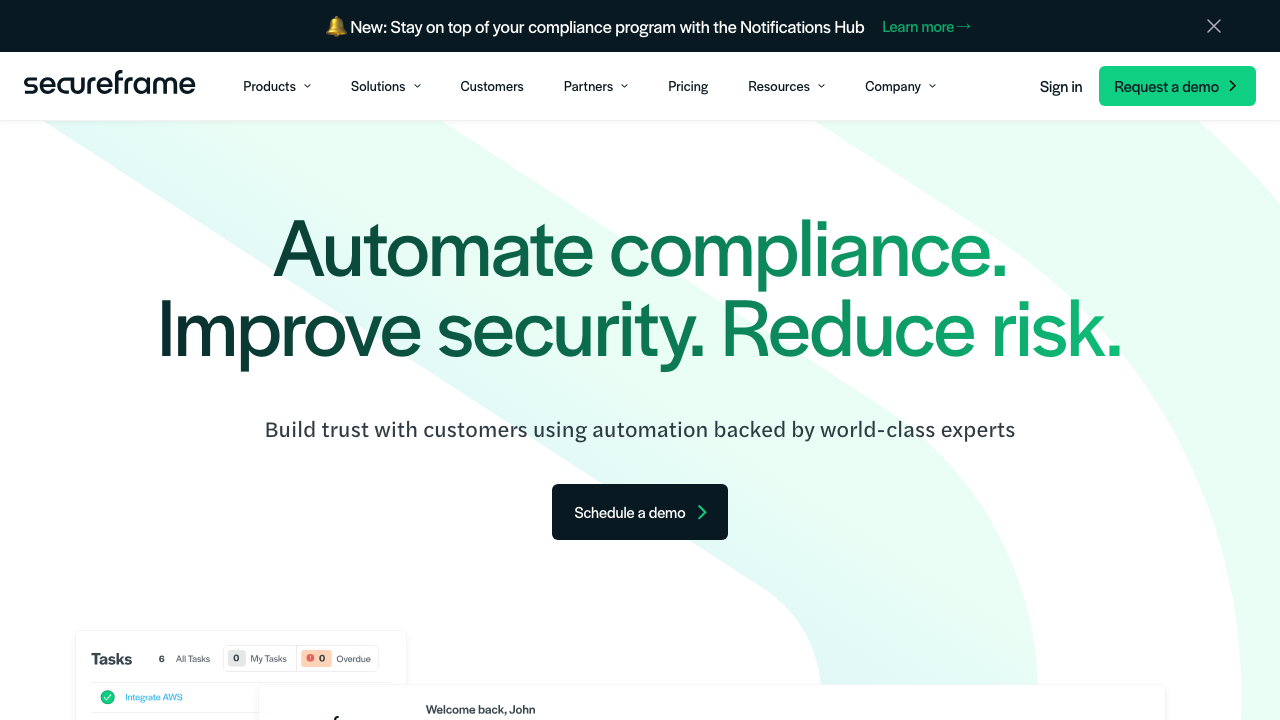
Secureframe competes on included human guidance rather than on automation depth. A named person walks you through readiness, which addresses the actual bottleneck for a first-time team: not knowing what an auditor will accept.
Pros
- Guided onboarding with a human included rather than sold as a premium tier, which is the fastest way past the not-knowing-what-good-looks-like problem
- Broad framework coverage so the platform does not need replacing when procurement asks for the second one
- Policy and training workflows are clean and cover the personnel evidence auditors sample most heavily
- Generally quotes below the two category leaders while covering the same core function
Cons
- Less recognised than Vanta, which occasionally prompts a prospect question instead of none
- Automation depth on unusual infrastructure matches peers, so the manual residue is unchanged
- Guided service quality depends on who is assigned, and that is hard to evaluate before signing
- Broad rather than deep, so any individual capability loses to a specialist
Best for: Small teams with no compliance experience who would rather buy guidance than configuration options.
Pricing: Annual subscription by headcount and framework count, with implementation guidance included in the package.
Sprinto
Sprinto assumes your stack is entirely managed cloud and SaaS, and builds around that assumption instead of trying to cover everything. For teams that match, the automation fits closely and the price is lower than the leaders. For teams that do not, the fit degrades quickly.
Pros
- Priced below the category leaders, which is the concrete reason most small teams shortlist it
- Automation is tuned for fully cloud-native stacks, so coverage is high when your infrastructure matches its assumptions
- Async task routing pushes evidence work to the responsible person rather than to a dashboard nobody opens
- Fast to a working configuration, which matters when the window needs to start
Cons
- The cloud-native assumption is load-bearing and hybrid or self-hosted infrastructure fits badly
- Smaller auditor network in some regions, which narrows your choice of firm
- Fewer escape hatches when a control has to differ from the template
- Less procurement recognition than the leaders, though the report comes from the auditor rather than the platform
Best for: Small cloud-native teams for whom price is the deciding factor and whose infrastructure has nothing unusual in it.
Pricing: Annual subscription banded by headcount, positioned below the category leaders, with frameworks added as modules.
Oneleet
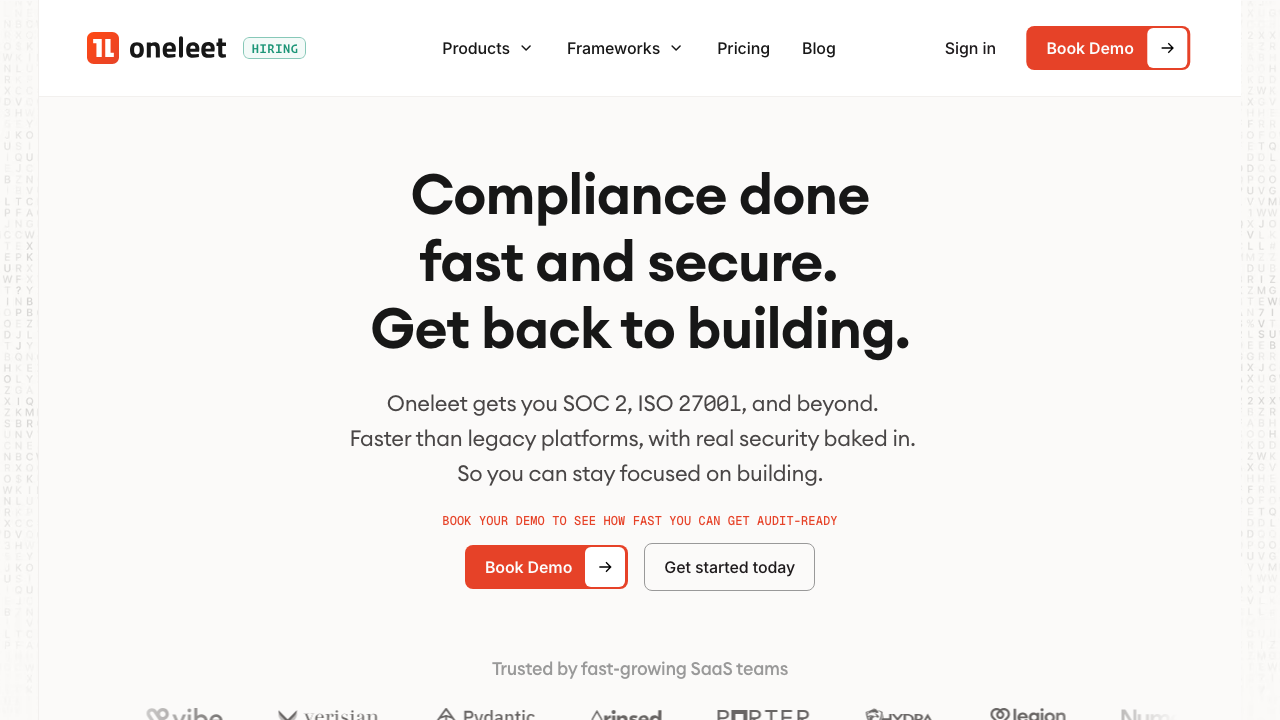
Oneleet argues the category has optimised for passing audits rather than for being secure, and bundles penetration testing and real security review into the package. If you were buying a penetration test anyway, the comparison changes, because you are consolidating two line items rather than choosing between platforms.
Pros
- Penetration testing included in the package, which removes a separate procurement cycle and a separate vendor from the annual calendar
- Findings are oriented toward real weaknesses rather than toward criteria coverage, so the output is useful independently of the report
- Newer product without a decade of accumulated feature surface, which makes it easier to operate with a small team
- Appeals directly to technical founders who would rather spend the budget on security work than on evidence administration
Cons
- Smaller vendor with less operating history, which matters for a system holding years of audit evidence
- A bundled penetration test is a different proposition from an independent specialist firm, and some enterprise reviewers will ask who performed it
- Narrower integration catalogue, so verify your specific systems rather than trusting the category
- Less familiar to procurement, meaning more explaining during enterprise diligence
Best for: Technical teams who want the audit and a genuine penetration test from one supplier and are comfortable with a younger vendor.
Pricing: Annual package with security services bundled rather than sold as separate engagements.
Thoropass
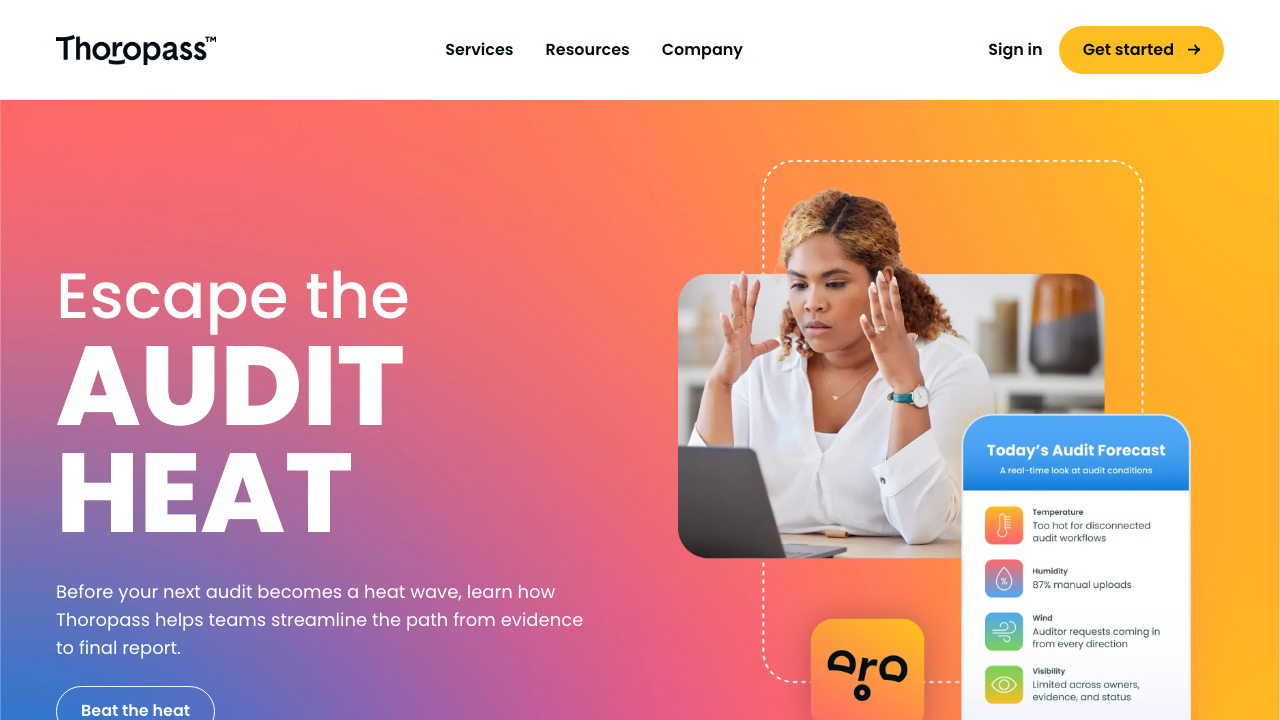
Thoropass sells the platform and the audit as a single engagement through an in-house audit practice. The coordination benefit is real: no evidence-format negotiation between two vendors, and the examiners see the evidence throughout the window rather than at fieldwork.
Pros
- One engagement for both halves, removing the handoff that causes most fieldwork friction
- Auditors observe evidence continuously, so problems surface during the window instead of at the end of it
- Combined pricing is predictable year to year, since the audit is not renegotiated separately
- Multi-framework support under the same combined model
Cons
- Independence deserves direct questioning when the software and the examination come from the same group, and you should ask how the teams are separated before signing
- Bundling hides what the audit portion actually costs, which weakens your renewal position
- Leaving means replacing the platform and the audit relationship simultaneously
- Software polish trails the platform-only leaders
Best for: Teams who value one accountable vendor over the ability to shop the platform and the audit separately.
Pricing: Combined annual pricing covering platform and audit engagement, scaled by headcount and frameworks in scope.
Comp AI
Comp AI is the open-source entrant in a category that has been entirely proprietary, offering a self-hostable compliance platform alongside a managed option. The strategic argument is straightforward: your evidence and control definitions stay in a system you can run yourself, which removes the renewal leverage that defines this market.
Pros
- Open source and self-hostable, so your evidence store and control definitions are not hostage to a renewal negotiation
- Removes the headcount-band meter entirely if you self-host, which is the pricing structure that hurts small teams most
- Transparent implementation, so you can see exactly what a test checks rather than trusting a description of it
- Attractive for teams who already run their own infrastructure and are comfortable operating another service
Cons
- Much younger than the incumbents, with a smaller integration catalogue and less evidence of long audit cycles completed on it
- Self-hosting means you operate, back up and secure the system that holds your audit evidence, which is not a trivial obligation
- No established auditor familiarity, so expect to explain the evidence format rather than hand over a recognised export
- Smaller community, so unusual problems have fewer public answers
Best for: Engineering-led teams who already self-host infrastructure, want control over their compliance data, and can absorb the operational and explanatory overhead.
Pricing: Open source and free to self-host with no per-employee meter. A managed option is sold separately; the real cost of self-hosting is infrastructure plus the engineering time to run it.
Doing it yourself with a spreadsheet and an auditor
This is a real option and the category would rather you did not consider it. For a small team with disciplined people, it works, and it is the baseline every paid option should have to beat.
What it actually involves. You write your policies, adapting public templates and reading every line rather than accepting them. You define your controls in a spreadsheet, one row per control, with the criterion it maps to, the owner, the cadence and where the evidence lives. You create a folder structure for evidence, one directory per control. You put the recurring evidence tasks in a calendar with an owner, because the only failure mode that matters here is nobody doing it. Then you hire an auditor directly and hand them the folder.
When this is the right call. You are pre-revenue or very small, the requirement is one report rather than a growing compliance surface, and someone on the team will genuinely own it. Your infrastructure is simple enough that the evidence is a handful of screenshots and exports rather than continuous telemetry. You are going for Type I first, which is a point-in-time examination and therefore far less evidence to accumulate.
When it is not. You need Type II, because a Type II window means producing evidence with timestamps spread across months, and a human doing that by hand misses weeks. Your headcount is growing, because personnel evidence scales with people and manual roster tracking breaks. You are heading for a second framework, because the mapping work you would do by hand is precisely what the platforms automate. Or nobody will own it, in which case the spreadsheet is a decision to fail slowly.
The honest arithmetic. The subscription buys continuous evidence capture and a structure that survives the owner being busy. That is worth real money once a Type II window is running. It is worth much less for a Type I, and close to nothing if the person who would have operated the spreadsheet is the same person who will now operate the platform and still has to do the access reviews.
One hybrid worth considering: do the first Type I manually, learn what the auditor actually asks for, then buy a platform for the Type II window with that knowledge. You will evaluate vendors far better having seen the evidence requests once.
Needs first-hand data: If you are weighing the manual path, write out the full list of recurring evidence tasks for your intended control set with their cadences, then time yourself doing one week of them. Multiply across the length of a Type II window. That total, compared against a quote, is the actual decision, and most teams have never made the estimate before choosing.
How to choose
Four questions, in order.
Is this a price problem or a fit problem? If price, Sprinto, Comp AI or the manual path are the real answers, and Drata or Secureframe will disappoint you. If fit, meaning framework breadth or control flexibility, Drata is the direct upgrade and price is not the lever.
How much of your stack is API-reachable? Fully cloud-native means most options work and you choose on price and support. Self-hosted or hybrid means demanding a per-system answer from each vendor, and accepting that the manual residue will be similar everywhere.
One framework or several? One framework and no plans means buy the cheapest thing that covers it well. Several, including anything regional, means mapping quality is the deciding property and it is worth paying for.
Who owns it? A named owner can extract value from a configurable platform or run the manual path. No owner means buy the most opinionated defaults you can find, because every configuration decision you defer becomes an exception in the report.
| Option | Primary reason to pick it | Framework mapping | Meter | Manual residue |
|---|---|---|---|---|
| Drata | Framework breadth and control flexibility | Strongest in the category | Headcount band plus frameworks | Same as peers, depends on your stack |
| Secureframe | Included human guidance | Good | Headcount band plus frameworks | Same as peers |
| Sprinto | Lower price for cloud-native stacks | Adequate | Headcount band | Higher if anything is self-hosted |
| Oneleet | Penetration testing bundled in | Adequate | Bundled annual package | Same as peers |
| Thoropass | Platform and audit as one engagement | Good | Combined annual pricing | Lower during fieldwork |
| Comp AI | Open source, self-hostable, no per-employee meter | Developing | Free self-hosted, or managed | Higher, plus operating the platform |
| Spreadsheet and an auditor | No subscription at all | You do the mapping | None | All of it |
| SOC 2 (framework, not a product) | Not a choice, it is the requirement | Defines the criteria | None | Defines the work |
Frequently asked questions
Is switching compliance platforms worth the disruption?
Rarely in the middle of a Type II window, and often at the boundary between windows. The evidence you have already accumulated does not migrate cleanly, because each platform stores artefacts in its own structure tied to its own control definitions. If you switch mid-window you will effectively run both until the window closes. Time the move to start with a new window, and treat the migration cost as the re-collection of a window’s worth of evidence rather than as a data export.
Will an enterprise customer care which platform I used?
No. The customer asks for the report, and the report comes from the audit firm, not the platform. Nothing in it names your compliance software. Where the platform does show up in a sales conversation is the Trust Center page, which some vendors provide and some do not, and which genuinely deflects questionnaires. That is a sales feature, so weigh it as one.
Can I keep Vanta for SOC 2 and use something else for another framework?
Technically yes and it is almost always a bad idea. You end up collecting the same evidence twice into two systems with two sets of control definitions, which is exactly the duplication that framework mapping exists to remove. If a second framework is coming, that is the moment to consolidate onto whichever platform maps them together best, not the moment to add a second subscription.
Does an open-source compliance platform actually satisfy an auditor?
The auditor does not care what software produced the evidence. They care that the evidence is authentic, timestamped, complete for the sampled period, and that it supports the control as described. A self-hosted platform can produce all of that. What you lose is the auditor’s familiarity with the export format, which costs you explanation time during fieldwork rather than a failed opinion. Budget for the conversation, not for a problem.
What is the cheapest path to a SOC 2 report?
A Type I, scoped narrowly to Security only, with policies and evidence maintained manually and an auditor engaged directly. That is genuinely the floor, and it is a legitimate answer for a company whose customer will accept Type I now and Type II later. It stops being the cheapest path the moment a Type II window starts, because sustained manual evidence collection costs more in attention than the subscription costs in money. The rest of the security programme that sits underneath either path is in best application security tools.
Related reading
- Best SOC 2 compliance automation platforms — the framework itself, what Type I and Type II mean, and the full platform comparison.
- Best application security tools — the security work underneath the evidence, which the report attests to rather than creates.
- Best security tools for small engineering teams — what a small team can genuinely operate alongside a compliance programme.
- Best cloud security posture management tools — the deeper version of the configuration monitoring these platforms do shallowly.
- Best PII detection and data privacy tools — the data-side obligations that no compliance platform resolves for you.