This article is not about logging your own application. It is about the feature an enterprise customer demands: a record, visible to them, of who did what inside their tenant of your product, exportable into their security stack, retained for as long as their policy says.
The two get confused constantly, and the confusion is expensive. Your application logs exist so your engineers can debug. They are unstructured, sampled, retained for weeks, full of internal identifiers, and written for whoever was on call. A customer-facing audit log is a product surface. It has a schema other systems parse, a retention period someone contractually agreed to, an access model that keeps one tenant out of another tenant’s history, and a guarantee that entries are not edited after the fact. Pointing your observability pipeline at a customer UI does not produce that.
The requirement arrives the same way every time. A security questionnaire, usually alongside SSO and SCIM, containing a line about audit logs and a line about exporting them into a SIEM. Somebody says the events are already in the logs. Three weeks later the team is writing a schema migration under deal pressure, and discovering that the events they need were never emitted in the first place because nobody instrumented the admin panel.
The work splits cleanly. Emitting the right events with a schema that survives is yours and cannot be bought. Storing, serving, retaining and exporting them is where the tools on this page earn their money.
Key takeaways
- A customer-facing audit log is a product feature with a contract attached, not a view over your application logs. Different schema, different retention, different access model.
- Schema is the decision you cannot undo cheaply. Actor, action, target, context and a version field, with stable identifiers, is the minimum that survives three years of product change.
- Append-only is the property the entire feature rests on. If an entry can be edited or deleted by application code, the log answers nothing during a dispute.
- Export into the customer SIEM is what enterprise procurement is actually asking for. A UI they have to log into is a partial answer.
What enterprise buyers actually mean
When a security questionnaire says audit logs, it is shorthand for four separate requirements that arrive together. Answering only the first is the usual mistake.
A record of security-relevant actions in their tenant. Logins and failed logins, permission changes, role assignments, API key creation and revocation, SSO and provisioning configuration changes, data export, deletion of anything, and changes to settings that affect security. Not every click. The set an investigator would need.
Attribution they can trust. Every entry names who did it, with enough identity to be useful six months later when that person has left. An entry attributed only to an internal user ID that no longer resolves is not attribution.
Retention matching their policy. Frequently a year, often longer, sometimes driven by a regulator rather than a preference. This is the requirement that quietly decides your storage architecture, because a year of per-tenant events at enterprise volume is not a table you keep in your primary database forever.
Export into their own systems. They run a SIEM. They want your events in it, correlated with everything else, alerted on by their rules. A dashboard inside your product does not satisfy this, because their security team does not live in your product. This is the requirement most often underestimated and the one that most often blocks a deal.
A fifth expectation is implicit and rarely written down: that the log cannot be quietly altered. Nobody asks how you guarantee it until there is an incident, and then it is the only question.
Two adjacent requirements usually arrive in the same questionnaire. SCIM provisioning, because they want lifecycle managed from their directory, and evidence for SOC 2, because their auditor asks about yours. All three are the same enterprise-readiness push and are worth planning together rather than in three separate quarters.
Schema design that survives
This is the part to get right, because everything downstream inherits it and a schema change to an append-only store is genuinely awful. You cannot rewrite history in a log whose value is that history is not rewritten.
Five components. Everything else is elaboration.
Actor. Who performed the action. Needs a stable identifier, a human-readable name captured at the time of the event, and a type, because actors are not only users. Service accounts, API keys, your own support staff acting on the tenant, automated jobs and the customer’s identity provider all take actions. Capturing the display name at write time rather than joining to a users table later is deliberate: the user record will change, be renamed, or be deleted, and the log entry must still read correctly.
Action. What happened, as a stable machine-readable string. user.role.updated, not Updated role. Define a naming convention on day one, namespaced by resource, past tense, and never reuse or repurpose a string. Customers will write SIEM rules against these, which means your action names become an API with all the compatibility obligations that implies.
Target. What the action was performed on. Type, identifier, and a display name captured at write time. Same reasoning as the actor name.
Context. When, from where, and how. Timestamp in UTC with sub-second precision, IP address, user agent, request or trace identifier, and the authentication method used. The request identifier is the one engineers forget and later wish they had, because it connects the audit entry to your own application logs during an investigation.
Tenant. Which customer this belongs to, on every single entry, non-nullable. This is the field that enforces isolation, and it must be impossible to write an entry without it. A missing tenant ID in an audit log is a cross-customer data exposure waiting for a query bug.
Then two fields that seem optional and are not.
Schema version. An integer on every entry. You will change the shape. When you do, consumers parsing five-year-old entries need to know which shape they are looking at rather than inferring it. Adding this later is impossible for entries already written.
Idempotency key. A deterministic identifier for the event so that a retry does not produce a duplicate. Audit pipelines retry, and a duplicated security event is confusing in exactly the situation where confusion is most costly.
Four rules that prevent the common disasters.
Never store the value of a secret. Record that an API key was created and which key, by identifier. Never the key. The audit log is the most widely read and longest retained data in your system, and putting credentials in it turns your compliance feature into your worst exposure. The same applies to anything a PII detection tool would flag, which arrives in metadata far more often than teams expect.
Denormalise names, reference by identifier. Both. The identifier lets you correlate, the captured name makes the entry readable when the referenced record no longer exists.
Keep metadata additive. A free-form object for action-specific detail is necessary and should only ever grow. Removing or repurposing a key breaks the customer’s rules silently, and they will not tell you until an audit.
Decide about before and after values early. Customers want them for configuration changes and they are the fastest way to leak sensitive data into a permanent store. The workable rule is an allowlist per action type of which fields may be captured, with values redacted by default.
Needs first-hand data: Instrument your product and count the security-relevant actions it can actually perform, including admin panel operations, API endpoints and background jobs. Compare that against the events you currently emit. The gap, measured in specific unlogged actions rather than as a feeling, is the real scope of the work and is almost always larger than the initial estimate.
Append-only is the whole guarantee
An audit log that application code can update or delete is a table of claims, not evidence. During a dispute the only question that matters is whether an entry could have been changed after it was written, and the honest answer has to be no.
Append-only is enforced in layers, and each layer catches a different failure.
At the database. The write path uses a role with insert permission and nothing else. No update, no delete, on that table. This costs nothing and eliminates the entire class of accidental mutation through an ORM, a migration script or a well-meaning cleanup job. It is the single highest-value control in this whole article and most teams skip it.
In the code path. A single write function, no update or delete functions in existence, and nothing that constructs raw statements against that table. If deleting an entry requires writing new code, the guarantee holds under pressure.
In storage. Object storage with a retention lock or an equivalent immutability setting, so that even an operator with full credentials cannot remove entries before the retention period expires. This is the layer that matters for insider threat, which is the threat model an audit log exists to address.
Cryptographically. Hash chaining, where each entry includes the hash of the previous one, so that altering an entry invalidates everything after it. This detects tampering rather than preventing it, and detection is what you need for evidence. It becomes genuinely strong when the chain head is periodically published somewhere you do not control, because otherwise whoever can rewrite the entries can recompute the chain.
Tamper evidence is a spectrum and most products need only the lower rungs. Database permissions plus immutable storage is enough for the overwhelming majority of enterprise questionnaires. Hash chaining is worth it when your customers are in regulated industries and your log is likely to be evidence in a formal process. Be honest with yourself about which you are, because implementing a chain and then not publishing the head is ceremony.
Deletion is the interesting corner. An append-only log meets a GDPR erasure request, and the two requirements are in genuine tension. The usual resolution is that audit logs are retained under a legitimate interest for security and legal obligation rather than being deleted on request, while the personal data inside them is minimised to what that purpose actually needs. Which is a strong argument for capturing identifiers and role names rather than rich personal detail in the first place.
Retention, export and the SIEM question
Retention drives architecture. One year of per-tenant security events, queryable by customer, is a volume question your primary transactional database will lose eventually. Three tiers is the pattern that works:
Hot. Recent entries, served to the customer UI and API with low latency. Weeks to a few months.
Warm. The remainder of the contractual retention period, queryable but slower, usually in a columnar store or a log platform.
Cold. Compressed, in immutable object storage, restorable on request. Cheap, and the tier where a long regulatory retention actually lives.
The mistake is serving all three from the same store and discovering the cost curve at the moment a large customer signs.
Export is where deals are won and lost. Four shapes, in increasing order of how much enterprise buyers like them.
A CSV download from the UI. The minimum. It answers the questionnaire line and satisfies nobody’s security team, because it requires a human to remember to do it.
An API with cursor pagination. Genuinely useful. Their team can build a pull-based integration. Make the cursor stable and the ordering total, because a pagination cursor that skips entries under concurrent writes produces gaps in a security log, which is the worst possible bug in this feature.
Streaming to their destination. The thing they actually want. Events delivered continuously to their SIEM or their object storage. This is where the buy-versus-build calculation tips, because maintaining connectors for a handful of SIEM products, each with its own format expectations and failure behaviour, is ongoing work that has nothing to do with your product.
A supported connector in their SIEM’s marketplace. The strongest position, and mostly a distribution question rather than an engineering one.
Two details that cause support tickets. Ordering: events must be exportable in a deterministic order with a stable position, or a customer resuming a stream after an outage cannot tell what they missed. And delivery semantics: say plainly whether you guarantee at-least-once or at-most-once, because their deduplication depends on knowing which, and this is exactly what the idempotency key in your schema is for.
Needs first-hand data: Take your largest tenant and project their audit event volume at the retention period your enterprise contracts require, then measure the query latency of the customer-facing filter view against that volume in your candidate store. Most teams discover the architecture is wrong at the point where a customer actually has a year of history, which is a year too late to change it cheaply.
WorkOS
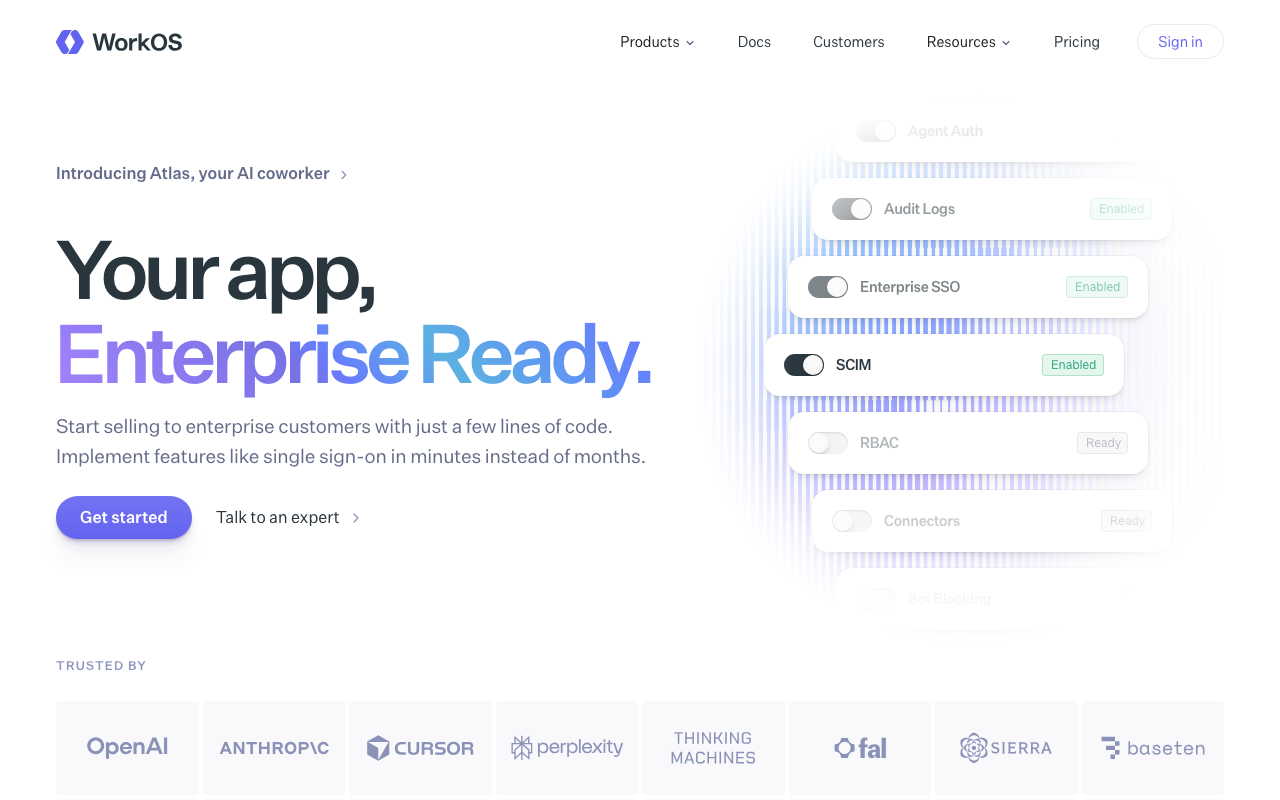
WorkOS sells enterprise-readiness features as APIs, and Audit Logs is the one relevant here: you emit events through their API, they store them, provide a customer-facing viewer you can embed, and handle export into common SIEM destinations. For a team meeting this requirement under deal pressure alongside SSO and directory sync, buying all three from one place is the argument.
Pros
- The customer-facing viewer and SIEM export are included, which are the two parts that are pure product work with no engineering interest
- Ships alongside SSO and directory sync, and those requirements almost always arrive in the same questionnaire from the same buyer
- Opinionated schema with actor, action and target enforced, which pushes teams toward a structure that survives instead of a free-form event blob
- Removes the retention and storage tiering problem entirely, which is the part that quietly becomes expensive
Cons
- Your customers’ audit trail lives in a third party, which some enterprise buyers will question during diligence and some regulated industries will reject
- Priced per connected organisation, so the cost scales with the enterprise customers who asked for the feature
- Their schema is their schema, so a requirement it does not model is something you wait for rather than build
- Correlating audit entries with your own internal logs means joining across two systems you do not control equally
Best for: B2B SaaS teams shipping the enterprise-readiness bundle under deal pressure who want the viewer and SIEM export without building either.
Pricing: Metered per connected enterprise organisation, with audit logs sold alongside SSO and directory sync rather than by event volume.
Cribl
Cribl is a telemetry pipeline rather than a store. It sits between sources and destinations, parses, reshapes, enriches, redacts and routes, and can fan the same stream to several places at once. In an audit logging architecture it is the layer that solves the export problem: one internal event shape, many customer destinations, without writing a connector per SIEM.
Pros
- Routing one event stream to many destinations in different formats is precisely the per-customer export problem, solved as configuration rather than code
- In-pipeline redaction lets you strip sensitive fields before events reach a destination, which is the cheapest place to enforce a data minimisation rule
- Decouples your emit format from every consumer format, so a customer requesting an unusual destination does not become a code change
- Replay from object storage means you can re-deliver history to a new destination without your application re-emitting it
Cons
- It is a pipeline, not a store or a customer-facing UI, so you still need both and this is an addition to your architecture rather than a replacement
- Operationally significant in its own right, and a pipeline in the path of security events is a component that must not silently drop anything
- Priced on data volume, which is the meter that surprises teams whose event volume grows with customer count
- Overkill for a product with a handful of enterprise customers and one export destination
Best for: Teams with many enterprise customers each wanting events in a different destination, where connector maintenance has become real recurring work.
Pricing: Metered on data volume processed through the pipeline, with self-hosted and managed deployment options.
Datadog
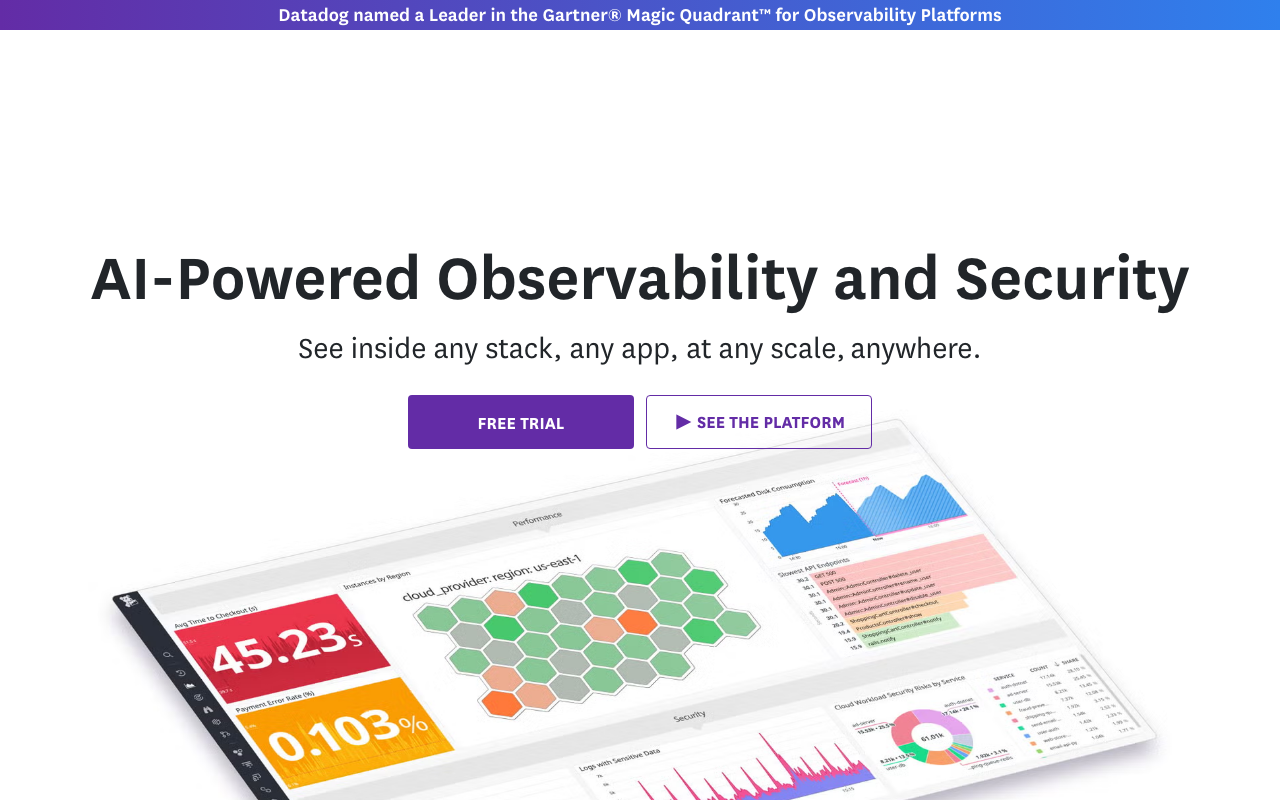
Datadog’s Audit Trail is a record of actions taken inside Datadog itself, not a product for your customers’ audit log. It is included here because it is frequently confused for one, and because Datadog’s log platform is a plausible warm-tier store for your own audit events if you are already a heavy user.
Pros
- If you already run Datadog, audit events can live beside your application telemetry, which makes correlation during an investigation genuinely easy
- Mature query, retention and alerting, so building internal detections on top of security events is straightforward
- Audit Trail gives you a real answer when a customer asks who at your company accessed their monitoring data, which is a question enterprise buyers do ask
- Long-term archival to your own object storage is supported, which fits the cold tier of a retention strategy
Cons
- Audit Trail is about your use of Datadog, not a customer-facing audit log product, and treating it as one is a category error
- No multi-tenant customer-facing viewer, so the entire product surface is still yours to build
- Log ingestion and retention pricing makes a long contractual retention expensive compared with a columnar store
- Putting customer audit data into an observability platform tends to blur the separation between debugging telemetry and evidence, which is the confusion this whole category suffers from
Best for: Teams already standardised on Datadog who want audit events correlated with application telemetry, and who will build the customer-facing surface themselves.
Pricing: Metered on ingested log volume with separate retention tiers, and Audit Trail licensed as an add-on to the platform.
Panther
Panther is a detection platform built on a data lake, aimed at security teams who write detections as code against high-volume log data. It is not a customer-facing audit log product, and it belongs in this comparison because it is the right answer to the adjacent question: what your own security team does with these events once they exist.
Pros
- Detections written as code, versioned and tested in a repository, which fits engineering teams far better than a rules UI
- Built for high volume with a data lake underneath, so long retention is economically sensible rather than punitive
- Normalises across sources, so your product audit events sit alongside cloud and identity logs in one detection surface
- Strong fit if the reason you are building audit logging is partly your own detection needs rather than purely a customer requirement
Cons
- Solves your detection problem, not your customer’s visibility problem, and provides nothing customer-facing
- Assumes a security team that will write and maintain detections, which most small engineering organisations do not have
- Enterprise pricing and operating model that does not fit a team whose requirement is one questionnaire line
- Adopting it for audit logging alone means adopting a SIEM, which is a much larger commitment than the problem requires
Best for: Teams who need real detection over their own security telemetry and want it as code rather than as a rules console.
Pricing: Metered on data volume ingested into the platform, with enterprise annual contracts.
Hydrolix
Hydrolix is a log store built for very high volume with aggressive compression and long retention, designed so that keeping years of data queryable does not become the dominant line in your infrastructure bill. In an audit logging architecture it is a candidate for the warm and cold tiers rather than a complete product.
Pros
- Built explicitly for long retention at volume, which is the economic problem multi-year audit retention creates
- Compression and storage separation mean old data stays queryable rather than being archived into unqueryable cold storage
- Fits as the tier behind a customer-facing API, so recent data can live somewhere fast while history stays reachable
- Removes the usual tradeoff between retaining what contracts require and paying what an observability platform charges for it
Cons
- A store, not a product, so the schema, the API, the customer UI, the access model and the export connectors are all still yours
- Specialist infrastructure to operate and understand, which is a real commitment for a team whose problem is one feature
- Small vendor relative to the platforms, so diligence matters for a system holding contractual retention
- Unjustifiable at low volume, where a columnar table in your existing database is entirely sufficient
Best for: Products with very high audit event volume and multi-year contractual retention where storage cost has become the deciding constraint.
Pricing: Metered on data volume with storage and compute separated, oriented toward high-volume long-retention workloads.
Building it yourself on Postgres or ClickHouse
For most products this is the right answer, and it is less work than the vendor pages imply. The schema is yours regardless, the emit path is yours regardless, and what you are buying from a vendor is storage, a viewer and export connectors.
Postgres is the correct default. A single append-only table, partitioned by month, with a composite index on tenant and timestamp, serves the customer-facing view well past the point most teams expect. Revoke update and delete from the application role on that table. Detach old partitions and archive them to object storage when they pass the hot window. This is boring, it uses infrastructure you already operate, and it is the version you should build first unless you already know your volume is extreme. If your Postgres setup needs a refresher on operating this shape, managed Postgres providers covers the hosting side.
ClickHouse when the volume actually demands it. Columnar storage, heavy compression, and fast aggregation over long ranges. The reason to move is not that queries are slow, it is that retention has made the table expensive and the customer-facing filter view scans too much. Understand the tradeoffs before jumping: a columnar store is not a transactional database, uniqueness is not enforced the way you expect, and deduplication is something you design for rather than assume. The comparison in Postgres vs ClickHouse vs Tinybird covers where the boundary actually sits and why teams cross it earlier than they need to.
The pattern that works with either. Write events to a durable queue from the application, consume into the store asynchronously, and treat the queue as the source of truth for delivery. This keeps audit writes off the request path, gives you retries without duplicating entries thanks to the idempotency key, and means the same stream can fan out to a customer’s export destination without a second emit path.
What you are actually signing up to maintain. The customer-facing filter and search UI. A paginated export API with a stable cursor. Retention enforcement and archival. At least one SIEM delivery integration, then another each time a customer asks. Backfill tooling for when you add a new event type and a customer wants history. None of it is hard. All of it is ongoing, and that ongoing cost is the thing the vendors are actually selling you out of.
How to choose
Start by separating the three jobs, because no single product on this page does all of them and buying as if one does is the recurring mistake.
Emitting correct events with a durable schema. Always yours. Not purchasable. Do this first and do it carefully, because it is the only irreversible decision here.
Storing and serving to the customer. Build on Postgres unless volume says otherwise, move to ClickHouse or a specialist store when retention economics say so, or buy WorkOS if the viewer and the SIEM export are what you are trying to avoid building.
Getting events into the customer’s security stack. An API first, streaming when a deal requires it, Cribl when the number of distinct destinations has made connector maintenance a recurring job.
And keep your own detection needs separate from the customer requirement. Panther, or anything in best log management tools, answers what your security team does with the events. That is a different purchase from what your customer sees.
| Option | What it actually provides | Customer-facing UI | Retention economics | Picks itself when |
|---|---|---|---|---|
| WorkOS | Storage, embedded viewer, SIEM export | Yes | Included in the per-organisation meter | Shipping the enterprise bundle under deal pressure |
| Cribl | Routing, reshaping and redaction | No | Not a store | Many customers, many different destinations |
| Datadog | Store and query for your own team | No | Expensive at long retention | Already standardised on Datadog |
| Panther | Detection as code over security telemetry | No | Good, data lake underneath | Your own security team needs real detections |
| Hydrolix | High-volume long-retention store | No | Its entire reason to exist | Volume and multi-year retention dominate cost |
| Postgres | A table you already operate | You build it | Fine until it is not | Almost always, as the first version |
| ClickHouse | Columnar store for high volume | You build it | Strong at scale | Retention cost, not query speed, forced the move |
Frequently asked questions
Can I just expose my application logs to customers?
No, and the reasons are structural rather than a matter of effort. Application logs are unstructured, frequently sampled, retained for weeks rather than years, contain internal identifiers and occasionally secrets, and have no tenant isolation guarantee. Exposing them means auditing every log line your codebase has ever written for sensitive content, then continuing to audit every new one forever. A separate, deliberately emitted event stream with its own schema is less work than that, and it is the only version that survives a security review.
How long do I have to retain audit logs?
There is no universal answer, which is why the requirement shows up in contracts rather than in a standard. Enterprise customers commonly ask for a year and regulated ones ask for longer. What matters architecturally is committing to a number you can serve economically, because contractual retention is genuinely hard to shorten later. Pick a default, offer longer retention as an enterprise option, and make sure your storage tiering can honour it before sales promises it.
Does SOC 2 require audit logging?
Not as a named technical requirement, because SOC 2 does not specify technology. In practice you will describe controls around monitoring and access, and the evidence for those controls is logs. More directly, your customers’ auditors ask them about the systems they use, which is how the requirement reaches you as a questionnaire line rather than as a criterion. The framework side is covered in best SOC 2 compliance automation platforms.
What is the difference between an audit log and an event stream?
An audit log is a subset of your events, selected because they are security-relevant, with a stricter schema, a longer retention, an append-only guarantee and an external audience. An event stream is a general mechanism. Many teams build the audit log as a filtered, enriched projection of an existing event stream, which works well as long as the audit projection has its own schema contract and its own immutable store rather than being a query over the raw stream.
Do I need hash chaining for tamper evidence?
Usually not. Database permissions that make mutation impossible from application code, plus immutable object storage with a retention lock, satisfy the overwhelming majority of enterprise security reviews and address the realistic threat. Hash chaining matters when your logs are likely to be evidence in a formal legal or regulatory process, and it is only meaningfully stronger if you publish the chain head somewhere outside your own control. Implementing the chain and keeping the head in the same database is ceremony rather than a guarantee. The broader control set is in best application security tools.
Related reading
- Best application security tools — the wider security programme this feature sits inside.
- Best log management tools — the other kind of logging, for your engineers rather than your customers.
- Postgres vs ClickHouse vs Tinybird — where the storage boundary actually sits when audit volume grows.
- Best SCIM provisioning tools — the other enterprise-readiness requirement that arrives in the same questionnaire.
- Best SOC 2 compliance automation platforms — why your customer is asking, and what their auditor wants from them.
- Best PII detection and data privacy tools — keeping sensitive data out of the longest-retained store you own.