There are two reasons teams look for a Vault replacement, and they point at completely different products. Working out which one you have is the whole decision.
The first is the licence. Vault moved to the Business Source License, and for some organisations that is a policy question with a binary answer: legal will not approve it, or a customer contract forbids it, or the internal open source policy has a list and BUSL is not on it. Nothing about Vault’s engineering is in dispute. You want the same thing under a different licence.
The second is operational complexity. Somebody stood up Vault, it works, and now unsealing, the storage backend, the HA topology, upgrade testing, a disaster recovery plan and a restore drill are all somebody’s job, usually somebody who has four other jobs. The system that was supposed to reduce risk is now the thing most likely to take production down, because every pod that restarts talks to it. You do not want the same thing under a different licence. You want less of it.
If you have the first problem and pick a product that solves the second, you will lose dynamic secrets, your policy model and your authentication backends, and the migration will be a rewrite rather than a lift. If you have the second problem and pick a fork, you have changed the copyright header and kept every 3am page. Sort this before you look at a single feature matrix.
Key takeaways
- A licence problem has one clean answer: OpenBao, the Linux Foundation fork, where the API, CLI, policy language and secret engines came across from the fork point and most automation keeps working.
- A complexity problem has no drop-in answer. Every managed alternative trades away some part of Vault’s model, most often the breadth of dynamic secret engines and the policy expressiveness.
- Dynamic secrets and leases do not migrate. They are generated, not stored, so you rebuild the engine configuration on the destination and cut over clients, rather than exporting anything.
- The migration work is mostly path layout and policy translation, not data movement. Plan for a dual-read period where clients can resolve a secret from either store, because a big-bang cutover of every consumer is how this goes wrong.
The two exits, and what each one costs
Be specific about the requirement, because these products are not substitutes for each other.
If the constraint is the licence, what you need is behavioural compatibility. The things that will hurt if they change are the HTTP API paths, the CLI verbs your scripts call, the HCL policy documents, the auth method configuration, the secret engine mount layout, and the client libraries your applications import. A fork preserves all of those at the fork point. Anything that is not a fork preserves none of them.
If the constraint is operational load, be honest about which part. There are three distinct burdens people conflate.
Unsealing and key management. The seal ceremony surprises teams that did not plan for it. Auto-unseal using a cloud KMS key removes most of the pain and is the first thing to try before concluding Vault is unmanageable, because it is a configuration change rather than a migration.
Availability and storage. Running an HA cluster with integrated storage, taking backups, and testing restores is real platform work. This is the burden a managed service genuinely removes.
Configuration complexity. Policies, roles, auth methods, mount tuning and the lease model are conceptually heavy. A managed service does not remove this if you still need the same expressiveness. It removes it only if you are willing to accept a simpler model, which usually means accepting coarser access control.
The uncomfortable middle case: teams whose actual problem is that nobody owns Vault. Moving to a managed product means nobody owns a managed product, and it will drift into the same state with a monthly invoice attached. Ownership is not a procurement outcome.
What you give up leaving the Vault lineage is worth stating plainly. The dynamic secret engines are the broadest in the category and no managed alternative matches the full set. The PKI engine issuing short-lived certificates from an internal CA is a real capability that most alternatives do not have. Response wrapping, where a secret is delivered as a single-use token that proves whether it was intercepted, has no equivalent elsewhere. The policy language is more expressive than the IAM-style models most alternatives use. If you depend on any of these, your shortlist is OpenBao and possibly Akeyless, and the rest of this list is not for you.
Migrating existing secret paths without breaking every consumer
This is the section that decides whether the project takes three weeks or three quarters, and it is almost never written down before somebody starts.
The problem is not moving the data. Secrets are small, and every product has an API you can write into. The problem is that a secret’s path is an interface. Every application, Terraform module, Kubernetes manifest, CI job and shell script that reads secret/data/prod/payments/stripe has that string embedded in it, and the destination product probably cannot express that same string.
Work through it in this order.
Inventory the real read paths, not the tree. Listing the KV tree tells you what exists. The audit log tells you what is actually read, by whom, and how often. Those two sets differ substantially, and the difference is your deletion list. Run this before anything else, because migrating dead secrets is pure cost and the dead fraction is usually large.
Decide the destination layout before you move one value. Vault’s KV engine gives you an arbitrary path hierarchy. Most alternatives give you a flatter model: projects and environments, or a flat namespace with a name, or a cloud-native store where the secret name is a single string with conventions inside it. You have to map a tree onto that, and the mapping should be mechanical and written down. A rule such as “mount plus path with slashes replaced by hyphens, environment as an explicit attribute” is worth more than a clever hierarchy, because a mechanical rule can be applied by a script and reversed when you find a mistake.
Translate policies, and expect this to be the slow part. A Vault policy grants capabilities on a path glob. An IAM-style destination grants actions on a resource, and a project-based destination grants a role on a project or environment. These do not map one to one. The dangerous direction is the one that feels easy: collapsing several narrow Vault policies into one broader grant because the destination cannot express the distinction. Every time you do that, write it down as an accepted risk rather than letting it disappear into the migration. Teams that skip this arrive at the other side with access control materially weaker than what they left, and no record of when that happened.
Map authentication methods. Vault’s Kubernetes auth, AppRole, OIDC and cloud auth backends each have a destination equivalent that is close but not identical. The Kubernetes case is the one to test first, because service account token projection, audience claims and issuer validation all have to line up, and the failure mode is a pod that starts and then fails to read anything. Never migrate by giving workloads a static token to talk to the new store, even temporarily, because temporary bootstrap tokens outlive every migration.
Rebuild dynamic secrets rather than migrating them. There is nothing to export. The database secret engine holds a connection and a set of creation statements; you recreate those on the destination if it supports them, and if it does not, this is the point where you discover that your replacement is not a replacement. Do this part first, not last, because it is the part most likely to change the decision.
Run a dual-read period. Put an indirection in front of resolution so a client can ask for a logical name and get it from either store. A small resolver library, a sidecar, or an environment variable naming which store to use per service. Then migrate consumers one at a time, verify from the audit logs on both sides that reads have actually moved, and only then stop writing to the old store. Big-bang cutovers fail on the consumers nobody knew about, and there are always consumers nobody knew about.
Keep both stores authoritative for nothing. During dual-read, one store must be the write path and the other must be a read-only replica populated by a sync job. Two writable stores diverge within days, and reconciling them is worse than the original migration.
Finish properly. The migration is not done when the new store works. It is done when the old store is deleted, its credentials are revoked, and every secret that existed in both places has been rotated. Until you rotate, a former Vault operator still knows every value you migrated.
Needs first-hand data: Pull ninety days of Vault audit log, aggregate reads by path and by client identity, and compare that set against the full KV listing. Record three numbers: paths read in the period, paths never read, and distinct client identities per path. The never-read set is your deletion candidate list, and the paths with many distinct readers are the ones that need the dual-read shim rather than a direct cutover.
Needs first-hand data: For each Vault policy in use, write the destination grant you intend to replace it with and mark whether it is narrower, equivalent or broader. Count the broader ones. If that count is not close to zero, the migration is weakening your access control, and that needs a decision from someone senior rather than a note in a pull request.
OpenBao
OpenBao is the Linux Foundation fork of Vault, created after the licence change and continuing under an open source licence. Because it forked from a Vault release, the HTTP API, CLI, HCL policy language, auth methods and secret engines came across intact, which makes it the only option here where migration is mostly a matter of pointing clients at a different address. It is the answer to a licence problem and specifically not an answer to an operational one.
Pros
- API, CLI and policy compatibility inherited from the fork, so existing automation, Terraform providers and client libraries largely work unchanged
- Open source licence under foundation governance, which resolves the procurement and legal objection completely rather than partially
- Dynamic secret engines and the lease model came across, so the capabilities that justify running a secrets platform are present rather than trimmed
- Public roadmap and governance, which is a real consideration for anyone who has now been surprised by a licence change once
Cons
- Every operational burden of Vault is preserved exactly: unsealing, storage backend, HA, upgrades and restore drills are still yours
- Divergence from Vault grows with every release on both sides, so compatibility is a property of today that must be re-verified at each upgrade
- Third-party integrations and most documentation target Vault, so anything unusual needs testing rather than trusting
- Fewer managed hosting options and a smaller pool of engineers who have run it under load
Best for: Teams whose only problem with Vault is the licence, who want the same mechanics and can keep operating them.
Pricing: Free and open source with no vendor and no bill. The cost is the infrastructure it runs on and the engineering time to operate it, plus third-party support if you choose to buy it.
Infisical
Infisical is the closest thing to a middle path: an open source core you can self-host, a hosted option if you would rather not, dynamic secrets for supported backends, and a project and environment model that is considerably simpler than Vault’s path and policy tree. It is a real reduction in operational surface if you self-host, and a removal of it if you do not, at the cost of narrower dynamic secret coverage and a less expressive policy model.
Pros
- Offers both self-hosted and managed, so the deployment decision can change later without changing products
- Dynamic secrets for supported backends preserve the capability most teams would otherwise lose leaving Vault
- Project, environment and folder structure is much faster to reason about than a policy path tree, which shortens onboarding for application teams
- Includes secret scanning, which closes a leak path a store alone does nothing about and is covered in secret scanning tools
Cons
- Dynamic secret backend coverage is narrower than Vault’s, so verify your specific databases and cloud providers rather than the category claim
- No equivalent to Vault’s PKI engine or response wrapping, so those capabilities are lost rather than migrated
- Self-hosting reintroduces an availability-critical service, with the HA and restore obligations you were trying to escape
- Open core boundary moves over time and capabilities can end up on the commercial side
Best for: Vault users who want a simpler model and to keep dynamic secrets, with the option of self-hosting for compliance reasons.
Pricing: Open source core free to self-host, with a hosted service and per-seat enterprise tiers adding SSO, audit retention and advanced access control.
Doppler
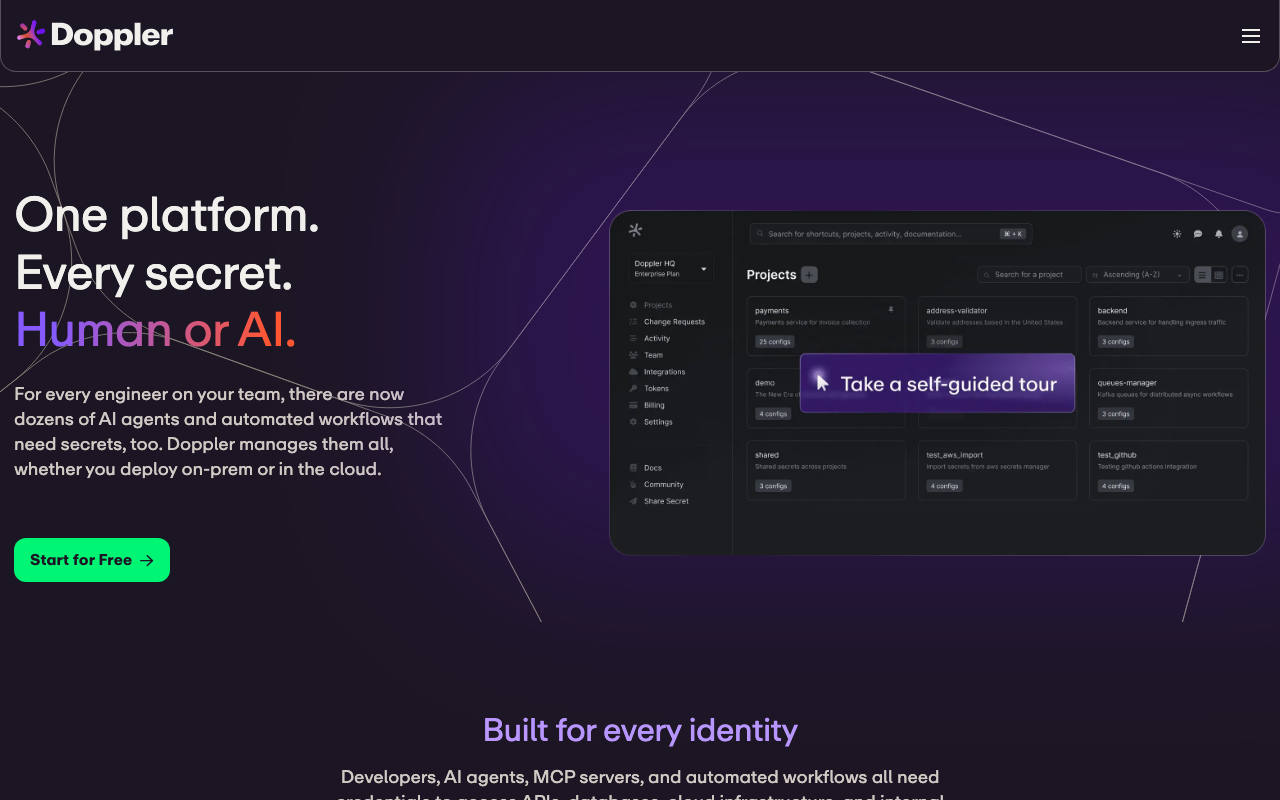
Doppler is the cleanest exit from operational load and the furthest from Vault’s model. It is a hosted platform organised around projects and environment configs with inheritance, injecting secrets through a CLI or syncing them into CI platforms, clouds and container platforms. There is nothing to operate. There are also no dynamic secrets, no PKI, and no policy language, so this is a replacement only if your Vault deployment was, in practice, a KV store with authentication in front of it.
Pros
- No infrastructure at all, which is a complete answer to the operational complexity that drove the search
- Config inheritance across environments removes the duplicated-value drift that Vault path trees encourage
- Broad sync integrations mean the migration can push values into the systems that consume them rather than changing every consumer
- Change history and diffs per secret make the post-migration “what changed” question answerable without reading an audit log
Cons
- No dynamic secrets, so if any part of your Vault usage generates credentials on demand, this is a downgrade and not a migration
- A third-party service holds every secret, which is a trust decision that needs an explicit answer rather than an assumption
- Sync-based delivery copies values into other systems, so revoking in Doppler does not revoke the copy already sitting in a CI platform
- Per-seat pricing scales with headcount rather than with the size of your secret inventory
Best for: Teams whose Vault install is effectively a KV store, who want the operational burden gone entirely and can accept static secrets.
Pricing: Free tier for small teams, then per-seat monthly pricing with higher tiers adding SSO, audit retention and finer access control.
AWS Secrets Manager
If your workloads are on AWS and your Vault deployment exists mainly to hold values those workloads read, the native store removes both the licence question and the operations at once. Access becomes IAM, encryption becomes KMS, audit becomes the trail you already collect, and there is no cluster. The tradeoffs are the absence of dynamic secrets in the Vault sense and a meter that rewards coarse secret layout.
Pros
- Nothing to operate, and the availability question becomes the cloud provider’s rather than yours
- IAM-based access control means one permission system instead of two, which usually simplifies the policy translation work
- Managed rotation for supported credential types, notably the managed relational databases, covers part of what dynamic secrets were doing
- Federation support means CI jobs and workloads authenticate with identity they already have, with no bootstrap credential
Cons
- No dynamic secret generation, so short-lived database credentials need managed rotation or a different mechanism entirely
- Per-secret monthly and per-call charges push toward packing values into one secret, which undoes the fine-grained IAM control that is the reason to use it
- Rotation outside supported types is a function you write, test and monitor, which is production code with a pager attached
- AWS-centric, so a hybrid or multi-cloud estate ends up running two stores and two access models
Best for: AWS-only estates using Vault as a KV store, where removing a cluster matters more than dynamic secrets.
Pricing: Metered per stored secret per month plus a charge per API call, with rotation functions billed as ordinary serverless compute.
Google Secret Manager
The Google Cloud equivalent, with the same argument and one useful difference for migration: explicit version lifecycle. Versions are enabled, disabled and destroyed independently, which maps directly onto a safe cutover where the old value stays resolvable but disabled until you are sure nothing reads it.
Pros
- Per-secret IAM grants make least privilege straightforward without a separate policy language to translate into
- Version enable, disable and destroy gives you a reversible cutover step, which is unusually helpful during a migration
- Audit logging is on by default through the platform, so audit continuity across the migration is easy to demonstrate
- Workload identity federation removes bootstrap credentials for both workloads and CI
Cons
- No built-in rotation for credential types at all, so every rotation path is yours to write, which is a step down from both Vault and AWS
- No dynamic secrets, with the same implication: this is a KV replacement, not a platform replacement
- Metering on access operations means a tight refresh interval or a restart loop becomes a cost line nobody predicted
- Flat namespace with sparse organisational structure, so your Vault path tree becomes a naming convention you have to police
Best for: Google Cloud estates replacing a Vault KV store, where a reversible per-version cutover is worth having.
Pricing: Metered per active secret version per month plus a charge per access operation, with a free allowance at low volume.
Akeyless
Akeyless is the alternative that keeps the most of Vault’s capability surface while removing the cluster. It offers dynamic and just-in-time credentials for databases, clouds and remote access, certificate issuance, and secretless access to targets, delivered as SaaS with a gateway component you deploy for caching and private network reach. Its distinguishing technical claim is a distributed key model where the encryption key is never assembled in one place, including on the vendor’s side, which is aimed squarely at the objection that stops teams putting secrets in SaaS.
Pros
- Dynamic and just-in-time credentials as a managed service, which is the capability most alternatives drop
- Certificate and PKI issuance alongside secrets, covering another Vault engine that usually gets lost in a migration
- The key management model is designed so the vendor cannot unilaterally decrypt your secrets, which changes the SaaS trust conversation materially
- A gateway you run locally keeps retrieval latency and API call volume under your control, and gives you a private network path
Cons
- The gateway is real infrastructure to deploy, size, upgrade and monitor, so the operational burden is reduced rather than removed
- Control plane availability is a vendor dependency, and you need to know precisely what the gateway can serve while disconnected
- Smaller community than Vault, so worked examples, integrations and public answers to odd failures are thinner
- The distributed key model is genuinely different and your security team will need to understand it before approving it
Best for: Teams leaving Vault for operational reasons who still need dynamic secrets and PKI, and want them managed.
Pricing: Subscription tiers metered on a combination of client count and managed objects, with the gateway you host billed as your own infrastructure.
Bitwarden Secrets Manager
Bitwarden Secrets Manager is the machine-secrets side of a password manager many organisations already run, with projects, service accounts, access tokens and a CLI and SDKs for retrieval. Its argument is consolidation and a low floor: if Bitwarden already holds your human credentials and your Vault usage is modest, this collapses two systems into one with one audit trail and one offboarding process. It is a KV store with good access control, not a secrets platform.
Pros
- One vendor for human and machine secrets, so offboarding removes both without a second checklist somebody forgets
- Open source codebase with a self-hosting option, which keeps the licence objection answered if that is what drove the search
- Projects and service accounts give a simple, comprehensible access model that is quick to translate policies into
- Low adoption cost for organisations already standardised on Bitwarden, since the identity and administration are already in place
Cons
- No dynamic secrets, no leases and no PKI, so it replaces only the KV portion of a Vault deployment
- Machine secrets are a newer part of the product than the password manager, so expect thinner integration coverage than infrastructure-native tools
- Simpler policy model than Vault, which means some narrow policies will have to be collapsed into broader grants
- Not designed around infrastructure workflows, so large fleets and high retrieval rates are not the primary design target
Best for: Smaller organisations already on Bitwarden who used Vault as a KV store and want one system and one bill.
Pricing: Add-on to the business plans priced per seat, with the self-hosted option free of licence cost and billed only as your own infrastructure.
How to choose
Answer the first question honestly and most of the list disappears.
Is this a licence problem or a complexity problem? Licence only, and you keep the operations: OpenBao, and the migration is mostly a config port and a re-verification at each upgrade. Complexity: keep reading.
Do you actually use dynamic secrets, PKI or response wrapping? Check the audit log rather than asking around, because the answer people give and the answer the log gives are often different. If yes, your shortlist is OpenBao and Akeyless, and everything else is a capability loss you would be choosing without noticing.
Have you tried auto-unseal and managed storage first? If the operational pain is concentrated in the seal ceremony and the storage backend, a configuration change may solve it more cheaply than a migration. Do this experiment before committing to a project measured in quarters.
Is your compute on one cloud? Then the native store is the cheapest exit by a wide margin, because it removes the service, the licence and the second permission model in one move. Accept that it is a KV replacement and check that the read volume does not make the meter unpleasant.
Is the real problem that nobody owns it? Then name an owner before you choose anything. A managed product with no owner becomes an unmaintained managed product with an invoice.
| Option | Vault compatible | Dynamic secrets | Who operates it | Picks itself when |
|---|---|---|---|---|
| OpenBao | Yes, from the fork point | Yes | You | The licence is the only problem |
| Infisical | No | Supported backends | You or vendor | Simpler model wanted, dynamic secrets kept |
| Doppler | No | No | Vendor | Vault was a KV store and ops must go away |
| AWS Secrets Manager | No | No, rotation instead | Cloud provider | AWS-only estate, KV replacement |
| Google Secret Manager | No | No | Cloud provider | Google Cloud estate, reversible cutover matters |
| Akeyless | No | Yes, managed | Vendor plus your gateway | Dynamic secrets and PKI required, cluster must go |
| Bitwarden Secrets Manager | No | No | Vendor or you | Already on Bitwarden, modest secret inventory |
Whichever you pick, sequence it the same way: rebuild dynamic secrets first because that is where the decision breaks, translate policies second because that is where the risk hides, dual-read third, and rotate everything at the end. The wider context for what a store is supposed to do is in best secrets managers.
Frequently asked questions
Is OpenBao a drop-in replacement for Vault?
At the fork point it was close to one, and in practice most deployments move with configuration changes rather than rewrites. The realistic caveats: the two codebases diverge with every release, so compatibility is something you verify at each upgrade rather than assume; third-party tooling and vendor integrations are built and tested against Vault, so anything beyond the common paths needs its own test; and enterprise features that were never in the community edition are not there. Treat it as a migration with a very short diff, not as a rename.
Can I keep my Vault policies when I move?
Only if you move to OpenBao. Everywhere else the policy model is different, usually IAM-style resource grants or project-level roles, and the translation is manual. The specific risk is that the destination cannot express a narrow Vault policy, and the path of least resistance is a broader grant. Write the translation down policy by policy, mark each one narrower, equivalent or broader, and treat any broader row as a decision that needs sign-off rather than a migration detail.
How do I migrate secrets without downtime?
Put an indirection between the application and the store so a logical name resolves to either backend, sync the old store into the new one in one direction only, then move consumers one service at a time and confirm from both audit logs that reads have actually shifted. Keep exactly one writable store throughout. Do not attempt a coordinated cutover of every consumer, because the consumers you do not know about are the ones that break, and they break on a weekend deploy rather than during the migration window.
Do I still need to rotate everything after migrating?
Yes, and this is the step most migrations skip. Every static value that existed in the old store has been readable by whoever had access to it, has passed through your migration tooling, and may sit in a script, a temporary file or a terminal history. Treat the completion of the migration as a known exposure event and rotate the full set. The credentials you cannot rotate easily are the ones to note as risk, and they are also the ones that argue for dynamic secrets on the destination.
What if the real problem is that nobody wants to run Vault?
That is an ownership problem wearing a technology costume. A managed product removes the unseal ceremony and the upgrade window, which is genuine relief, but somebody still has to own policy design, access reviews, rotation and the break-glass path. Name that person or that team first. If you cannot, the honest move is the smallest system that meets your requirement, usually the native cloud store, because the less configuration surface there is, the less damage an unowned system does. Small teams in this position should read best security tools for small engineering teams before buying anything.
Related reading
- Best secrets managers — the full field, with the rotation and dynamic secret mechanics in detail.
- Best application security tools — where a secrets store sits in the wider programme and what to fix first.
- Best secrets management for CI/CD pipelines — federation, log leakage and rotation without breaking the pipeline.
- Best secret scanning tools — finding the credentials already committed before you migrate anything.
- Best audit logging tools — proving audit continuity across a store migration.
- Best security tools for small engineering teams — the version of this decision when there is no platform team.