Every AI code review tool passes the trial. You install it on a Friday, it comments on Monday’s pull requests, the comments are articulate and specific, somebody posts a screenshot in the team channel, and procurement is easy.
Then week two happens. The bot leaves nine comments on a four-file pull request. Two are real, three restate what the diff already says, two are style preferences that contradict your linter, and two are wrong in a way that takes the author ten minutes to disprove. The author resolves all nine without reading them carefully, because that is what a human does when the prior probability of usefulness drops below the cost of evaluation.
By week four the comments are scrolled past. By week eight somebody asks why we are paying for it. Nobody uninstalls it, because nobody owns it, so it sits there generating noise on every pull request forever.
That arc is the actual outcome for most deployments of this category, and it is entirely predictable from one number that no vendor publishes: what fraction of the bot’s comments a reviewer still reads after the novelty is gone. Everything in this article is organised around measuring that before you commit, because the tools genuinely differ and the difference is not visible in a demo.
Key takeaways
- The metric that matters is whether reviewers still read the bot in week three. Comment count, coverage and detection claims do not predict it.
- Precision beats recall for a review bot, and by a lot. A tool that finds half the issues with few false alarms is read; a tool that finds all of them inside noise is not.
- The technical differentiator is context depth: a bot that sees only the diff cannot know that the function you changed has four other callers.
- Measure on merged historical pull requests where you already know what the human reviewer caught. That gives you ground truth for free.
- Configure hard: turn off entire comment categories rather than tuning thresholds. Most of the noise is one or two categories you never wanted.
The week-two test
Here is the evaluation, and it costs you one afternoon.
Take twenty pull requests that merged in the last quarter, chosen to include a few where a real bug got through to production and a few that were clean. You already know the answer for each, because the review comments and the follow-up fixes are in the history.
Run each candidate against them. For every comment the bot produces, put it in exactly one of four buckets.
Caught a real defect. Something that would have caused incorrect behaviour, a security problem, or a production incident. This is the only bucket that justifies the tool.
Legitimate but low value. Correct and uninteresting. A missing null check on a path that cannot be null, a suggestion to extract a variable, a note that a function is long. Not wrong, not worth a reviewer’s attention.
Restates the diff. “This function now accepts an optional parameter.” The reviewer can read. This bucket is pure noise and is depressingly large in most tools by default.
Wrong. Asserts something untrue about the code, usually because the bot could not see a file it needed. The most expensive bucket, because each one costs the author real time to refute and one of them poisons trust in the other three buckets.
Now compute the only ratio that matters: bucket one divided by total comments. That is the probability a reviewer assigns to the next comment being worth reading, and human behaviour tracks it closely. When it is high, people read. When it is low, people develop a reflex of resolving without reading, and once that reflex exists it does not come back even if you improve the tool later.
Then check the other direction. Of the real defects that human reviewers caught in those twenty pull requests, how many did the bot also find? A tool that misses everything your humans catch is not adding a layer, it is adding a queue.
Needs first-hand data: Run each candidate against twenty merged pull requests with known outcomes and publish the four-bucket breakdown with raw comment counts. Repeat after four weeks of live use, because the live number is always worse than the backtest and the gap between them is the tool’s real noise floor.
What a review bot can and cannot know
The useful way to separate these products is by how much of your repository they can see, because that sets a hard ceiling on what any model behind them can say.
Diff-only. The bot receives the patch and the surrounding few lines. It can comment on the code in front of it, which means style, obvious logic errors within a function, a missing error check, an unsafe string concatenation. It cannot tell you that the function you just made stricter has four callers that pass the value you now reject, because it has never seen those callers.
Diff-only tools are cheap, fast, and produce the highest proportion of bucket three and bucket four comments, because the model fills the gap in its knowledge with a plausible guess. When a bot confidently tells you a variable is unused and it is used in a file it did not read, that is diff-only in action.
Diff plus retrieved files. The bot pulls in related files: the changed file in full, imports, sometimes tests. Better. The retrieval is usually similarity-based, so it finds files that look related rather than files that are related, with the recall problem that implies.
Whole-repository index. The bot maintains a graph of the codebase, resolves symbols, and can answer “who calls this” exactly. This is the only architecture that can reliably produce the comment you actually want, which is “this change breaks the assumption in the other place”.
The cost is real: indexing has to happen, stay current, and scale to your repository, which is why tools in this tier tend to be the ones with an indexing heritage. It is also the tier where the vendor holds a copy of your entire codebase rather than diffs, which changes the security review from a small one to a large one.
Cross-pull-request awareness. The frontier, and mostly not solved. Your change is fine and the change merging in the next hour conflicts with it semantically rather than textually. Almost nothing catches this, and any vendor claiming otherwise deserves a specific test.
The category that a model should not be doing
A large fraction of default bot output duplicates work that deterministic tools already do better, faster, and without ambiguity. Formatting is a formatter’s job. Unused imports are a linter’s job. Type errors are the compiler’s job. Known vulnerable dependencies are a scanner’s job, covered in supply chain security tools.
If your pipeline already runs those, every bot comment about them is noise by definition, and turning those categories off is usually the single largest improvement you can make to the signal ratio. Get the deterministic layer right first, which is the argument in code quality and technical debt tools. The bot should be spending its attention on the things only a reader of the whole change can notice: broken invariants, missed edge cases, a migration that is not backward compatible, an error path that silently swallows.
The load-bearing question nobody asks
Who owns the bot?
A review tool with no owner degrades in one direction only. Nobody tunes it, nobody turns off the category producing half the noise, nobody notices that it has been commenting on generated files for three months. Assign an owner before you install it, give them a monthly ten minutes to look at the comment mix, and give them the authority to turn it off.
The same applies to the agent side of the ledger. If coding agents are producing more pull requests, the review bot is not a substitute for the review capacity you now need. It is a filter in front of it, and a filter with a bad precision ratio makes the queue slower rather than faster.
CodeRabbit
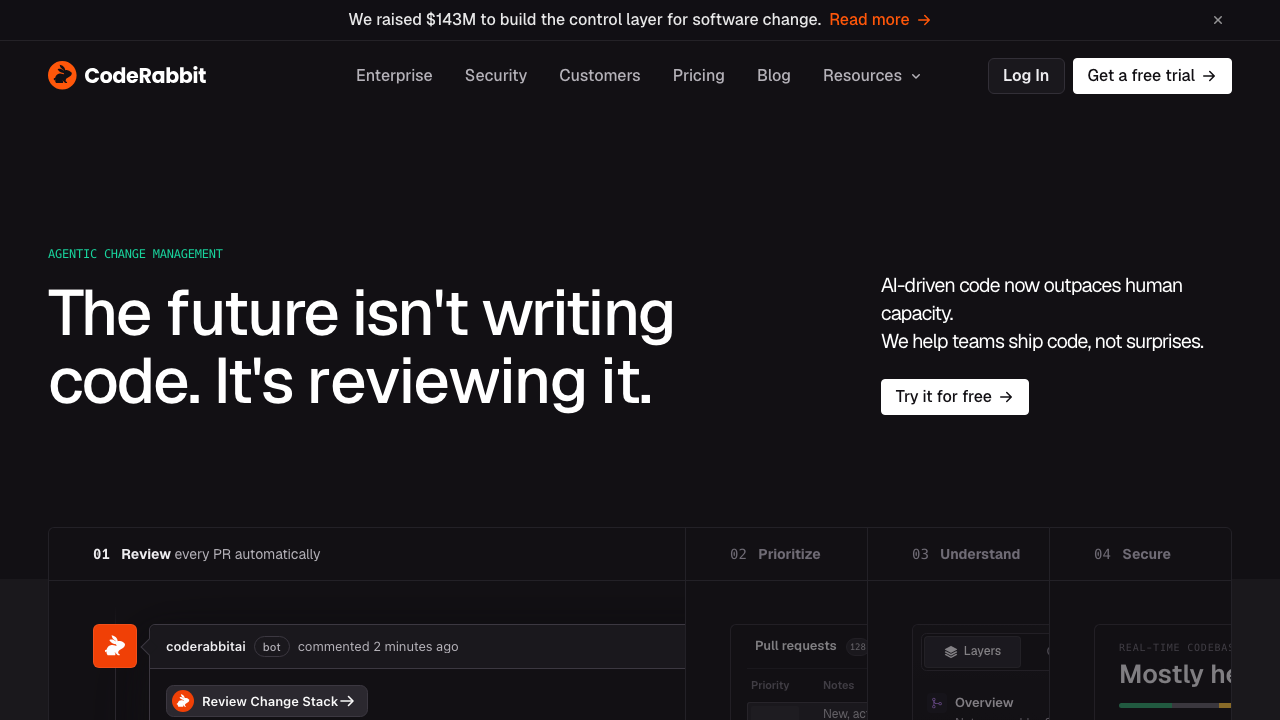
CodeRabbit is the most widely deployed product in this category and the most opinionated about the review being a conversation. It posts a summary of the change, then line-level comments, and it responds when you reply to it, so disagreeing with a comment is a thread rather than a resolve. It layers its own analysis on top of established open source static analysis tools, which means a meaningful share of its findings are deterministic rather than generated.
Pros
- Combining traditional static analysis with model review means the high-confidence findings are actually high confidence, not a model’s opinion
- Conversational replies let an author resolve a wrong comment by explaining, which is far less costly than arguing with a bot that cannot hear you
- Broad language coverage and a fast path to a working install on the major git hosts
- Configuration supports turning off whole categories and pointing it at your own instructions, which is where most of the noise reduction comes from
Cons
- Default verbosity is high, and an unconfigured install is the archetype of the week-two failure described above
- Summary comments on small pull requests restate what the diff already shows, which trains reviewers to skip the whole block
- Context beyond the changed files is limited compared with index-backed reviewers, so cross-file consequence is not its strength
Best for: Teams who want a review bot running this week and are willing to spend an hour on configuration in month one.
Pricing: Per seat and per month with a free tier for open source repositories, and higher tiers adding self-hosted and enterprise controls.
Greptile
Greptile’s premise is that review quality is a retrieval problem. It builds a graph-style index of the whole repository and uses it to reason about a change in context, so its intended output is the comment that requires knowing about a file nobody touched. That focus shows in its comment style, which is lower volume and more architectural than most competitors.
Pros
- Whole-repository indexing makes cross-file consequence reachable, which is the category of bug human reviewers most often miss
- Deliberately low comment volume, which is the correct design choice for the precision-over-recall tradeoff
- Learns from how your team responds to comments, so categories your reviewers consistently dismiss should quiet down
Cons
- Indexing your entire codebase on vendor infrastructure is a bigger security conversation than sending diffs, and some organisations will stop there
- Index freshness matters on a fast-moving repository, and stale context produces exactly the confident-but-wrong comment you are trying to avoid
- Fewer deterministic findings than tools built on static analysis, so more of the output is model judgment
Best for: Teams with a large interconnected codebase where the expensive bugs come from unexpected coupling rather than local mistakes.
Pricing: Per developer and per month, with enterprise tiers covering self-hosted deployment and volume arrangements.
Graphite
Graphite is a pull request workflow product first and a review tool second, and that ordering is the point. It is built around stacked pull requests, where a large change becomes a chain of small ones reviewed independently, and its AI reviewer operates inside that workflow. Small stacked diffs are easier for both humans and models to review well, so some of its advantage comes from the change shape rather than the model.
Pros
- Stacking attacks the actual cause of bad review, which is that large pull requests do not get reviewed carefully by anyone
- The reviewer sees a small coherent diff, which raises signal for the same underlying capability
- Merge queue and review workflow in one product, so the bot is part of the flow rather than a bolt-on commenter
Cons
- Adopting it means adopting stacked pull requests, which is a real change to how your team works and not a small one
- Value is highest for teams already doing trunk-based development with small changes, and lowest for teams shipping long-lived feature branches
- The review capability is one part of a broader platform, so you are buying a workflow decision rather than just a reviewer
Best for: Teams willing to change their branching model to get small reviewable diffs, with the AI review as a benefit of that change.
Pricing: Per seat and per month, with a free tier for individuals and small teams and enterprise plans above it.
Qodo
Qodo approaches review as one part of a quality loop that also includes test generation, treating the question “is this change correct” and the question “is this change tested” as the same question. Its review output tends toward change classification, checklist-style findings and suggested tests for the modified behaviour rather than prose commentary.
Pros
- Linking review findings to generated tests turns a comment into an artifact, which is more actionable than a paragraph
- Structured output, such as labelling the change type and listing focus areas, is easier to skim than free-form commentary
- Open source components mean you can inspect the review prompt and pipeline rather than trusting a black box
Cons
- Suggested tests need the same scrutiny as any generated test, and an accepted test that asserts current behaviour locks in the bug you were reviewing for
- The product surface spans several tools, which is more to evaluate and configure than a single-purpose reviewer
- Depth of whole-repository context is weaker than index-first competitors, so cross-file findings are less reliable
Best for: Teams who want review and test coverage addressed by one product and are disciplined about reviewing generated tests.
Pricing: Free tier plus per seat and per month paid plans, with enterprise options for self-hosted deployment.
Codacy
Codacy is a code quality platform that added AI review, rather than an AI review product that added quality tooling, and the difference shows in what it is good at. Its foundation is a large set of deterministic analysers with configurable quality gates that can block a merge, which is the part of the stack that produces zero false confidence.
Pros
- Quality gates that fail a build are enforceable in a way that a comment never is, which is what you need for standards you actually mean
- Deterministic analysers across many languages give you a stable baseline that does not change when a model does
- Trend reporting over time answers the question a manager will ask, which is whether anything is improving
Cons
- The generated review layer is less distinctive than purpose-built competitors, because the platform’s centre of gravity is static analysis
- Wide analyser coverage out of the box is a noise source until someone curates the rule set, and curation is unglamorous work that gets skipped
- Dashboard-first reporting pulls attention away from the pull request, where review decisions actually get made
Best for: Teams who want enforceable quality gates and trend reporting first, with AI commentary as an addition rather than the product.
Pricing: Per seat and per month with a free tier for open source, and self-hosted enterprise plans.
Sourcery
Sourcery began as a Python refactoring tool that suggested concrete code improvements inline, and grew into pull request review. That origin gives it a distinctive output style: rather than describing a problem, it proposes the replacement code, which is a much lower-effort thing for an author to act on.
Pros
- Suggestions arrive as applicable diffs rather than prose, so acting on a comment is one click instead of a rewrite
- Deep heritage in code quality and refactoring patterns, which produces consistent and predictable suggestions
- Works in the editor as well as on pull requests, so issues get fixed before review rather than during it
Cons
- Strongest on refactoring and readability, which is the class of comment most likely to land in the low-value bucket for a busy reviewer
- Language depth is uneven, with the Python heritage still visible in how good the suggestions are
- Less oriented toward finding correctness bugs across files, which is where review value is highest
Best for: Python-heavy teams who want consistent code quality suggestions applied early, in the editor, before a reviewer ever sees them.
Pricing: Free for open source with per seat and per month paid tiers for private repositories and teams.
GitHub Copilot
GitHub Copilot’s review capability reviews pull requests inside GitHub itself, requested like a human reviewer or configured to run automatically. Its advantage is not depth, it is that it is already there: no new vendor, no new data path, no new bill, and the findings land in the same review interface everyone already uses.
Pros
- Zero integration work for teams already on GitHub with Copilot licences, which removes the most common reason evaluations never finish
- Inherits your existing GitHub permissions and enterprise data handling, so the security review is mostly already done
- Comments land natively in the review interface with suggested changes, indistinguishable in workflow from a human reviewer
Cons
- Review depth is shallower than specialist tools, particularly for consequences spanning files it was not given
- Customisation is thinner, so shaping the comment mix to your standards is harder than with configuration-first competitors
- Being bundled means nobody chose it, and a tool nobody chose is a tool nobody owns or tunes
Best for: Teams already standardised on GitHub and Copilot who want a review layer with no procurement and no new data path.
Pricing: Included with paid Copilot plans, billed per seat and per month.
How to choose
Start by deciding what class of bug is costing you, because that determines the architecture you need, not the brand.
If your incidents come from local mistakes, missing validation, unhandled errors, bad string handling, a diff-aware tool with strong static analysis underneath is enough and will be cheaper and quieter. Combine it with strict linting and you have covered the ground.
If your incidents come from coupling, a change that was locally correct and broke an assumption elsewhere, only a whole-repository index can help you, and you should be prepared for the security conversation that comes with it.
If your problem is that pull requests are too big to review, no reviewer, human or generated, will fix that. Change the pull request size first. That is a workflow decision, and it is the one with the largest effect on review quality of anything in this article.
If your team already ignores your linter, do not buy a review bot. You have a standards-ownership problem and adding a second ignorable voice makes it worse.
Then pick with two constraints in mind. Whether your organisation will accept the vendor holding a full copy of the repository, which eliminates roughly half the field for some companies. And whether anyone will own the configuration, because an unowned bot converges on noise regardless of which one you bought.
| Tool | Context depth | Output style | Picks itself when |
|---|---|---|---|
| CodeRabbit | Diff plus retrieved files | Conversational, high volume by default | You want coverage this week and will tune it |
| Greptile | Whole-repository index | Low volume, architectural | Expensive bugs come from cross-file coupling |
| Graphite | Diff, inside a stacked workflow | Inline, on small diffs | You will adopt stacked pull requests |
| Qodo | Diff plus retrieval | Structured, with suggested tests | Review and test coverage are one initiative |
| Codacy | Deterministic analysers plus review | Gates and dashboards | You need enforceable blocking rules |
| Sourcery | File and diff scope | Applicable code suggestions | Python-heavy, quality-focused teams |
| GitHub Copilot | Diff plus repository signals | Native GitHub review comments | You are on GitHub and want zero new vendors |
Needs first-hand data: After four weeks of live use, pull the comment resolution data from your git host and measure what fraction of bot comments were resolved without any reply, edit or linked commit. That number is the week-two test running continuously, and it is the one to put in front of whoever approves the renewal.
Frequently asked questions
Should an AI reviewer be allowed to block a merge?
Only for deterministic findings. A failing lint rule, a failing test, a known vulnerable dependency, a policy violation: block on those, because they are reproducible and arguable in advance. Generated judgment should never block, because the appeal process is a human overriding a bot, which is either a rubber stamp or a source of resentment.
Does an AI reviewer replace human review?
No, and framing it that way guarantees the week-two failure. It is a first pass that catches a subset of mechanical problems before a human spends attention. The things human review is actually for, whether this is the right change, whether it fits the architecture, whether the team can maintain it, are not in scope for any of these tools.
How much configuration should we expect to do?
More than the vendor implies and less than a week. The high-value moves are turning off categories already covered by your linter and formatter, excluding generated files and vendored directories, and writing a short instructions file describing conventions your team actually enforces. That is an afternoon and it usually halves the noise.
What about reviewing code an agent wrote?
Same tools, higher stakes, and one extra rule: review the test changes separately from the source changes. The characteristic agent failure is adjusting an assertion so a suite goes green, and in a large diff that edit is invisible. Make it visible and most of the risk goes away.
Related reading
- Best AI coding assistants — the five-task suite, and how to score tools on your own repository.
- Best AI coding agents — the upstream source of the pull requests your reviewers now have to absorb.
- Best AI test generation tools — why a suggested test needs more scrutiny than a suggested fix.
- Best code quality and technical debt tools — the deterministic layer to fix before adding a generated one.
- Best code search tools — the indexing capability that separates shallow reviewers from deep ones.
- Best supply chain security tools — dependency findings belong in a scanner, not in a review comment.