A test generator points at your untested module and produces forty tests. They all pass. Coverage goes from eleven percent to eighty-four. Somebody screenshots the dashboard.
Now break the module. Change a greater-than to a greater-than-or-equal, invert a boolean, return an empty list instead of null. Run the forty tests again.
If most of them still pass, you did not gain a safety net. You gained forty files that have to be maintained, that will break on every legitimate refactor, and that will make the next engineer believe the module is tested when it is not. That belief is worse than the honest eleven percent, because the honest number made people careful.
This is the central problem of the category and it is structural rather than a quality issue with any particular vendor. A test generated by reading the implementation asserts what the implementation does. It cannot assert what the implementation should do, because nobody told it, and the code is not a specification. So the bug in line forty becomes an assertion in the test file, permanently, and the test now defends the bug.
There is one situation where that is exactly what you want, and it is migration work. Everywhere else it is the failure mode you are buying the tool to avoid. The rest of this article is about telling the two apart, and about the one check that does it reliably.
Key takeaways
- Coverage measures which lines ran, not whether anything would notice if they changed. A generated suite can reach high coverage and catch nothing.
- Mutation testing is the only cheap, automatable check that distinguishes generated coverage from meaningful coverage. Run it on the generated suite before you trust the number.
- A test that asserts current behaviour locks in current bugs. That is correct for characterisation before a migration and wrong everywhere else.
- Tests written against the implementation break on refactors that change nothing observable, which is how generated suites become the reason nobody refactors.
- Review generated tests harder than generated source. A wrong test is invisible in CI, because it passes.
Generated coverage versus meaningful coverage
Coverage is a record of which lines executed during the test run. That is all it is. It says nothing about assertions, and a test with no meaningful assertion covers exactly as many lines as a test with a good one.
That gap is where generated suites live. Four failure patterns show up constantly, and once you can name them you will see them in every generated suite you read.
The tautological assertion. The test calls the function, computes the expected value using the same logic the function uses, and asserts they match. It cannot fail. This happens more often than you would believe, particularly for anything involving date arithmetic or formatting, because the model does not know the right answer either and reaches for the only way to produce one.
The mock that asserts the mock. The test mocks every dependency, calls the function, and asserts that the mocks were called. It verifies that the code calls what it calls. Change the behaviour inside those calls and nothing fails, because nothing real ran.
The implementation-shaped test. Assertions on private state, on the number of internal calls, on the exact shape of an intermediate value. Fully coupled to how the code works rather than what it does. It passes today, fails on the first honest refactor, and every failure is a false alarm that costs someone twenty minutes.
The happy path at scale. Forty tests, all supplying well-formed input, none supplying null, an empty collection, a boundary value, a duplicate, or a string with a newline in it. Coverage rises because the happy path traverses most lines. The bugs live on the paths nobody generated.
Meaningful coverage is the opposite of all four: an assertion on observable behaviour, derived from something other than the implementation, with inputs chosen because they are interesting rather than because they are convenient.
The practical consequence is that you cannot evaluate a test generator by looking at the coverage delta. You have to evaluate it by breaking the code.
Mutation testing: the check that tells them apart
Mutation testing is a technique rather than a product, and it is the right tool for exactly this job. It should be part of how you evaluate every tool in this article.
The mechanism is simple. A mutation engine makes small semantic changes to your source, one at a time. It flips a comparison operator, negates a condition, replaces a return value with a default, removes a statement, changes a boundary. Each mutated version is called a mutant. It then runs your test suite against each mutant.
If a test fails, the mutant is killed, which means your suite noticed the change. If every test still passes, the mutant survived, which means you have code whose behaviour can change with nothing objecting. The fraction killed is your mutation score, and unlike coverage it is a direct measurement of whether the suite would catch a regression.
Mature mutation engines exist for most major languages and integrate with normal build tooling.
What it gives you
A ground-truth answer to the only question that matters about a generated suite. Run it against the module before generation, generate tests, run it again, and the change in mutation score is the actual value the tool delivered. Coverage will move a lot. Mutation score is what moves honestly.
It also localises the problem. Surviving mutants point at specific lines whose behaviour is unprotected, which is a far more actionable output than a coverage report full of red. In practice the surviving mutants cluster exactly where the four failure patterns above are concentrated, so it doubles as a review aid.
And it is a defensible acceptance criterion. “Generated tests must raise the mutation score on the target module” is a rule that cannot be satisfied by producing more tests, which is the incentive you want.
What it does not do
It is slow. Every mutant requires a test run, so a naive setup multiplies your suite runtime by the number of mutants. This is why it belongs on changed files in CI or on a nightly job over one package, not on every commit across a monorepo. Incremental and diff-scoped modes exist in the better engines and are what make it practical.
It produces equivalent mutants: changes that alter the code without altering observable behaviour, which no test can or should catch. Those are permanent false negatives and they mean a perfect score is neither achievable nor a goal. You are watching the direction of the number, not the number.
It says nothing about tests you do not have for behaviour that does not exist yet, and nothing about integration or contract correctness across services. It measures how well a suite defends the code that is there.
And it is not a substitute for reading the tests. A suite can kill mutants with assertions so coupled to the implementation that it will break constantly. Mutation score catches the useless test; only a human catches the expensive one.
Needs first-hand data: Take three representative modules, record the mutation score before generation, generate tests with each candidate, and record the score after. Report the delta per tool alongside the number of generated tests, so you can see how many tests each tool needed to buy one point of real protection.
Where asserting current behaviour is exactly right
There is one job where the whole objection above inverts, and it is worth stating clearly because it is the highest-value use of these tools.
Before a framework upgrade, a language port or a risky refactor, you want a suite that pins down what the system currently does, including the parts that are wrong. That is a characterisation suite, and generated tests are an excellent way to build one precisely because they assert current behaviour without judgment. You are not trying to encode intent. You are trying to detect change.
The rules for that use are different. Generate broadly, accept tests you would normally reject, keep them for the duration of the migration, and then delete them deliberately rather than by neglect. A characterisation suite left in place after the migration becomes a suite that fails on every legitimate change, and a team that habitually deletes failing tests has lost more than the suite ever gave them. The full sequence is in AI tools for legacy code migration.
The other high-value variant is capture rather than generation: record real traffic against the running system and replay it. Production inputs contain the cases nobody imagines, which is exactly what generated inputs lack.
Reviewing a generated test is not like reviewing generated code
Generated source that is wrong usually announces itself. It fails to compile, a test goes red, a reviewer notices the diff does not match the ticket.
Generated tests that are wrong pass. That is their defining property, and it means the normal safety net is inverted: CI cannot help you, so review is the only gate. Three rules make that review tractable.
Read the assertions first, not the setup. Most of a generated test is arrangement. The value is in one or two lines. If the assertion is on a mock, on internal state, or is computed rather than literal, the test is suspect regardless of how thorough the setup looks.
Check the expected values against something other than the code. A specification, a ticket, an API contract, your own understanding. If the only justification for an expected value is that the function currently returns it, you have a characterisation test, and you should know that you are accepting one.
Review test diffs separately from source diffs. This matters most when an agent is producing both, because the single most expensive move in agentic development is adjusting an assertion to make a suite go green. In a large diff that edit is invisible. Split the review and it becomes obvious. The same argument appears in AI code review tools.
One more rule for anyone running agents: never let the same run both fix a bug and edit the test that covers it. Require that the failing test exist first, and that the fix be evaluated against a test the agent is not permitted to touch.
Diffblue
Diffblue Cover generates unit tests for Java using reinforcement learning against the code rather than a language model writing test text. It explores inputs, observes behaviour and produces JUnit tests that reflect what the code does, deterministically and without sending source to a model provider. It is the most different product in this article and the most honest about what it produces, which is characterisation coverage at scale.
Pros
- Deterministic generation with no model provider in the path, which makes it viable in environments where source cannot leave the network
- Operates autonomously across very large Java codebases, which is the scale where hand-writing characterisation tests is impossible
- Output is plain JUnit with no runtime dependency on the vendor, so the tests outlive the tool
- Honest positioning: it describes what it produces as reflecting current behaviour, which is the correct claim
Cons
- Java only, so it is irrelevant to most of the industry
- Produces characterisation tests by design, so it locks in existing bugs and you must treat the output accordingly
- Generated tests can be verbose and mock-heavy, which is real maintenance weight on a codebase already carrying too much
Best for: Enterprise Java teams who need a safety net over a large untested codebase before a migration, with a hard constraint against source leaving the network.
Pricing: Commercial licensing for teams and enterprises, with a free community edition for individual use.
Qodo

Qodo, previously known as CodiumAI, treats test generation and code review as the same problem: deciding whether a change is correct. Its test capability analyses a function, proposes behaviour cases in plain language, and generates tests for the ones you accept. That intermediate step is the important design choice, because reviewing a list of described behaviours is much faster than reviewing forty test bodies.
Pros
- Proposing behaviours before generating code puts the review step where it is cheap, which is the best ergonomic idea in this category
- Works in the editor and on pull requests, so tests arrive with the change rather than in a later cleanup sprint
- Multi-language support across the mainstream stacks
- Open source components mean the generation pipeline is inspectable rather than a black box
Cons
- Proposed behaviours are still derived from the implementation, so the tool cannot tell you about a case the code forgot
- Accepting suggestions quickly is easy, and a fast accept path is also a fast path to a suite full of implementation-shaped assertions
- Depth on complex integration scenarios trails what a specialist harness can do
Best for: Teams who want tests generated alongside changes in the normal pull request flow, with a review step that is quick enough to actually happen.
Pricing: Free tier plus per seat and per month paid plans, with enterprise options including self-hosted deployment.
Keploy
Keploy takes the opposite approach to everything else here: it does not read your code. It records real traffic against a running application, capturing requests, responses and the downstream calls each one made, then replays them as test cases with the dependencies mocked from the recording. The inputs are real, which solves the problem that generated inputs are always the ones somebody thought of.
Pros
- Test inputs come from actual traffic, so they include the malformed, ancient and pathological cases nobody would write by hand
- Downstream calls are captured as mocks automatically, which removes the most tedious part of writing integration tests
- Language-agnostic at the network layer, so a polyglot service estate gets one approach
- Excellent fit for pre-migration characterisation, where representativeness matters more than intent
Cons
- Records current behaviour by definition, so it pins bugs in place and is not a specification
- Recording production traffic raises data handling questions immediately, because payloads contain whatever your users sent
- Covers what traffic exercised, so cold paths and rare branches stay untested no matter how long you record
Best for: Service teams who need realistic integration coverage fast, particularly before a rewrite or an upgrade.
Pricing: No vendor bill for the open source project. A commercial cloud offering exists for teams wanting hosted recording and management.
EarlyAI
EarlyAI works inside the editor, generating and running unit tests as you write rather than as a batch job over an existing codebase. The design bet is on timing: a test proposed while the function is still in your head is a test you can evaluate properly, where a test proposed three weeks later is one you will accept without reading.
Pros
- Generating at authoring time is when the author has the context to judge whether an assertion is right
- Tests are executed and validated as they are produced, so obviously broken output does not reach you
- Low-friction editor workflow means it gets used, which is more than can be said for most test tooling
Cons
- Oriented to new and actively changing code, so it does little for the large untested legacy module that is your actual problem
- Unit scope, so integration and contract behaviour are out of reach
- A newer product with a smaller track record than the established options, so fewer teams have hit the limits before you
Best for: Teams who want tests written alongside new code by the person who wrote it, rather than retrofitted later by someone else.
Pricing: Free tier with per seat and per month paid plans for teams.
Claude Code
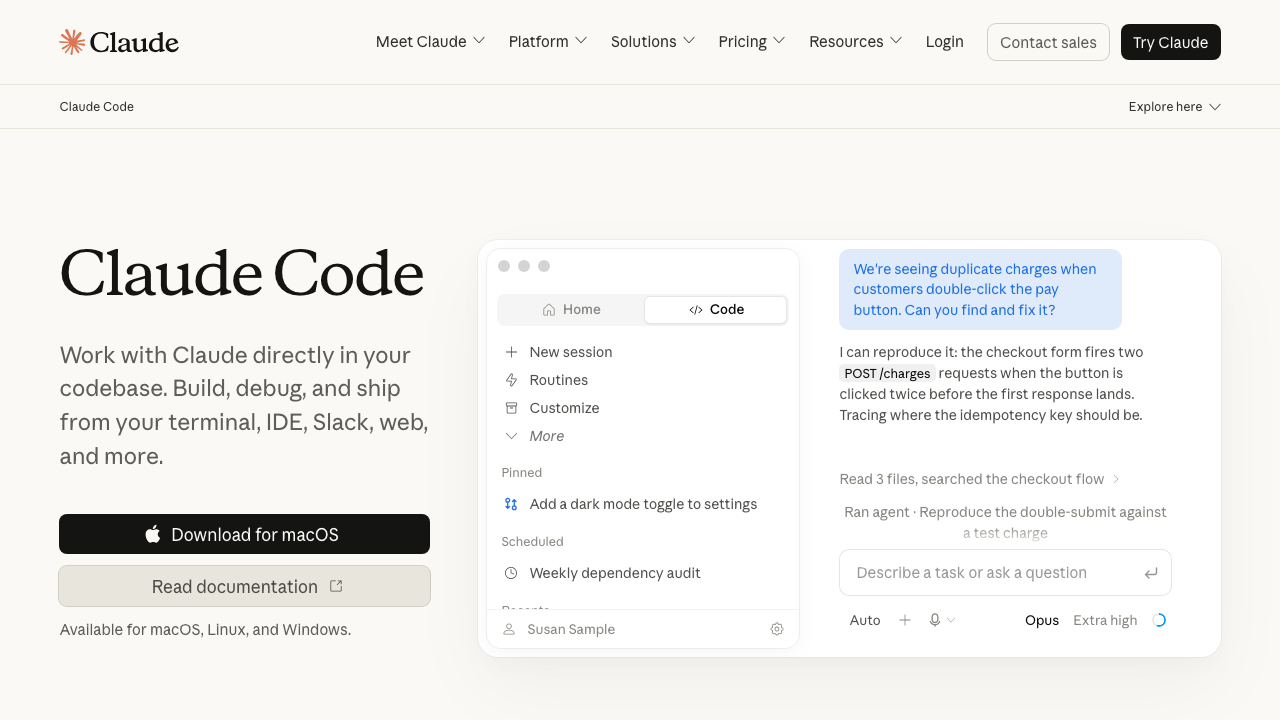
Claude Code is Anthropic’s agentic coding tool, running as a CLI, a desktop app for Mac and Windows, a web app, and VS Code and JetBrains extensions. For testing its relevant property is that it explores: it reads the module, the neighbouring tests, the fixtures and the helpers, so generated tests follow your existing conventions instead of importing a style from somewhere else. It also runs the suite, sees failures, and iterates, which is where most of the value and most of the risk sits.
Pros
- Reads your existing test files first, so output matches your framework, fixtures and naming rather than a generic template
- Can run the mutation testing loop itself: generate, run the engine, examine surviving mutants, write tests targeting them
- Handles integration and end-to-end tests, not only unit tests, because it can run the application and the suite
- Explaining what a module does before testing it is a genuinely useful precursor artifact on unfamiliar code
Cons
- Iterating against a failing suite creates pressure toward making tests pass rather than making code correct, and that has to be constrained explicitly
- Not a batch tool: generating coverage across hundreds of files is slower and less reproducible than a dedicated generator
- Output quality varies with instruction quality, so a vague request produces happy-path tests like everything else
Best for: Teams who want tests that match their conventions, and who will drive a mutation testing loop rather than accept a coverage number.
Pricing: Included with consumer subscription tiers, or usage-based against the API where teams want per-seat control and spend reporting.
GitHub Copilot
Copilot generates tests the way it generates everything else: inline in the editor from the surrounding context, or through chat when you ask for a test for a selected function. Its advantage is not depth, it is proximity. It is already installed, already approved, and requires nobody to evaluate anything.
Pros
- Zero additional procurement or data path for teams already licensed, which is why it gets used when specialist tools do not
- Convention-aware within the open file and nearby tests, so output usually fits the project
- Fits the smallest possible unit of work: write function, generate test, move on
Cons
- No batch capability, so a large untested module is a long manual grind function by function
- Strong bias toward happy-path assertions, which is precisely the pattern that inflates coverage without adding protection
- No notion of what it has and has not covered, so there is no completeness signal at all
Best for: Incremental test writing alongside new code by teams already standardised on GitHub and Copilot.
Pricing: Included with paid Copilot plans, billed per seat and per month.
How to choose
Decide what you are actually trying to buy, because these tools solve three different problems and only one of them is yours this quarter.
If you need a safety net over a large untested codebase before touching it, you want batch characterisation coverage, and you should accept that the tests encode current bugs. On Java that points at a dedicated batch generator. On a service with real traffic, recorded replay beats anything generated from source. Set the expectation internally that these tests are temporary scaffolding, and put a deletion date on them.
If you want new code to arrive tested, you want generation at authoring time in the editor, by the person with the context to judge the assertions. This is the use with the best long-term return and the least dramatic coverage chart.
If you have a specific module that keeps breaking, do not start with generation at all. Run mutation testing on the existing tests first. Surviving mutants will tell you exactly which behaviours are unprotected, and then you generate against that list. Generating blind and hoping the coverage number moves is how you end up with a large suite and the same incidents.
Whatever you choose, adopt one acceptance rule before the first test lands: a generated suite is accepted only if it raises the mutation score on the target module. That rule cannot be satisfied by producing more tests, which is the entire reason to have it. Coverage targets can be, which is why coverage targets produce the suites everybody complains about. The deterministic quality layer underneath all of this is in code quality and technical debt tools.
| Tool | Generation method | Scope | Picks itself when |
|---|---|---|---|
| Diffblue | Deterministic exploration, no model | Java unit tests, batch | Large Java codebase, source cannot leave the network |
| Qodo | Behaviour proposals then generation | Unit tests in editor and pull requests | You want a cheap review step before the test body exists |
| CodiumAI | (former name of Qodo, same product) | You are searching for the old brand | |
| Keploy | Recorded traffic replay | Service-level integration tests | Real inputs matter more than intent |
| EarlyAI | Editor-time generation and execution | Unit tests on new code | Tests should be written by the author, now |
| Claude Code | Agentic, reads existing tests first | Unit, integration, end to end | You will run a mutation loop rather than chase coverage |
| GitHub Copilot | Inline completion and chat | One function at a time | Already licensed, incremental work only |
| Mutation testing | (technique, not a product) | Any suite | You need to know whether any of the above worked |
Needs first-hand data: Track two numbers for a quarter after adopting any of these: the mutation score on the modules with generated tests, and the number of test-only commits that changed an assertion without changing source. The second number is your early warning that the suite is being edited to stay green rather than to stay correct.
Frequently asked questions
Is CodiumAI the same thing as Qodo?
Yes. CodiumAI is the earlier name of the company and product now called Qodo. If you are comparing them as two options, you are comparing one product with itself.
Should I set a coverage target for generated tests?
No. A coverage target is a metric that a generator can satisfy without producing value, which makes it actively harmful once a tool is in the loop. Set a mutation score target on modules in scope instead, and let coverage be a diagnostic you look at rather than a goal you chase.
Are generated tests worth maintaining long term?
Only the ones that survive a deliberate review of their assertions. Generated characterisation suites should be treated as temporary and deleted at the end of the migration they supported. Generated unit tests with assertions someone verified against a specification are ordinary tests and stay.
How do I stop an agent from editing tests to make them pass?
Structurally rather than by instruction. For bug fixes, require the failing test to exist before the fix and make the test file read-only for that run. For everything else, review test diffs separately from source diffs. An instruction not to cheat is not a control.
Does high mutation score mean the tests are good?
It means they would notice a regression, which is most of what you want. It does not mean they are maintainable. A suite can kill mutants using assertions so tightly coupled to the implementation that every refactor turns red. Mutation score catches the useless test, and only a human reading the assertions catches the expensive one.
Related reading
- Best AI coding assistants — the five-task suite, where task four is exactly this problem and is graded by injecting faults.
- Best AI tools for legacy code migration — the one context where asserting current behaviour is the correct goal.
- Best AI code review tools — why a suggested test needs harder scrutiny than a suggested fix.
- Best AI coding agents — the agents that will run the generate-and-iterate loop, and how to constrain it.
- Best code quality and technical debt tools — the deterministic layer that should be right before any of this is worth doing.