The fastest way to get customer identity wrong is to buy a workforce identity product and point it at consumers. The protocols are the same. Almost nothing else is.
A workforce directory has a known, bounded population. Somebody in HR creates the account, somebody in IT can reset it, and a user who cannot log in raises a ticket and waits. Nobody in that population is trying to register ten thousand accounts an hour, nobody is asking you to delete every trace of them under a legal deadline, and nobody abandons the company because the signup form asked for a phone number.
Consumer identity inverts every one of those. The population is unbounded and self-registering. There is no help desk, so every recovery path has to be self-service and every self-service path is also an attack surface. A meaningful share of registration traffic is automated. Users arrive from six different social providers and expect to find the same account. Deletion is a legal obligation with a clock on it, and it has to reach every system that ever received a copy of the data. And every additional field on the signup form costs you real registrations, which is why progressive profiling exists at all.
That is the gap this category fills. CIAM platforms are identity products designed for a population that did not ask to be managed, arrives at unpredictable scale, and has legal rights over the data you hold.
Key takeaways
- Workforce identity optimises for control over a known population. Consumer identity optimises for conversion, self-service recovery and legal data obligations over an unknown one. Buying the wrong one is expensive to reverse.
- Bot registration is a load and fraud problem that arrives before real traffic does, and it distorts every metric you were going to use to evaluate the platform.
- Deletion at scale is the hardest CIAM requirement and the least demoed. Ask specifically how deletion propagates to backups, logs, analytics exports and downstream systems.
- Consent and preference state is identity data. If it lives in a marketing tool instead of the identity platform, you will eventually make a decision about a user from a stale copy of it.
What actually changes at consumer scale
Five things behave differently, and each one turns into a procurement question.
Registration is a funnel, not a provisioning step. Every field, every verification interstitial, every redirect is a place people leave. That is why progressive profiling exists: collect an email and nothing else at signup, then ask for the phone number at the point where it is obviously useful, like enabling MFA or arranging a delivery. A workforce product has no concept of this because nobody abandons onboarding at their new employer.
Recovery has to be self-service and therefore attackable. Password reset, email change, MFA reset and account recovery are the four flows that fraud actually targets, because they are the ones designed to work for someone who has lost access. Every improvement in recovery usability is a potential improvement in takeover success, and the design work is in finding the balance rather than in shipping the feature.
Identity is fragmented across providers by default. The same human signs up with email in January, with a social provider in March, and on a phone in June. Without account linking you now have three accounts, three sets of entitlements, and a support conversation. Linking rules based on verified email are the standard approach, and they carry a real risk: linking on an unverified email is an account takeover primitive.
The data has legal weight. Consent state, preference state, data residency, retention, deletion and portability are all live obligations, and they are obligations on identity data specifically. Where they live matters as much as whether they exist.
Traffic is spiky and partly hostile. A campaign, an app store feature or a seasonal peak can multiply registration volume without warning, and a credential stuffing run looks superficially similar to a successful campaign. Capacity planning and abuse detection are the same conversation.
Progressive profiling, consent and preference state
These three often get lumped together as “the profile”, and they have genuinely different requirements.
Progressive profiling is about when you ask. The mechanism is a schema where most attributes are optional, plus a rule engine that can interrupt a session to collect one when it becomes necessary. What to check: can a field be made conditionally required based on which product area the user entered, can you collect it without a full page redirect, and does a partially complete profile break anything downstream.
Consent is about proof. You need to record what the user agreed to, which version of the policy text that was, when, and through which interface. When the policy changes you need to re-collect rather than silently carry the old consent forward. The audit question is not “is the flag set” but “can you demonstrate how it came to be set”, and that is a different data model: an append-only record of consent events rather than a boolean on the user.
Preferences are about communication. Channel-level and topic-level opt-in, usually overlapping with a marketing platform that also thinks it owns this data. Pick one system of record deliberately. Two copies drift, and the direction they drift is always toward sending a message to somebody who opted out.
The failure mode that catches people is storing consent in the marketing tool because that is where the campaigns run. Then the user deletes their account in the identity platform, the marketing tool never hears about it, and a message goes out to a person whose record you are legally required to have destroyed.
Needs first-hand data: Take one real user through your intended flow and trace every system that ends up holding their email address: identity platform, marketing tool, analytics, data warehouse, support desk, logs, backups. Write the list down. That list is your deletion scope, and almost every team finds it is twice as long as they expected.
Bot registration is a load problem before it is a fraud problem
Open a public signup form and automated traffic finds it, usually within days. The motives vary: SEO spam, promotional abuse against free credits, credential stuffing to validate leaked password lists, and card testing where your signup is the cheapest way to get a session.
What it costs you, in order of how quickly you notice:
Email and SMS spend. Every fake registration triggers a verification message. SMS is metered and internationally priced, so an SMS-based flow under automated attack is a bill arriving in real time. This is the one that gets noticed first because finance notices it.
Sender reputation. Verification emails to addresses that do not exist generate bounces, and a high bounce rate degrades deliverability for everyone, including the real users whose password resets now land in spam. Recovering a damaged sending reputation takes weeks.
Database and metric pollution. Registration counts, activation rates and cohort analysis all become fiction. The most expensive version of this is a growth decision made on numbers that were mostly bots.
Genuine load. Registration is one of the most expensive operations an identity system performs, since it writes, hashes a password and sends a message. A sustained automated run is a real capacity event.
The defences are layered rather than singular: rate limiting by IP and by fingerprint, a challenge that escalates on suspicion rather than firing for everyone, disposable email domain detection, phone number validation before an SMS is sent, and anomaly detection on registration rate per source. What you are evaluating in a CIAM platform is whether these are built in and tunable, or whether you will be assembling them from a separate bot management vendor and your own code.
The other thing to check is whether abuse signals are visible to you. A platform that silently blocks traffic without telling you what it blocked is a platform where you cannot distinguish a successful campaign from a successful attack.
Deletion at scale, which is the requirement nobody demos
A deletion request under GDPR or comparable regimes has a legal deadline and is not satisfied by flipping a status column. Four parts, all of which need an answer before you sign anything.
Propagation. The identity platform holds the canonical record, but copies exist in your analytics, your warehouse, your support tool, your email provider and your logs. Deletion has to reach all of them. Whether the platform emits a deletion event you can subscribe to, or whether you find out by polling, decides how you build this.
Backups. You cannot selectively delete from an immutable backup, and everybody knows this, so the accepted practice is a documented retention window after which the backup expires, plus a suppression list so that a restore does not resurrect a deleted record. Ask what the platform’s backup retention is and whether restores reapply deletions.
Logs and audit trails. Authentication logs contain identifiers. Audit obligations often require keeping them. These two requirements are in direct tension and the resolution is usually pseudonymisation rather than deletion, which needs to be a designed behaviour rather than something you retrofit.
Rate and volume. One deletion is an API call. A data broker request covering a large batch, or a regional withdrawal, is a bulk operation. Ask whether bulk deletion is a supported operation with a defined rate, or whether it means driving the single-record API in a loop for a week.
The related requirement is data residency. If you must keep EU user data in the EU, you need to know not just where the primary store is but where backups, logs, support tooling and any machine learning features process it. Residency claims that cover only the primary database are common and are not what the obligation means.
Needs first-hand data: Issue a deletion request for a test account that has been fully exercised, with a social login linked, an MFA factor enrolled, a support ticket raised and a few days of activity logged. Then go looking for that identifier in every downstream system. Record what survived and how long it took to disappear. That is your actual compliance position.
LoginRadius
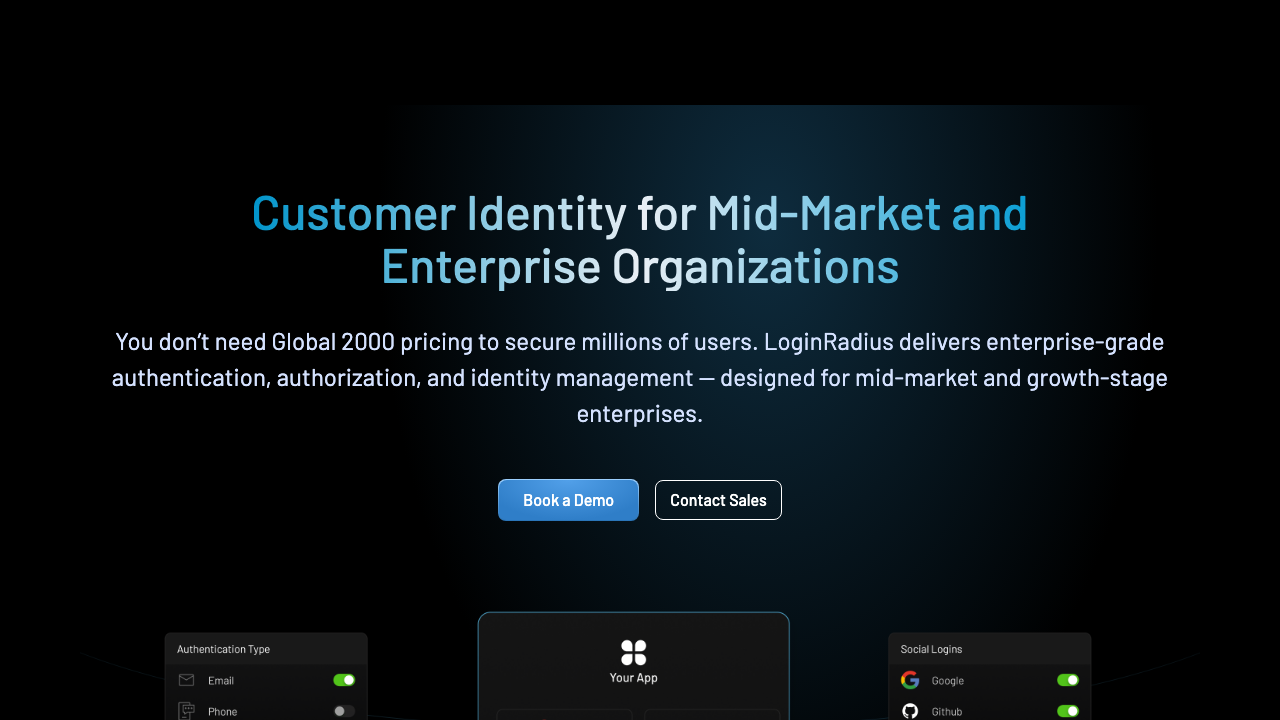
LoginRadius is a CIAM platform built specifically for consumer-scale identity rather than adapted from a workforce product: a broad social login catalogue, configurable registration and progressive profiling schemas, consent and preference management as first-class objects, and deployment options including regional data residency. Its centre of gravity is companies with large consumer user bases and real regulatory obligations across multiple regions.
Pros
- Consent and preference management are native identity objects with versioning, rather than a flag you maintain in a marketing tool
- Very broad social and regional identity provider coverage, including providers that matter outside North America and Europe
- Data residency options are a deployment decision rather than a contractual promise, which is what multi-region obligations actually require
- Registration schema and progressive profiling are configurable without code, so form changes are not release-gated
Cons
- Enterprise-oriented sales and onboarding, so it is a poor fit for a team that wants to swipe a card and ship this afternoon
- Breadth of configuration means real implementation effort and a learning curve before the platform pays off
- Developer-experience polish in SDKs and local iteration is behind the developer-first products in this category
- Less community content and fewer public code examples than the largest platforms, so troubleshooting leans on the vendor
Best for: Consumer brands with large user bases, multi-region data residency requirements and genuine consent obligations, where the identity data model matters more than time to first login.
Pricing: Enterprise contracts scoped by monthly active users, with regional deployment, advanced fraud capability and support tiers negotiated as part of the agreement rather than self-serve.
Auth0
Auth0 is the most widely adopted general-purpose identity platform, now part of Okta, and it covers consumer identity well because it was built for developers first and enterprise second. Its defining mechanism is Actions, server-side code you attach to points in the authentication pipeline, which means almost any consumer requirement can be implemented even when it is not a product feature.
Pros
- Actions let you insert arbitrary logic into login, registration and token issuance, which covers the long tail of consumer requirements no product anticipates
- Very large ecosystem of quickstarts, SDKs and community answers, so integration questions are usually already solved in public
- Strong social connection coverage plus account linking with a documented model for merging identities
- Attack protection features including breached password detection and bot detection are available inside the platform rather than requiring a separate vendor
Cons
- Costs scale with monthly active users and can become uncomfortable at consumer volume, which is exactly where CIAM lives
- Several capabilities that consumer products eventually need sit in higher tiers or add-ons, so the effective price is not the headline one
- Rules and Actions accumulate into a body of undocumented business logic that is hard to test and easy to break
- Now inside Okta, and the product boundary between Auth0 and Okta customer identity has been a moving target
Best for: Product teams who want a mature platform they can extend with code at every step, and who are willing to manage the cost curve as their user base grows. The migration mechanics matter if you expect to leave later.
Pricing: Metered on monthly active users with tiers gating enterprise connections, attack protection and support levels, plus separate treatment for machine-to-machine tokens.
Okta Customer Identity

Okta sells customer identity in two shapes and the distinction is the most important thing to understand before buying. The Customer Identity Cloud is Auth0 under Okta ownership, developer-oriented and extensible. The other path is customer identity built on Okta’s workforce platform, which brings that platform’s administrative model, policy engine and directory integration to an external user population. They have different data models, different admin experiences and different strengths.
Pros
- One vendor relationship covering both employee and customer identity, which simplifies procurement, security review and contract negotiation
- The workforce platform’s policy engine and lifecycle management are genuinely mature, and that maturity carries over
- Strong enterprise governance, audit and administrative delegation, which matters when identity is in scope for compliance programmes
- Large partner and integration network, so connecting identity to the rest of an enterprise stack is well-trodden
Cons
- Two overlapping customer identity products from one vendor is a real source of confusion, and picking the wrong one is an expensive correction
- The workforce-derived path carries assumptions from a bounded, administered population that do not fit self-registering consumers
- Enterprise pricing and sales motion, with little that a small team can evaluate without engaging sales
- Consumer-specific capability like progressive profiling and consent management is less developed than in platforms built for CIAM first
Best for: Enterprises already standardised on Okta for workforce identity who want customer identity under the same contract and governance model. Okta alternatives separates the two buyer types in more detail.
Pricing: Enterprise agreements with customer identity metered on monthly active users and workforce metered per employee, with feature tiers and support negotiated separately.
Descope
Descope’s distinguishing feature is a visual flow builder for authentication journeys: signup, login, step-up, recovery and risk-based branching composed as a drag-and-drop workflow rather than written in code. For consumer identity that is a strong fit, because the flows you most want to iterate on are exactly the ones that affect conversion, and iterating on them normally requires a deploy.
Pros
- Flows are edited and versioned outside your release cycle, so A/B testing a registration step does not need an application deploy
- Passwordless and passkey methods are first-class, which suits consumer products trying to remove password friction entirely
- Risk-based branching inside the flow lets you escalate to MFA only for suspicious sessions rather than for everyone
- Fast to a working integration, with SDKs that keep the application side thin
Cons
- The flow builder becomes the place your authentication business logic lives, which is a portability problem if you ever leave
- Newer vendor than the established platforms, so long-term viability is a real part of the decision for a system this central
- Deep consumer data management, consent versioning and multi-region residency are thinner than the CIAM-first platforms
- Visual flows are easy to change and therefore easy to change carelessly, and review discipline has to be imposed rather than inherited
Best for: Consumer product teams who iterate on signup and login experience frequently and want that iteration decoupled from application releases.
Pricing: Metered on monthly active users with free and self-serve tiers, and enterprise features and support on negotiated plans.
Frontegg
Frontegg is built around the idea that identity comes with an administrative surface the customer expects to use themselves: user management, team invitations, roles, audit logs and SSO configuration, all as embeddable components in your own application. That is a B2B posture more than a consumer one, and it is worth naming plainly, because in a CIAM comparison Frontegg fits products where the “consumer” is a member of an account rather than a standalone individual.
Pros
- Prebuilt admin components mean the account settings and team management screens are configuration rather than a quarter of frontend work
- Self-serve SSO configuration by the customer removes the per-customer setup call that otherwise scales linearly with deals
- Multi-tenant model is native rather than layered on, including roles and permissions per tenant
- Audit log surfaces are built in, which is usually an unbudgeted build when it first gets requested
Cons
- Oriented to B2B account structures, so a pure business-to-consumer product pays for tenancy machinery it does not need
- Embedded components carry the vendor’s UX assumptions, and deep customisation runs into limits
- Consumer-specific capability such as consent versioning, progressive profiling and social login breadth is not the focus
- Coupling to their SDKs and components makes a later migration heavier than a protocol-level integration would be
Best for: B2B products where users belong to accounts and the buyer expects self-serve administration, SSO setup and audit logs inside your product.
Pricing: Metered on monthly active users with tiers, and enterprise capabilities including advanced security and support on higher plans.
Stytch
Stytch is an API-first authentication platform with a deliberate bias toward passwordless methods and, unusually for this category, real fraud and bot prevention capability in the same product. That combination matters for consumer identity because the two problems are the same problem: removing password friction increases signup conversion, and increased signup conversion is also increased automated abuse.
Pros
- Device fingerprinting and bot detection sit alongside authentication rather than requiring a second vendor and a second integration
- Passwordless methods including magic links, one-time passcodes and passkeys are the primary path rather than an add-on
- API-first design gives you complete control of the interface, which consumer products with strong brand requirements usually need
- Separate B2B and consumer product lines, so the model you adopt matches the population you actually have
Cons
- API-first means you build the UI, and for a team that wanted a drop-in login box that is weeks of work
- Passwordless-first design makes password-based flows feel like a secondary path, which is awkward if you are migrating an existing password population
- Consent management and data residency capability is thinner than the CIAM-first platforms
- Smaller ecosystem than Auth0, so fewer community examples for unusual integrations
Best for: Consumer products going passwordless that also need bot and fraud defence on registration, and that want to own the interface completely.
Pricing: Metered on monthly active users with separate metering for fraud and device fingerprinting capability, and enterprise plans negotiated.
Zitadel
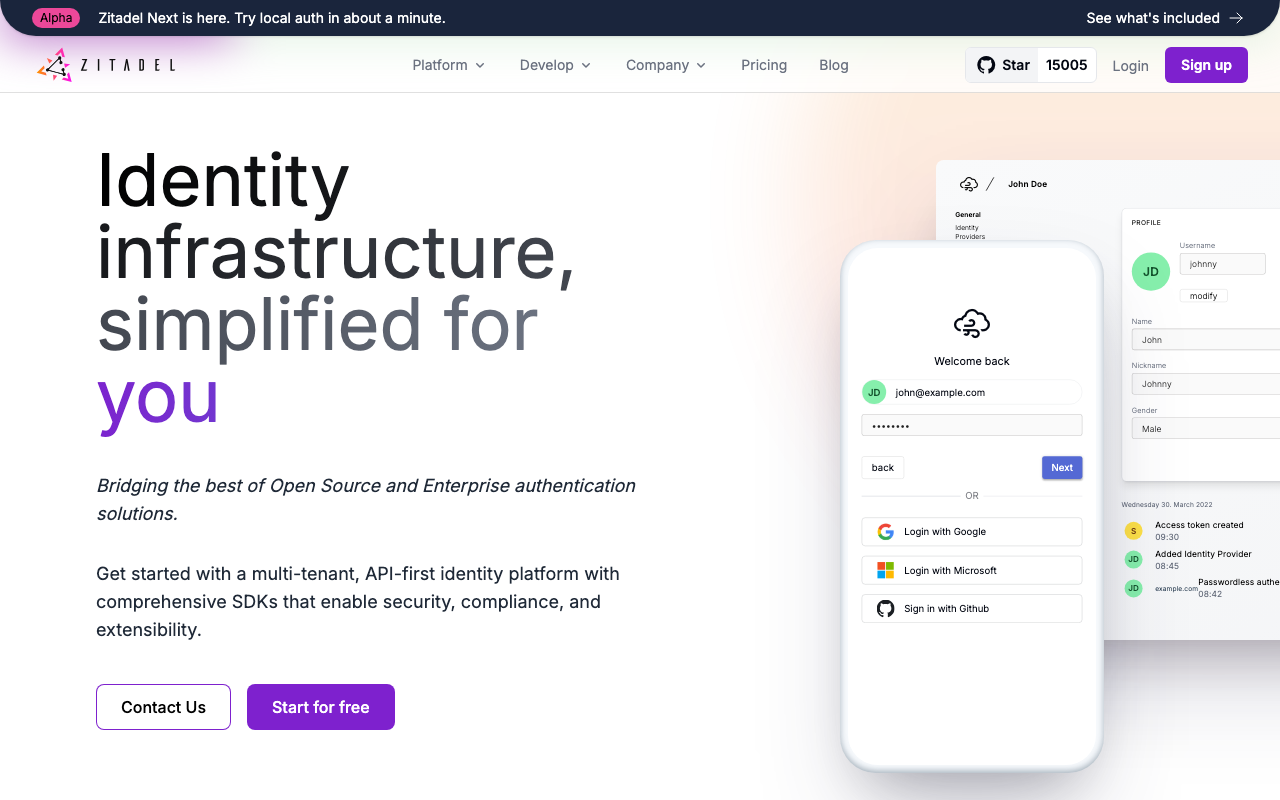
Zitadel is an identity platform available both as a managed cloud and as self-hosted open source, built on an event-sourced data model with organisations as the tenancy primitive. In a CIAM context its two arguments are the audit trail, which falls out of the architecture rather than being a bolted-on feature, and the fact that you can run the same code yourself if residency or cost eventually demands it.
Pros
- Event sourcing produces a complete immutable history of every identity change, which is the strongest audit position in this comparison
- Same codebase in the cloud and self-hosted, so residency requirements are answerable by relocating rather than renegotiating
- Passwordless and passkey flows are central to the product rather than an addition
- Organisations model both consumer accounts and business tenants, so a product that grows from B2C into B2B does not need a second platform
Cons
- Consumer-specific capability such as consent versioning, preference centres and progressive profiling is less developed than the CIAM-first platforms
- Social login catalogue is narrower than the platforms that compete on breadth
- Self-hosting introduces an unfamiliar operational shape, since event stream growth and projection rebuilds are not standard relational operations
- Smaller community, so consumer-scale operational experience is thinner in public
Best for: Teams that want a modern identity platform with a strong audit trail and an exit hatch to self-hosting, and whose consent requirements are straightforward.
Pricing: Managed cloud metered on usage with a free tier, alongside a free self-hostable open source build and paid enterprise support.
Keycloak
Keycloak is the open source identity provider most often pressed into consumer duty, and it can do the job. Realms, OIDC and SAML, social identity brokering, a theme system for branding the login pages and an extension model for custom logic cover most of the functional surface. What it does not bring is the consumer-specific layer: no consent versioning, no preference centre, no bot defence, and no opinion about your registration funnel.
Pros
- No per-user cost at all, which changes the arithmetic completely at the volumes where CIAM pricing hurts
- Social identity brokering covers the major providers, with identity mapping and account linking configurable
- Full control over data location, since the database is yours and placed wherever you need it
- Extension points let you build the consumer features it lacks, if you are willing to own them
Cons
- Everything consumer-specific is yours to build: consent records, preference management, progressive profiling logic and bot defence
- At consumer scale the operational burden is serious, since the session store and the database become genuinely high-QPS services
- Login page customisation means theme development inside the server, which frontend teams find frustrating compared with building a page
- Upgrades on a system this central require planned windows and rehearsal, and a mistake is a total login outage
Best for: Organisations with a platform team, a large user population where per-MAU pricing is prohibitive, and consumer requirements simple enough that building the missing layer is smaller than the licence it replaces.
Pricing: Free open source with no feature gating. The cost is infrastructure, database capacity and the engineering time to run and extend it, which at consumer scale is not small. The full open source landscape is in open source authentication solutions.
How to choose
Start by naming your population honestly. Individuals who sign themselves up and own their own data is consumer identity. Users who belong to an account that somebody bought is B2B identity, and the right products are in auth providers for B2B SaaS rather than here. Employees are workforce identity and a different purchase entirely.
Then rank your three hardest requirements. In practice they come from a short list: consent and residency obligations, registration conversion, social provider breadth, bot and fraud pressure, and per-user cost at your projected scale. Whichever two are hardest should pick the platform, because every product here handles the easy parts.
Then run the cost curve out to the user count you actually expect in three years, not the one you have. Per-MAU pricing is comfortable at launch and is the single most common reason teams migrate off a CIAM platform later. If the projected number is alarming, that is the argument for the self-hostable options, and it is a real argument, as long as you also staff the operations it implies.
| Platform | Shape | Strongest at | Weakest at |
|---|---|---|---|
| LoginRadius | CIAM-first platform | Consent, residency, social breadth | Developer-first iteration speed |
| Auth0 | Developer platform | Extensibility via Actions, ecosystem | Cost curve at consumer volume |
| Okta Customer Identity | Enterprise suite | Governance, one vendor for both identities | Two overlapping products, consumer depth |
| Descope | Flow-builder platform | Iterating login flows without deploys | Portability of logic, consumer data model |
| Frontegg | B2B identity with admin UI | Embedded account administration | Pure consumer use cases |
| Stytch | API-first platform | Passwordless plus bot and fraud defence | You build all the UI |
| Zitadel | Platform, cloud or self-hosted | Audit trail, residency via self-hosting | Consent and preference features |
| Keycloak | Self-hosted open source | No per-user cost, full data control | Everything consumer-specific is yours to build |
Needs first-hand data: Run a two-week pilot with real traffic on one non-critical registration surface and record three numbers per candidate: completed registrations as a share of starts, the share of registrations that fail verification or are flagged as automated, and the p95 wall-clock time from form submission to authenticated session. Conversion and abuse rate are the only CIAM metrics that predict the bill, and neither appears on a pricing page.
Frequently asked questions
What is the actual difference between CIAM and workforce IAM?
The population and who controls it. Workforce IAM manages a bounded set of accounts created by administrators, with a help desk as the recovery path and governance as the primary concern. CIAM manages an unbounded set of self-registering accounts, with self-service recovery as the only path, conversion as a first-order concern, and legal obligations over the data. The protocols overlap almost entirely. The product requirements barely overlap at all, which is why vendors who are strong at one are usually mediocre at the other.
Do I need consent management if I am not in the EU?
Probably, and increasingly so. Consent and deletion rights now exist in a growing list of jurisdictions with differing specifics, and the operational requirement is the same in all of them: a durable, versioned, auditable record of what a user agreed to and when. The cost of building that in later, after consent state has been scattered across a marketing tool and three product databases, is considerably higher than the cost of picking a system of record now.
How many social login providers do I actually need?
Fewer than the catalogue suggests, and not the same ones everywhere. Two or three that match where your users actually are will cover the overwhelming majority, and each additional button adds decision friction to the login screen rather than removing it. What breadth buys you is regional expansion without a platform migration, which matters if you expect to launch in markets where the dominant provider is not one of the global ones.
Can I self-host a CIAM platform to avoid per-user pricing?
You can, and at genuinely large user counts the arithmetic favours it. What you take on is more than the deployment: bot defence, consent records, preference management, deletion propagation and a session store that becomes one of your highest-QPS services. Budget that as a product you are building, not a service you are installing. The operational design is covered in self-hosted identity providers.
Where should account linking rules live?
In the identity platform, based on verified email, and never on an unverified one. The dangerous version is linking a social login to an existing account because the email addresses match, when the social provider has not verified that address. That turns “sign in with a provider that lets me set any email” into an account takeover. If a platform offers automatic linking, find out which verification signal it trusts before you enable it.
Related reading
- Best authentication providers for developers — the full category and the build-versus-buy arithmetic behind it.
- Best auth providers for B2B SaaS — what changes when users belong to accounts rather than to themselves.
- Okta alternatives — separating workforce identity from customer identity, which most comparisons confuse.
- Best open source authentication solutions — the self-hostable options and what running them actually costs.
- Best identity verification and KYC tools — when a verified email is not enough and you need to prove a real person.
- Best passwordless authentication providers — removing password friction from the consumer signup funnel.